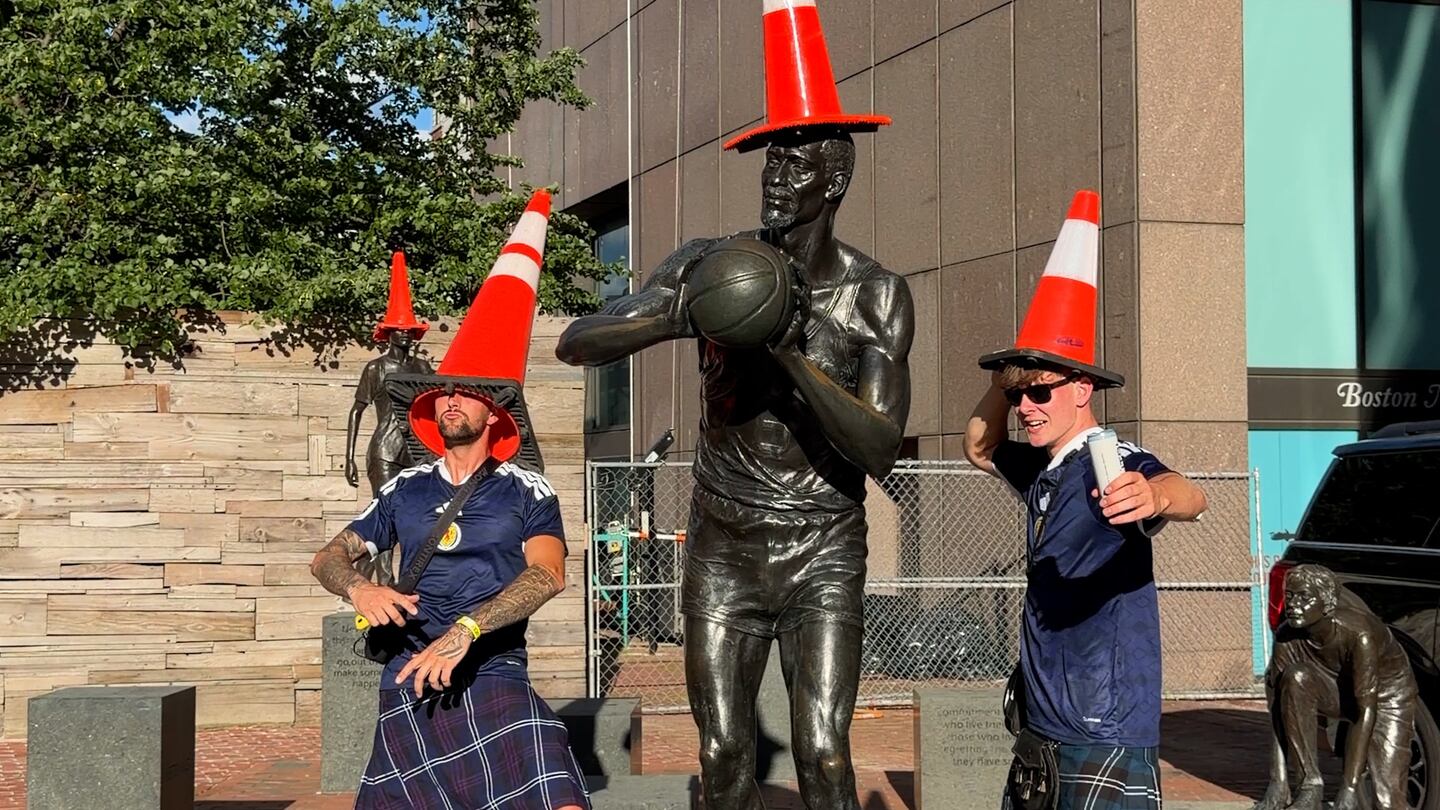
Why are traffic cones appearing on statues all over Boston during the World Cup? The Scots explain.
Statues across Boston have recently sported a new accessory: traffic cones perched on their bronze heads.
Read more ‘No Scotland, no party!’ Boston is starting to agree.
The pointy headgear is the doing of Scotland’s high-spirited Tartan Army, who have descended on the city for the World Cup, bringing with them kilts and bagpipes, a thirst for beer — and the occasional penchant for tomfoolery. Hence the bright orange cones perched like party hats on statues of Bruins legend Bobby Orr and Paul Revere.
The tradition began in Glasgow back in the 1980s. The story goes that, as a prank, some late-night revelers put a cone on the head of the Duke of Wellington statue, located outside the Gallery of Modern Art, Ross Walker, a lecturer in sport management at the University of Stirling, said in an email.
(The Irish-born Wellington was a commander of the British Army during the Napoleonic Wars and later served as prime minister of the United Kingdom.)
Initially, local authorities removed the cone. But locals continued to crown the statue every time its plastic hat was taken down, “to the point where it became a permanent fixture,” said Andrew Dunn, 53, of Glasgow, who’s enjoying the World Cup while visiting his daughter in Boston, in an email.
Scots say the tradition captures their sense of humor and how they refuse to take themselves too seriously.
Another popular Tartan Army prank when traveling for major away matches, Walker said, involves pouring liquid soap into public water fountains, turning them into overflowing bubble baths.
“Everywhere we go, we bring the party alongside an unrivalled enthusiasm and passion for the game,” said Walker, a lifelong member of the devoted fanbase.
Until Saturday, Scotland hadn’t appeared in the World Cup for 28 years. Or won a match in 36 years.
Ahead of the competition, Lee Turnbull, who was born in Scotland but grew up in London, joined the Boston Tartan Army Facebook group. Some fans, he said, had discussed popping cones onto statues once in the city.
“As soon as someone saw a cone and decided to put it on a statue, it just took over,” said Turnbull, 43, who now lives in California but is back in Boston with his wife to cheer on the Scottish team.
While at the Charlestown Navy Yard this week, he adorned a hippo sculpture with a cone. To help a friend’s son understand Scottish culture, Turnbull explained the tradition.
Soon enough, the boy was climbing the Mary Dyer statue outside the State House.
“It’s a little mark, and it’s a little bit of fun,” he said. “It now defines a culture, almost.”
It’s not clear whether this has all been a nuisance to local officials. The city couldn’t be reached for comment Tuesday evening. But several Scots said the cones have repeatedly been removed — and promptly put back up.
“People will go on shoulders. They’ll do whatever it takes,” said Angus Thomson, 63, who is from Scotland and now lives in Australia. In Boston for the World Cup, he placed cones on sculptures in Faneuil Hall Marketplace.
“It’s an off-the-cuff thing,” he said. “I looked at a traffic cone. I looked at a statue. They really should be together.”
Fans of the cone head customhave enthusiastically shared photos on social media. And both locals and Scots alike have snapped selfies alongside them.
“When they saw traffic cones in the center of Boston, there was only one place they were going to go,” quipped Alan McCloskey, 61, of Edinburgh.
Take a look at some more cones spotted on statues around the city:




Post Comment