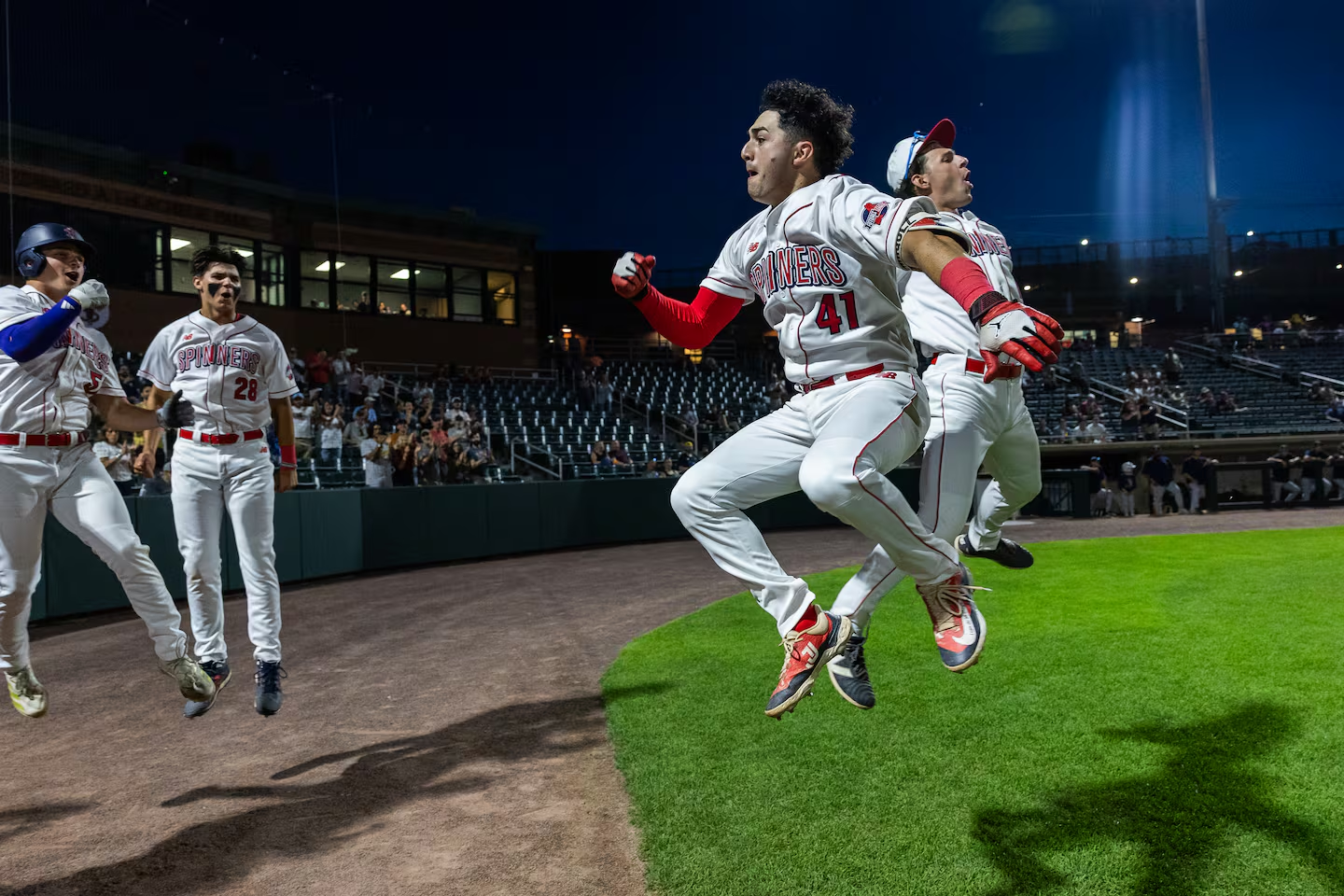
After hiatus, Lowell gladly welcomes Spinners home: ‘We’re so glad baseball is back’
LOWELL — Tom Curtis sits in LeLacheur Park on a warm June night.
The 71-year-old, who was an usher for the Lowell Spinners when they were a minor league affiliate of the Red Sox, looks around the place, which is humming with life for the first time since 2020. Batting practice is underway, music is playing over the loudspeakers, and families are finding their seats.
Read more How college hockey got the NCAA eligibility rule victory it was searching for
Now a brand ambassador for the new-look Spinners, Curtis is asked what it means to have baseball back in downtown Lowell for the first time in years.
“It’s the best,” said Curtis. ”I’ll be over there where all the people come in, and I welcome them to the ballpark, the families, all the boys and girls. It just put a smile on their faces.
“The biggest thing I’ve heard from the people is, ‘We’re so glad baseball is back in Lowell.’ ”
Baseball is back in Lowell. For some in the Merrimack Valley, after 2020, it was a phrase they never thought they’d hear again. For Curtis and others who spent the five long years between the dissolution of the minor league affiliate and the creation of the Futures League franchise, it was an eternity.
“People are just so excited that baseball is back,” said Tim Bawmann, who served as the general manager for the previous incarnation of the Spinners, and is now back as chief operating officer.
It’s only been a few weeks, but the return of the game has been a dream for fans. More than 5,100 packed the place for Opening Night in early June, and the Spinners drew 3,128 for a recent Saturday game that included an appearance from former Red Sox outfielder (and limited partner) Johnny Damon.
In addition to Bawmann’s return, former Spinners clubhouse attendant Del Christman — the legendary “Dog Man” — is back. The old mascots, The Canaligator and Bobbie Spooligan, are roaming the concourse. Curtis is back at his game-day station, pledging $100 to charity in his wife’s name for every Spinners home run.
And many of the same fans who contributed to a sellout streak of 413 games that ran from 2000-10 have also returned.
“This place, even despite the rain, was flooded with people,” said principal owner and chief baseball officer Marc Deschenes with a laugh when asked about Opening Night, which was held under gray and occasionally rainy skies. “Pardon the pun.”
For Deschenes, the early reaction from the business community has been gratifying, but the sight of a sold-out LeLacheur on Opening Night was special.
“It was a really, really good feeling to see smiles on people’s faces, get hugs and congratulations, and hear people saying, ‘Thanks for bringing summer baseball back to Lowell.’ I get the goosebumps talking about that now,” he said.
Baseball has deep roots in Lowell, dating to the 19th century. The Spinners debuted in 1996 as part of the New York-Penn League, a short-season Single-A affiliate of the Red Sox. They moved into LeLacheur Park in 1998, and enjoyed a successful run, helping serve as a launching pad for future Red Sox stars such as Mookie Betts, Jacoby Ellsbury, Jonathan Papelbon, Kevin Youkilis, Andrew Benintendi, and Hanley Ramirez.
After the 2020 season was canceled because of COVID and the decision to restructure the minor league system, the Red Sox announced in December 2020 they were dropping the Spinners as an affiliate.
The new incarnation of the Spinners is part of the Futures League, a seven-team circuit with franchises in Lowell, Nashua (N.H.), New Britain (Conn.), Norwich (Conn.), Vermont, Westfield, and Worcester. Established in 2011, its focus is to provide New England-based players an opportunity to compete in a summer college league that’s close to home.
Born in Lowell, Deschenes is the driving force. A former shortstop for UMass Lowell who had a 13-year professional career that included stops with the Cleveland and Red Sox organizations, he jumped at the opportunity.
Read more Even for those outside of New York, these Knicks took us on a magical championship ride
“When I got word that the Futures League was going to expand, and Lowell was going to be that site … I mean, my roots are here,” he said.
After winning the approval of the league, Deschenes said the biggest obstacle was blending a mix of good business and baseball acumen.
“At the end of the day, it was about making this place the crown jewel of Lowell again, as far as visibility, playing surface, and the resources,” Deschenes said. “And then from there just putting a competitive product together, both with the business piece and putting butts in the seats, but then also the product on the field.”
Deschenes’s first call was to Bawmann, who steered the Spinners through the glory days of the early 2000s. His institutional knowledge was instrumental in getting things off the ground.
“He was the mastermind of 10 years of consecutive sellouts here at the ballpark ― and a good friend of mine,” Deschenes said. “I called him right away and said, ‘What kind of advice can you give me as far as running a franchise?’ I can program baseball all day long, but as far as like the business end of it and putting 5,000 fans in the seats, that’s where he comes in. He’s taken this to a new level.”
There have been challenges. While the Spinners had access to a home field, it had fallen into disrepair that went beyond just a new coat of paint. Relationships needed to be forged with local businesses. A ticket plan had to be put in place.
“Really, it was a complete rebuild,” said Bawmann. “We had the name, but outside of the name, we had nothing else in place. No front office system. We didn’t have corporate partnership packages in place, we didn’t have ticket prices in place. Nothing. Zero. So we started from the ground up.
“And we pulled it off in five months. There are teams that take years to launch a franchise.”
At the same time, there was a lot working in their favor. They had a ballpark — albeit one that needed work — and a partner in UMass Lowell that was willing to work with the team when it came to things such as housing. They also had the support of local politicians, including Lowell’s mayor, Erik Gitschier.
“Any time an inner city gets an opportunity to have outside entertainment, we’re very lucky,” said Gitschier, who praised the partnership with UMass Lowell. “When you start talking about trying to get people out of the home and give them a family atmosphere in an inner city at a cost that is affordable, that’s important.”
The Deschenes-Bawmann duo, along with CEO John Croteau, has served the Spinners well. A pregame visit to the ballpark found Deschenes taking care of myriad issues, while Bawmann was on the phone coordinating game-day logistics.
“He did corporate sales today. He was trying to fix the blower to the inflatable we have out front, and he was hanging fence signs,” Bawmann said of Deschenes. “I’ve been in this industry a long time. I’ve never seen a principal owner put the kind of effort into this like him, so it’s refreshing to have that help.”
The season runs through early August, and the hope is that the burgeoning crowds continue to grow as more people realize baseball is back in Lowell.
“For us, our best advertising is word of mouth,” said Bawmann. “My motto was always, ‘Every night is Opening Night.’ Give them that same energy. And then, hopefully, they’ll go home and tell their neighbors, ‘I was at the Spinners game last night, and it was a blast.’ That’s how we built it before. And that’s how we’re going to do it again.”
Read more Iran coach says team ordered out of US right after 2-2 draw with New Zealand in World Cup opener


Post Comment