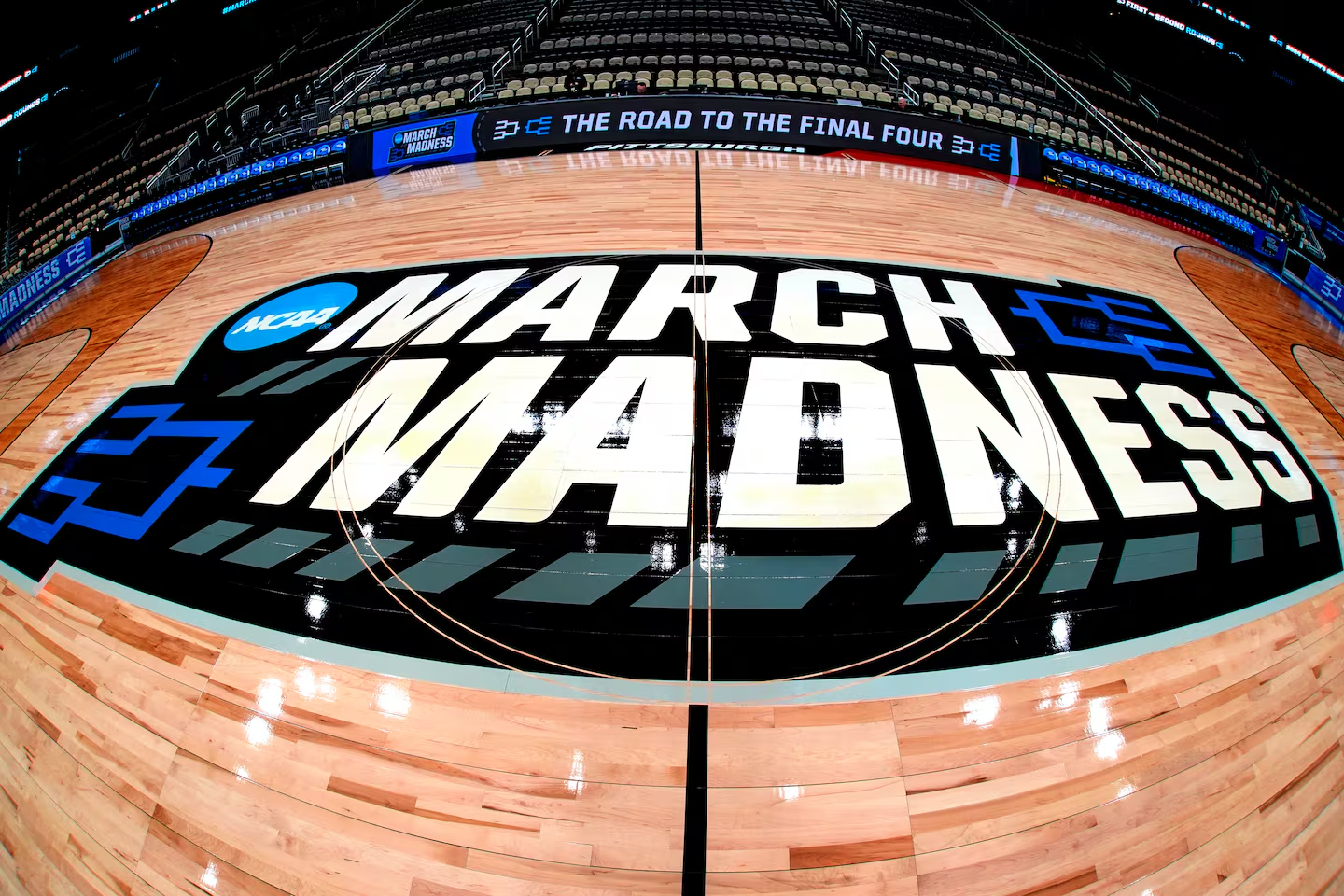
March Madness: Even with an expanded field, NCAA tournament too big to fail
The face of college sports is undergoing an extreme makeover. The NCAA just injected more filler and basketball Botox into that ever-changing complexion by expanding the measure of March Madness to 76 teams.
Both the men’s and women’s NCAA Basketball Tournament are getting plumped up from 68 teams to 76 for 2027. Sixty-eight was enough if you ask this college basketball connoisseur, especially for the women’s game where parity remains a work in progress. But fans aren’t the constituency this expansion is designed to appease. That would be the power conferences — the Southeastern Conference, the Big Ten, the Big 12, and the Atlantic Coast Conference — who in college sports are akin to the corporations that dictate American democracy. It’s their world, the rest of us are just inhabiting it.
This Spirit of 76 isn’t about increased representation. (About 21 percent of the 361 Division 1 men’s teams will now make the tournament, up from 18.) It’s about increased domination of college sports by the pigskin plutocrats.
Expansion ensures an uneasy peace between the football-driven Power 4 and the rest of the NCAA ecosystem by placating the moneyed class with increased access for their mega-conference members. That’s what’s really driving tournament expansion because the disaffection or defection of those power conference schools represents an existential threat to the NCAA and the men’s basketball tournament, which is the governing body’s biggest moneymaker. The NCAA brought in $1.56 billion in 2025, according to posted financial statements, and roughly $1.3 billion was derived from the men’s tournament.
Now, the bubble is more forgiving for the teams that finish in the bottom half of the standings in the SEC, Big Ten, Big 12, and ACC. They accounted for 35 of the 68 bids in this year’s tournament, which featured 31 automatic qualifiers and 37 at-large bids. That came a year after the SEC got 14 of its 16 teams in the Big Dance. Under the new format, there will be 32 automatic bids — the Pac-12 reborn from the ashes of radical conference realignment — and 44 at-large bids.
The First Four in Dayton, Ohio, will be replaced by 24 men’s teams playing 12 games across two sites. These preliminaries will be known as the March Madness Opening Round, according to an NCAA release.
“It gives more teams a chance to play in the best basketball tournament in the world,” said NCAA president Charlie Baker, via email. “And gives those teams a chance to earn [monetary] units for their conferences that can be reinvested in their programs.”
Baker, the popular former Massachusetts governor, has brought stability and pragmatism to the NCAA during this perilous period. He’s trying to stabilize college sports at a time when they’re being sloshed around like a sailboat in a hurricane, buffeted by winds of change. Baker is a deal-maker.
He secured the future of the tournament — and future windfalls for the NCAA — by preventing the power conferences from pushing out the Little Guys altogether. The NCAA estimates tourney expansion will yield $131 million in new revenue for member schools.
As much glee as there might be in seeing the NCAA cartel get humbled, when it’s happening at the hands of a more self-serving cabal of colleges it’s distasteful.
Based on the impetuousness and squabbling displayed by the Big Ten and the SEC over the College Football Playoff format, does anyone want these guys at the hands of the wheel of the basketball tournaments?
The sentiment went that there was a growing movement afoot by power conference power brokers to sideline the mid-majors and the automatic qualifiers, viewed as bid stealers by the Big Boys. That would’ve definitively bifurcated college basketball into the Haves and Have-nots.
It also would’ve threatened the secret sauce that makes the NCAA Tournament a cultural touchstone.
The hope inside the halls of the NCAA is that expansion will lead to more Miami (Ohio) University-types earning at-large bids. Miami went undefeated during the regular season (31-0) and then was upset in the Mid-American Conference by UMass before squeaking into the tourney.
But the reality is it’s much more likely that major conference teams with mediocre results like 17-16 Auburn, one of the first four teams left out of this year’s field, will gain access. Auburn, which finished 7-11 in SEC play, won the NIT, leading to more chest-thumping from the power conference peanut gallery.
In college basketball circles, there’s hope that more power conference teams now might be willing to schedule their less financially fortunate brethren with greater tournament leeway. That would boost the mid-major schools’ credentials.
But it’s still hard to square how this benefits the mid-majors as much as the power conferences. Expansion could allow a few more schools like New Mexico into the tournament. But that’s up to the selection committee. There will always be braying from the autonomy conferences that their mediocre member is more deserving, citing Quad 1 and Quad 2 wins, a component of the almighty NET (NCAA Evaluation Tool) rankings metric used to stack teams.
One thing we should agree on is that tournament expansion isn’t about including more teams capable of cutting down the nets.
Since the tournament expanded from 64 to 68 teams in 2011, no First Four team has played for a national championship. Two, VCU (2011) and UCLA (2021), reached the Final Four.
Bigger isn’t necessarily better, but it’s the inevitable March of time in March.
“I am old enough to remember the doomsaying that took place when the men’s tournament went from 16 to 32, from 32 to 42, from 42 to 48, from 48 to 64, and from 64 to 68,” wrote Baker. “Most people these days like the field as it is. I get that. I have no doubt they will like this version too.”
Read more With their PWHL season over, Fleet players ready to run it back, as is
The reality is the NCAA Tournament is too big to fail, even if it’s too big.



Post Comment