All 3 candidates for Mass. governor promise transparency. They also say they won’t release their tax returns.
Governor Maura Healey once vowed to bring more transparency to her office“than ever before.” The two Republicans hoping to unseat her recently rallied a crowd of thousands with calls for a more open government.
Read more As America 250 approaches, fewer Americans see their country as exceptional, poll finds
But when asked to open a window into their own books, all three clammed up.
The three major party candidates for governor refused requests from the Globe to disclose five years’ worth of their personal tax returns, a denial made all the more notable as their personal wealth and demands for transparency are animating this race.
Disclosingpersonal financial details isn’t required by Massachusetts law, but many politicians have provided the documents when running for higher office, Healey once being among them. The tax returns can provide insight into the money they have available to shape their ability to get their message out to voters.
They could, and have in the past, also shed light on any potential conflicts of interest in where they earn their money, where candidates have called home, or, as they debate how residents should be taxed, what they themselves pay to the government each year.
“It’s up to the candidate to make their tax returns public. It’s up to the voter to determine how important that info is to them to make a decision,” said Mary Connaughton, director of government transparency for the Pioneer Institute, a right-leaning think tank.
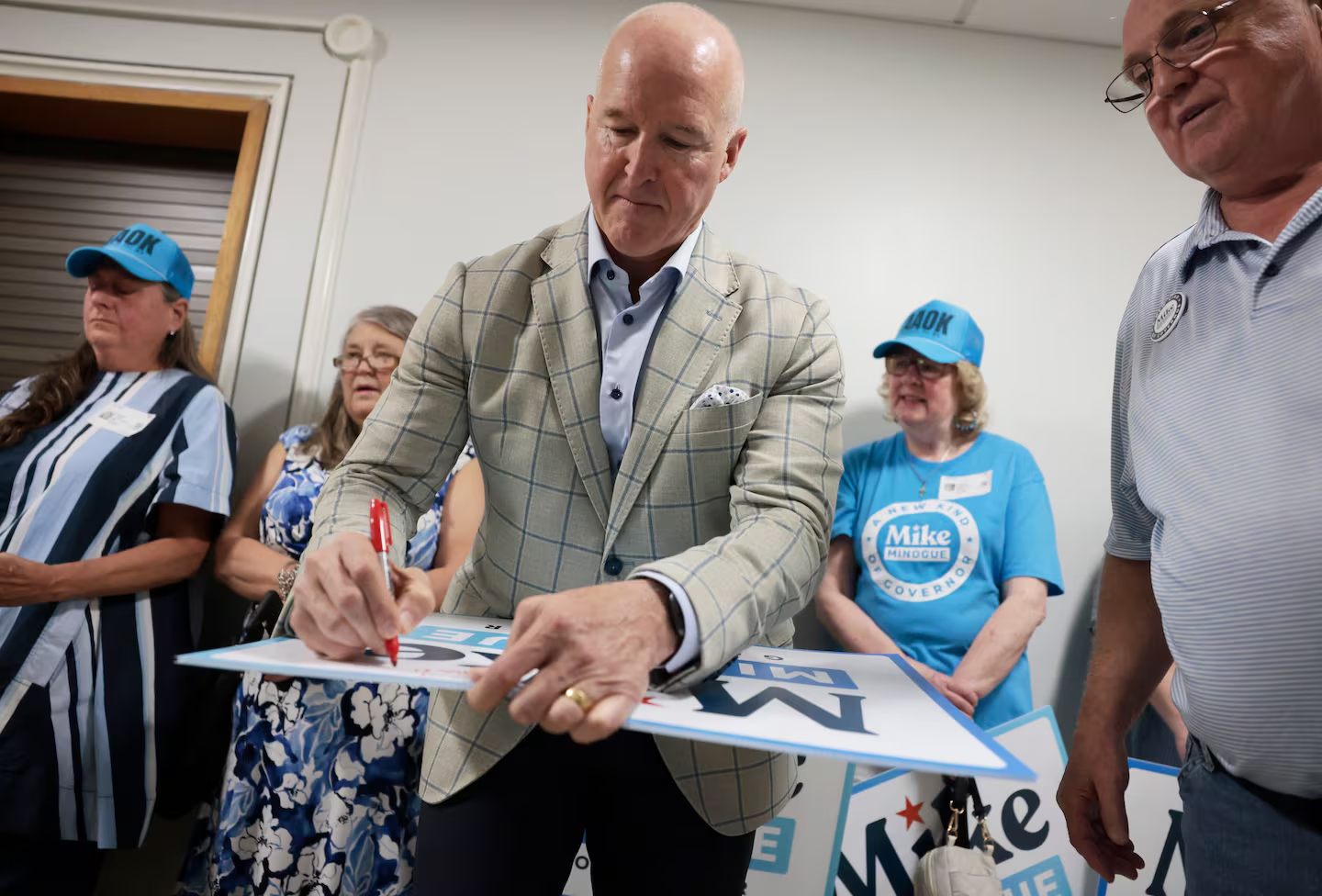
Mike Minogue, a former Abiomed executive and Republican candidate for governor, had already put a record $14.5 million of his own money into his campaignand could put in millions more, making his personal wealth a defining part of his bid to unseat Healey.
Former MBTA executive Brian Shortsleeve, meanwhile, has put $1 million into his gubernatorial bid, according to his campaign, framing it as a commitment that he’s “all in on this race” amid pressure for him to drop out.
Healey, whose campaign has $6 million on hand and a robust fundraising operation, is not self-funding her campaign.
Their reasons for shielding their tax returns varied. A spokesperson for Minogue said in a statement that information about Minogue’s financialswas public when he led Abiomed, a medical device company that, when it was sold, helped him pocket hundreds of millions of dollars. and that he filed with state officials a statement of financial interest, as is required of all candidates and officeholders.
Holly Robichaud, a Shortsleeve spokesperson, said he would under certain conditions. “Brian would be happy to disclose his returns if others in the race will do the same,” she said.
A spokesperson for Healey’s campaign declined to give a reason for why she would not disclose her tax returns, saying only that she “has provided extensive financial disclosures each year for nearly 20 years.”
“She believes strongly in the matter of those disclosures as a matter of transparency and accountability,” Kerry Lyons, the spokesperson, said.
She’s made her opponent’s ability to self-fund a key attack. In fundraising emails and press releases touting small-dollar donations it’s raised, Healey’s campaign has slammed her Republican opponents for raising funds “almost entirely through big-dollar donors and self-funding as their state party remains bankrupt.”
In the past, Healey has made her financial transparency a point of pride. She released five years of tax returns when she was first running for attorney general in 2014, with aides at the time calling it evidence she was running “the most open and transparent campaign.”
She did not, however, release her tax returns when she successfully ran for governor in 2022.
Some state Legislatures, including those in California and Vermont, passed laws requiring candidates running statewide to make their tax returns public. With that information, “you can kind of tell who their friends are,” said Bert Johnson, a political science professor and campaign finance expert at Middlebury College in Vermont.
“There is a saying translated from Spanish,” he said: “‘Tell me who you walk with, and I will tell you who you are.’”
In the Massachusetts Legislature, lawmakers have filed bills to require presidential candidates, but not statewide ones, to file tax returns, proposals inspired by President Trump’s decision to break with tradition by not disclosing his tax returns. (A similar law was struck down in California’s highest court.)
State Senator Becca Rausch, of Needham, has filed the bill for multiple legislative sessions, arguing that “we stand to learn a lot about candidates’ pressures … and interests and decisions about where they put their money.”
But she said she hasn’t given tax returns for gubernatorial candidates “any real thought.” Neither has state Senator Michael Barrett, who filed similar legislation.
“I don’t feel dogmatic about it, except in the case of hypocrites and posers,” the Lexington Democrat said. “That’s how I think about Trump.”
There’s a long history here, however, of candidates willingly opening their books and hand-wringing when they didn’t. US Senator Elizabeth Warren regularly releases hers, for example. Former Governor Charlie Baker released his tax returns in his run for office in 2014, as did his Democratic challengers, Steve Grossman and Martha Coakley.
In Boston, mayoral candidate Josh Kraft promised to, then did not, release his tax returns as he poured cash into his unsuccessful bid to unseat Mayor Michelle Wuin 2025, opening him to criticisms of being opaque. And Democrat Shannon Liss-Riordan — who earned Wu’s endorsement when she ran for Massachusetts attorney general in 2022 — also refused to release her tax returns as she put $9 million of her own money into her campaign.
What state candidates must reveal about their finances only goes so far.
All the candidates running for governor have submitted required statements of financial interest, which the public can access after showing proof of identity, such as a driver’s license. But the law only requires candidates to identify the ceiling on their earnings and investments at “$100,001 or more,” making precise calculations of their finances impossible and even rough ones difficult.
To be sure, public documents about Minogue’s finances paint a picture of someone with immense wealth. ASEC filing from when Abiomed was sold to Johnson & Johnson in 2022 shows Minogue made out with more than $240 million in separation payments from the company, including a sum to cover any taxes he would have to pay on the cash.
In his 238-page state financial disclosure, Minogue reported making at least $300,000 in income from his consulting firm and other businesses.
He also disclosed holding many government bonds and a hefty stock portfolio, including stocks in the company that owns Donald Trump’s Truth Social platform. Minogue reported making at least $818,000 in income from his investments in 2025, pushing the floor of his income last year to $1.1 million.
When asked late last month how much more money he was planning to pour into his campaign, Minogue demurred.
“I am willing to put in the resources for us to win,” he said after turning in signatures to get onto the ballot. (His campaign paid a Brookline signature-collecting firm $195,000 to help collect them.) “I always have a number in mind, but the coach of the Patriots doesn’t give away his playbook. We’re gonna have the resources to win.”
Minogue has said he wouldn’t take a salary as governor.
On his statement of financial interest, Shortsleeve reported at least $100,000 in income from his investment firm, though his disclosures help reveal his real estate holdings. He has a 13-room Colonial home in Wellesley and a condo on Beacon Hill, valued at $2.3 million and $2.9 million, respectively, according to property records, while his primary residence is a $12 million waterfront home in the exclusive Cape Cod village of Osterville.
Healey reported on her state financial disclosureearning her salary as governor — $243,493, according to state payroll records — and having no other business, real estate, trusts, mortgages, or other debt. She reported a few financial investments in various bonds, as well as index and mutual funds.
Wesley Hussey, a political science professor at Sacramento State University, said a relatively new California law requiring gubernatorial candidates to disclose their tax returns hasn’t drawn a lot of attention among Californians.
But it’s when a candidate appears to be hiding something about their finances in Massachusetts or California, then it could become a campaign issue.
“When the norm is to release your tax returns and you don’t, that generates a story,” he said. “People are already suspicious about you, and that grows.”
Read more Stacey King, longtime Bulls broadcaster who played on team’s first three-peat, dies at 59


Post Comment