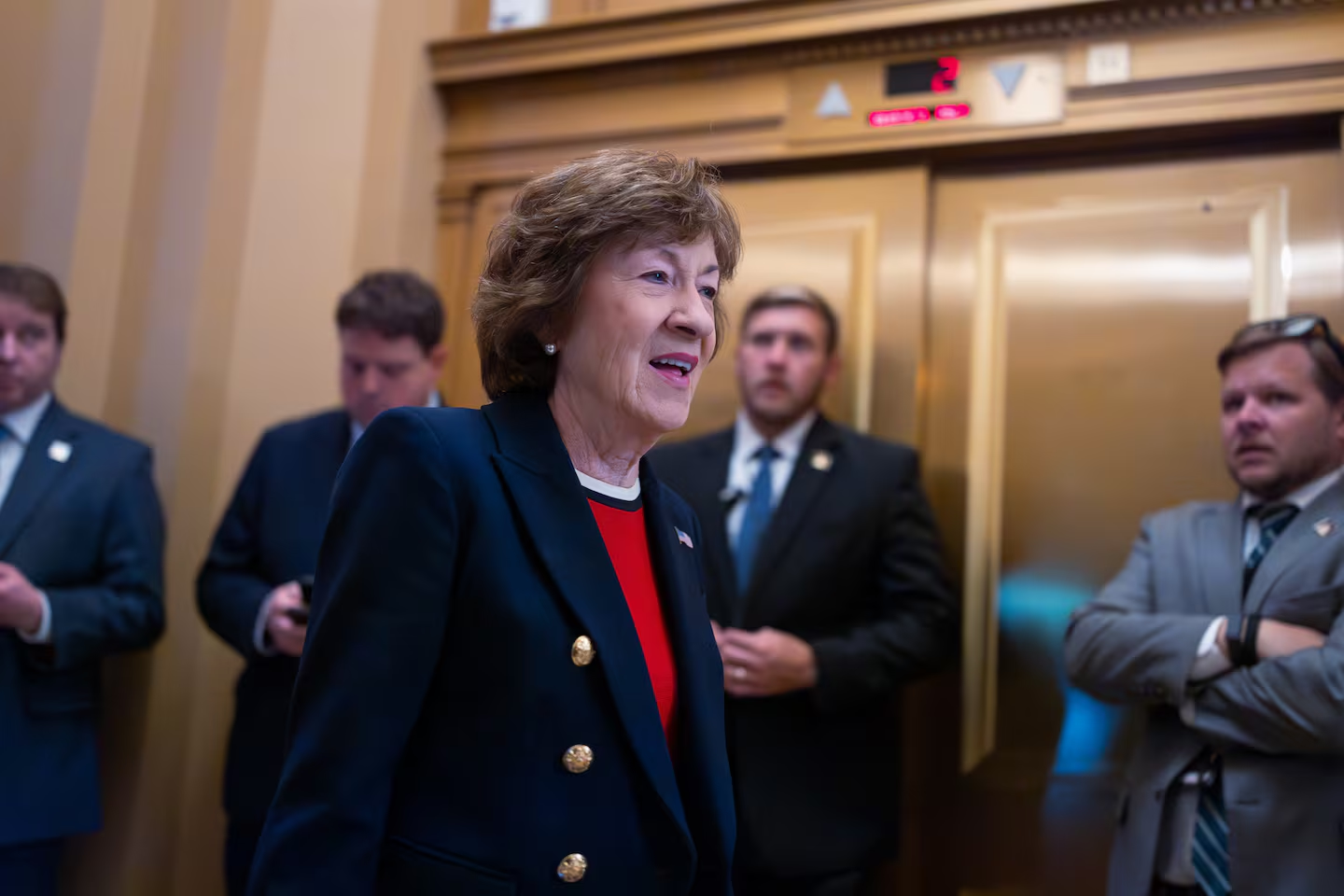
Casting her 10,000th vote in a row, Susan Collins sets a Senate record
WASHINGTON — Shortly after Susan Collins entered the Senate in January 1997 as a Republican from Maine, some of her more jaded senior colleagues offered her a bit of professional advice: Make sure to miss at least one roll-call vote to avoid getting trapped in an unbroken streak.
Read more R.I. judge says Trump officials must restart asylum and immigration processing
“More experienced senators said, ‘Miss one early; remove the pressure,’” Collins recalled. “I just wasn’t comfortable with that.”
Twenty-nine years later, now a powerful committee chair in a tough reelection fight, she is still not comfortable with the prospect of being recorded as not voting. Collins has not missed a single roll call in her Senate service, and Thursday night, she became the first senator in history to reach 10,000 consecutive votes cast without an absence. The record came as she crossed party lines to support an unsuccessful Democratic bid to send her party’s immigration bill back to committee to add a requirement that the government investigate losses and denials of Medicaid benefits.
Reaching the Senate milestone has not always been easy, and it came at an opportune time for Collins, who is facing stiff political headwinds as she seeks a sixth term.
As Collins was celebrating her record Thursday night to applause and accolades even from the Senate minority leader, a Democrat seeking to challenge her, Graham Platner, was dealing with the fallout from new reporting in The New York Times. In the account, women described volatile and “toxic” relationships with him in the past that were unsettling and at times emotionally wrenching.
For Collins, who is campaigning as the familiar and experienced contrast to a political newcomer who has acknowledged a checkered past, shattering the voting record underscored her current pitch to voters. But Collins has nurtured an almost obsessive determination to display a sterling roll-call record for decades, reflecting her dogged and perfectionistic approach.
The senator suffered a chipped bone in her ankle racing to avoid one particularly perilous near miss nearly two decades ago and had to rush back from the airport for another when a surprise vote was called. Luckily, the aircraft door had not closed.
She has spent plenty of Sunday evenings in Washington to make sure she would be on hand for Monday votes given the vagaries of the weather and the airline schedules.
“Most members come back on Monday, and they miss a lot of votes,” Collins said in an interview in the office of the Appropriations Committee that she now leads. “The plane will be delayed. There will be a storm. Something happens and they don’t get here. So I almost always come back on Sunday. That means I’ve missed Sundays at home. I was figuring that it is probably like 1,000 Sundays I’ve missed over the years.”
Perhaps her closest brush with a missed vote came in 2008, an election year, when she heard rumblings that majority Democrats who controlled the floor were interested in tripping her up and costing her a campaign talking point.
Read more Trump’s back-and-forth on troops in Europe potentially cost millions, US officials say
A vote was called while she was attending a session of the Homeland Security Committee in a nearby Senate office building, but she was assured that she had time to keep working before it was gaveled to a close. She began to grow anxious, though, and told her close friend and fellow committee member, Sen. Joe Lieberman of Connecticut, of her concern.
“I whispered to Joe, ‘I just don’t trust Harry Reid,’” she said, referring to the cagey Nevada Democrat who, as majority leader, controlled how long votes could be prolonged past the standard 15-minute limit. “He said, ‘Go, go,’ so I ran out. I had very high heels on that day, and I turned my ankle.”
As she exited the bank of elevators outside the Senate chamber, Republican staff members urged her to hurry.
“So I’m running on this very painful ankle, and I got to the Senate floor just as the presiding officer is saying, ‘Is there anyone else in the chamber who wishes to change their vote or cast a vote and I say, ‘Aye!’” Collins recalled.
Others have cast more votes overall than Collins, including her Republican colleague, Sen. Chuck Grassley of Iowa, 92, who had his own streak before it was interrupted by the coronavirus pandemic in 2020. William Proxmire, a former Wisconsin senator, recorded more consecutive votes between 1966 and 1988, though he had missed some earlier in his career.
Collins has not, a feat that colleagues on both sides of the aisle recognized as remarkably impressive given their own scheduling experiences in making and missing votes.
“For nearly 30 years, nothing — and I mean nothing — has stopped Sen. Susan Collins from coming to this floor and casting her vote on behalf of the good people of Maine,” said Sen. John Barrasso of Wyoming, the Republican whip. “As the Senate majority whip, it is my job to count the votes. No matter the topic, I can count on this: Susan will be here.”
Sen. Chuck Schumer, D-N.Y., the minority leader who has long worked to oust Collins, crossed the aisle Thursday night to shake her hand after a speech hailing her record.
“Sen. Collins and I belong to different parties and do not always see eye to eye, but 10,000 consecutive roll-call votes is an extraordinary streak by any measure, and I congratulate her on reaching it,” he said.
Read more Flexing influence, Ayotte helps defeat two Republican bills
This article originally appeared in The New York Times.


Post Comment