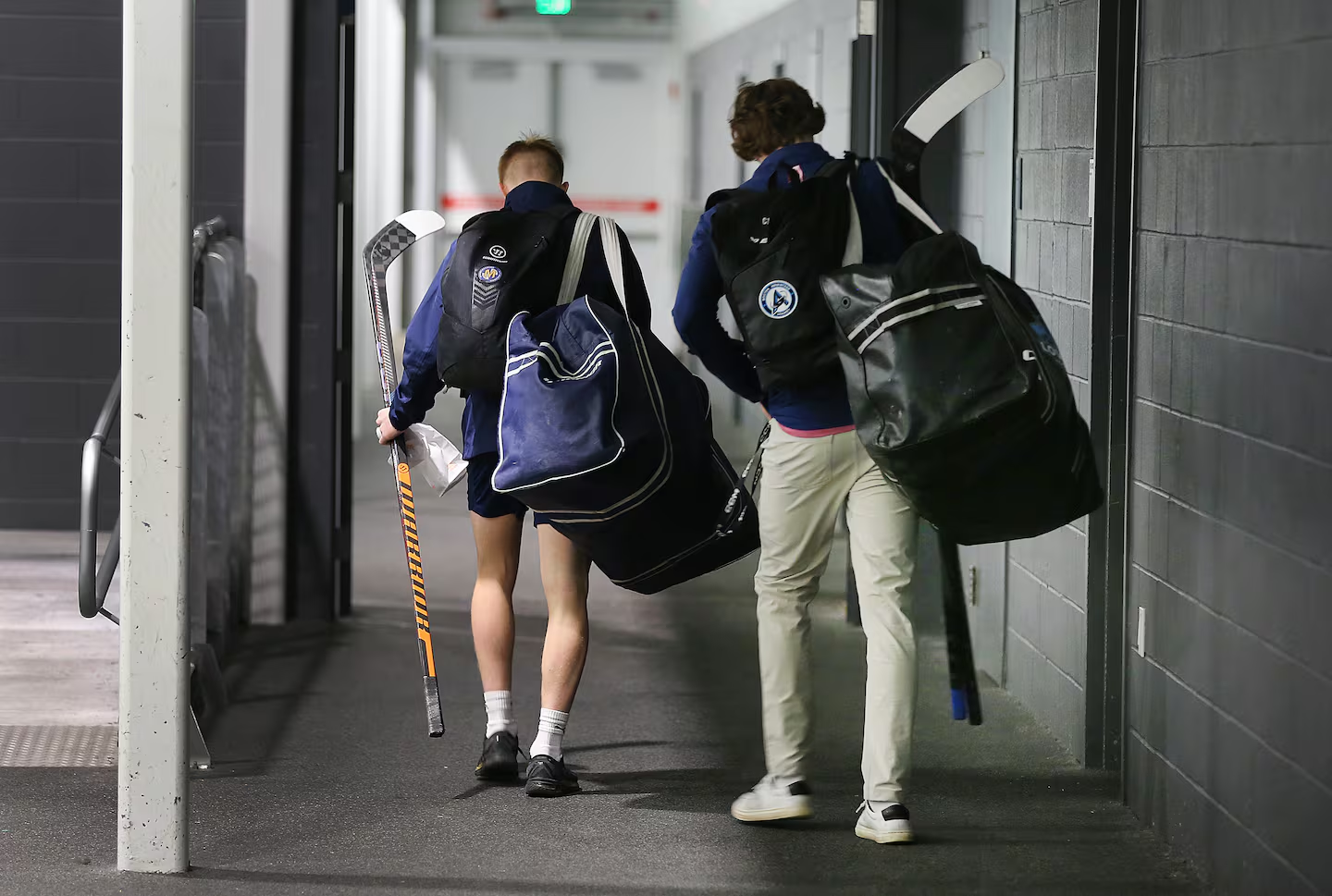
USA Hockey has a plan to develop American players. It could upend juniors as we know it.
As Canadians infiltrate NCAA hockey at record numbers, USA Hockey wants its program to remain the primary path players take to college. It also wants to strengthen its player pool.
So here comes a new plan.
The USA Hockey Development League, which is taking applications from teams now, will be a collection of 32 hand-picked Tier 1 junior boys’ teams from around the country, in the 15U and 17U age classifications.
Beginning in the 2026-27 season, teams in the Development League will play a 55-game season, 35 of which must be against league opponents. Playing multiple games in one day is prohibited.
In an interview, Jason Guerriero, USA Hockey’s New England player development director, touted the league’s anti-burnout measures. High-volume junior hockey programs can play 90 to 100 games per season, playing a half-dozen games in a weekend showcase tournament. Some coaches, Guerriero included, would rather see players train more, learn more, and play less.
“The rat race of club hockey and youth hockey right now is just games, games, games,” said Guerriero, a former captain at Northeastern. “If you look at the [US National Team Development Program], there’s a reason why those kids get bigger and better and stronger. I mean, yes, they have the state-of-the-art equipment, but they’re playing fewer games, and their focus is more on development.”
Guerriero, whose pro career included a stop in Finland, said his eyes were opened during his time as a Team USA assistant coach at the 2024 Youth Olympics. Chatting with his Finnish colleagues, he was struck by how they did not plan to bring their 20 best players to subsequent major tournaments. They would select the next 20 in that age group, then the next 20 for another tournament, “all the way up to 100,” Guerriero said.
The NTDP selects 46 players annually (split between 17U and 18U teams, both of which compete in the United States Hockey League, the country’s top junior league). If those are the best American juniors, the Development League will hope to find the next-best 704.
The roster limit is 22 players, including two goaltenders. Both goalies must be US citizens, a measure to help strengthen the American goalie pool. Teams can carry up to two non-US players.
USA Hockey said it will select programs based on “a matrix of past performance, commitment to player development, and history of player advancement.” The teams also will be picked to ensure “strategic regional representation.”
Teams will schedule their own games and will compete for a Development League championship. The kinds of top-tier junior programs expected to join the DL often play schedules loaded with other independent teams, regional showcase tournaments, and USA Hockey nationals.
USA Hockey began taking applications on May 1, and will stop on June 30. Accepted teams will be notified on Oct. 16. Guerriero said he didn’t have information on fees for players or programs.
USA Hockey’s venture comes on the heels of two major changes in the junior-to-college pipeline, which have turned college hockey younger and more Canadian in roster makeup.
The NCAA is moving toward a “5-in-5” rule, which would start a Division 1 athlete’s eligibility clock the academic year after high school graduation or the year they turn 19, whichever comes first. That could halt the current practice of hockey players spending two or three years in juniors before joining NCAA programs, often as 20-year-old freshmen.
Read more Explore the results of the Globe/Suffolk poll of likely GOP primary voters
This comes after the NCAA’s decision to allow former Canadian Hockey League players to compete in Division 1, beginning with the 2025-26 season. The ACHA (mostly club programs) did the same. CHL players are not, as of now, permitted to play in NCAA Division 3.
Opening the 65 Division 1 programs to ex-CHLers has made competition for roster spots hotter than ever. And the number of Americans in the CHL reportedly more than doubled when the rule changed, stealing from the USHL’s player pool.
USA Hockey felt it had to make a move.
“Will it help college hockey? We hope so,” Guerriero said. “The idea is to create that next wave, and put more American players in college hockey.”
Earlier this month, the NHL, USA Hockey, and the USHL released a vague statement, jointly promising “investments in player health and safety programming, coaching education resources, tools for improved analytics, enhanced player experience initiatives, and officiating recruitment and development systems,” all of that to make the USHL more competitive.
The Development League was not mentioned in that statement. It has, however, been a talking point in junior hockey.
“They’re going to change the whole landscape,” said Tim Lovell, who operates a slew of junior teams at Lovell Academy in Rockland, including the Boston Advantage.
Lovell was considering an application when reached in late April. Masters Academy International (Stow) boys’ hockey director Mike Anderson said his school would apply. Other local programs that could fit USA Hockey’s selection criteria, based on reputation and resources, include Mount St. Charles (Woonsocket, R.I.) and the Boston Junior Eagles (Wellesley).
Frank O’Connor, youth hockey director for the Northeast Generals, noted that junior programs from the South, Midwest, and West are conditioned to traveling long distances for games. He wondered if players in the more condensed Northeast, especially those at high-academic prep schools, would be amenable to more travel.
“It’s a fascinating idea and a great model,” O’Connor said, “but I have a hard time thinking it’s going to gain any traction in New England.”
Another question left unanswered: How will the unselected applicants react?
Several coaches contacted for this story wondered if a deep-pocketed private equity firm, such as Black Bear Sports, could drive the creation of an AAU-style league outside the constraints of USA Hockey.
Others speculated the chosen few — perhaps two or three from New England — would raise fees, given that such an endorsement from USA Hockey would make them standouts in a saturated market.
“The programs that get these tags, in my opinion, they’ll be able to charge whatever they want,” said Anthony Chighisola, hockey operations director for the Boston Militia. “Everything’s going to get more expensive. I think we already charge too much. Hockey is big business.”
Read more Why Red Sox first-round pick Kyson Witherspoon’s struggles seem familiar



Post Comment