Why a judge rejected New Hampshire’s proof-of-citizenship law for voter registration
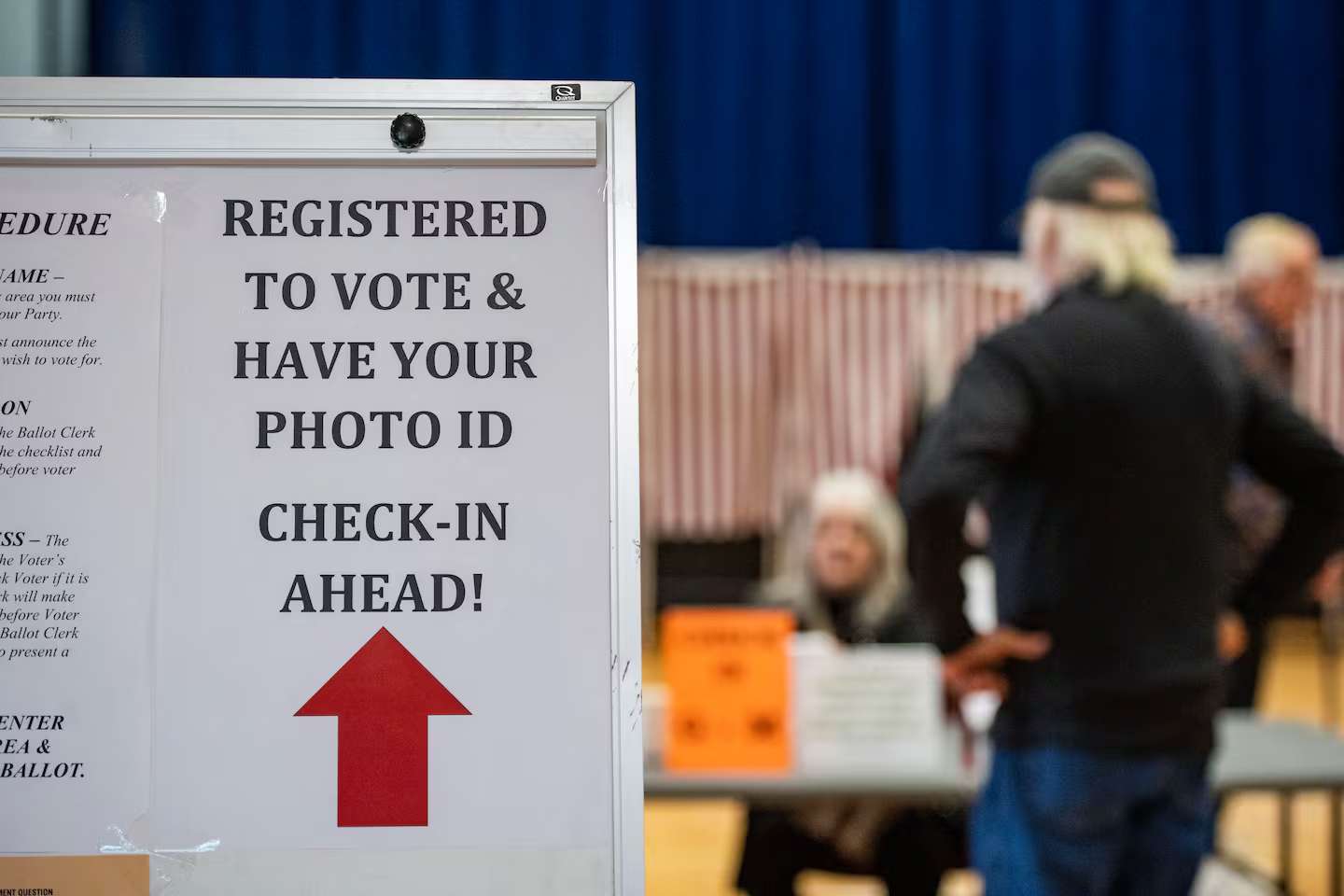
New Hampshire residents will once again be allowed to register to vote without producing a US passport, birth certificate, or naturalization papers, after a federal judge ruled late last week that the state’s strict 2024 proof-of-citizenship law had unjustifiably burdened voting rights.
Read more Konsta Helenius scores in overtime, Finland wins hockey world championship over Switzerland
Secretary of State David Scanlan confirmed on Friday that his office will bring back the “qualified voter affidavit” that allows people to register if they attest to their US citizenship and meet the other requirements. He noted that people will still need to provide documentation to prove their identity, age, and domicile. Voters will also need to show ID to obtain a ballot.
While the attorney general’s office said it is “disappointed” by the court’s decision and intends to pursue an appeal, the voting rights groups that filed two lawsuits challenging the law — including the American Civil Liberties Union of New Hampshire, the League of Women Voters, the New Hampshire Youth Movement, and others — are celebrating.
“This is a clear victory for voters,” said Olivia Zink, executive director of Open Democracy NH. “The court recognized what we have been saying all along: New Hampshire’s elections can remain secure without putting unnecessary barriers between eligible voters and the ballot box.”
Judge Samantha Elliott, who presided over a nine-day bench trial in February, wrote in her on Thursday that eliminating the qualified voter affidavits at the end of 2024 had placed a particularly heavy burden on young voters (who may lack easy access to certain documents) and married women (who often change their names after obtaining documents that prove their citizenship).
Most importantly, Elliott concluded the state’s reasons for eliminating the affidavits don’t actually justify the burdens that resulted from the policy change. Although the state argued this proof-of-citizenship law would combat voter fraud, the evidence at trial showed that only eight people had been identified as noncitizens who potentially voted in New Hampshire at any point between 1998 and 2024, she noted. Of those, only three may have used qualified voter affidavits to attest to their citizenship and register to vote. Only one has been criminally charged with intentional voter fraud. (His prosecution is pending.)
“Such miniscule numbers strongly undercut any legitimate concern about election integrity vis-à-vis noncitizen voting and, consequently, the state’s interest in addressing it,” she wrote.
Elliott noted numerous cases throughout 2025 in which prospective voters were turned away at the polls because of the stricter documentation requirements and related confusion. Those cases included a recently divorced woman in Concord whose name no longer matched the voter rolls and an 89-year-old man in Manchester who was told to prove his citizenship even though he had previously lived and voted in another ward within the city.
This case echoes similar litigation over a Kansas law that was deemed unconstitutional in 2018 after it prevented more than 31,000 otherwise-eligible citizens from registering to vote.
Read more Providence isn’t an official World Cup host. But it sure is acting like one.
Several other states — none of them in New England — have recently enacted similar “show-your-papers” laws, according to researchers with the Brennan Center for Justice.
The New Hampshire law’s impact was expected to be particularly acute for college towns, which are often Democratic strongholds in higher-turnout elections with many same-day registrants. In Durham, for example, where a total of about 8,400 voters cast ballots in the 2024 general election, more than 1,000 used affidavits to attest to their citizenship on Election Day, shortly before the new law took effect.
Bella Cannon, a student at the University of New Hampshire and a member of the New Hampshire Youth Movement, said the court’s ruling delivers a sense of relief, since the law’s added hurdles had made it “nearly impossible” for many of her peers to vote.
“Most students don’t have their proof of citizenship on hand,” she said. “Securing the right to affidavits at the polls eases my anxiety of being turned away on election day.”
Republicans who enacted the law expressed outrage at Elliott’s order.
“Democrats know their policies are deeply unpopular in the Granite State,” said Republican State Representative Ross Berry, who chairs the New Hampshire House Election Law Committee. “That is why they must rely on unelected far-left judges to force their ideology onto voters.”
This ruling comes as President Trump and his Republican allies push for Congress to adopt similar proof-of-citizenship requirements at the federal level, via the SAVE America Act, a measure critics warn could prevent millions from voting.
A version of this story appears in Globe NH | Morning Report, a free email newsletter focused on New Hampshire, including great coverage from the Boston Globe and links to interesting articles elsewhere. Sign up here.


Post Comment