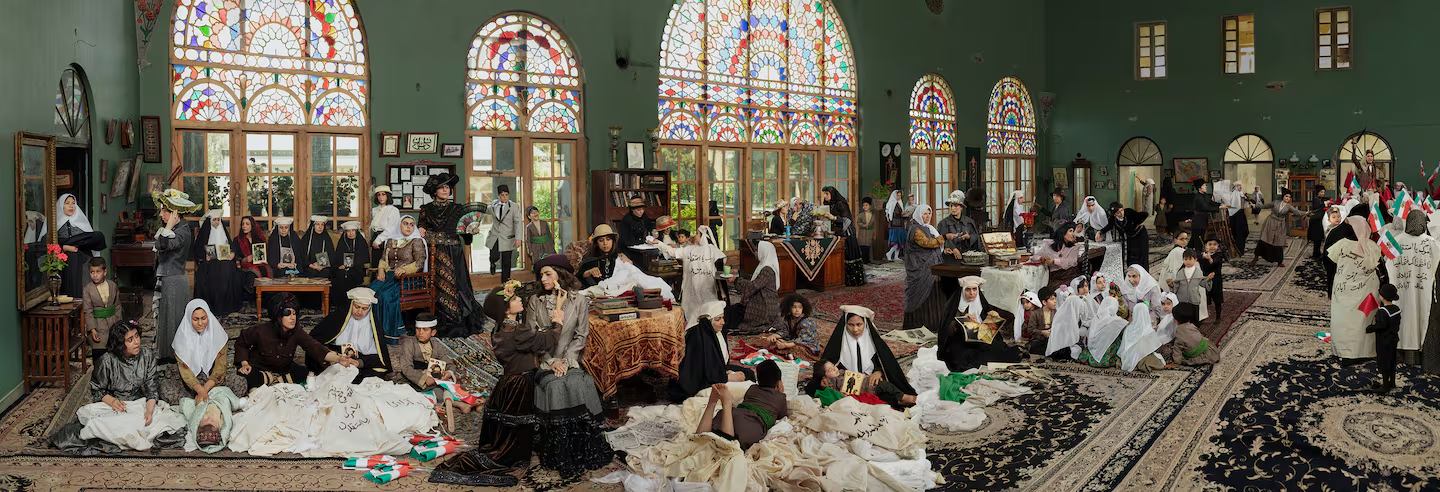
‘From Iran’ presents stunning and heroically scaled images of events for which there are no visual records
The heroically scaled images in Azadeh Akhlaghi’s “From Iran: A Visual Testimony” are stunning. One look, and you keep looking. They’re also disconcerting, twice over. Some of that is intended: The pictures are a bravura demonstration of that next-to-last word in the show’s title. Some of it’s unintended: The images also raise questions about that concluding word in the title.
Read more Thom Sesma on his pilgrim credentials, Trader Joe’s trail mix, and never checking a bag
“From Iran: A Visual Testimony” runs at Harvard’s Peabody Museum of Archaeology & Ethnology through March 21.
Aklaghi was born in Iran in 1978, the year before the shah was deposed. When she was awarded the Peabody’s prestigious Robert Gardner Fellowship in Photography, in 2019, no one might have predicted Operation Epic Fury. Even though none of the images relate to the war, all relate to 20th-century Iranian history, which makes the lessons they have to offer even more useful for Americans, perhaps, than Iranians.
The 16 photographs in “From Iran” come from a project called “The Vicious Circle,” which presents 11 key events between 1908 and 1979 — events for which there aren’t visual documentation. So these are photographic kin to history paintings — in the tradition of Velázquez’s “The Surrender of Breda,” say, or, closer to home, Emanuel Leutze’s “Washington Crossing the Delaware.”
Aklaghi stages these scenes on a large scale. Both in being staged and being big they recall the photographs of Jeff Wall or Gregory Crewdson. Also there’s very much a cinematic aspect to them (the sense of sweep, the highly detailed art direction). That Aklaghi was an assistant director for the great Iranian filmmaker Abbas Kiarostami does not come as a surprise.
Aklaghi spent 14 years working on these images — “tableaux” might be a more accurate word. A couple of making-of videos show how elaborate and exacting the staging is, as does the panning of each image in close-up in a film loop on a large monitor. The screen is 87 inches across and 52 inches high.
Three of the photographs get their own triptych. They’re big, too — the largest is just over 3 feet by 15 feet — big enough to seem almost like portals into the Iranian past. The effect furthers Aklaghi’s aim, which is to collapse the distance between present and past.
“By reconstructing events that were never photographed,” she writes, “I seek to question the authenticity of images and the ways collective memory is shaped through absence as much as evidence. This project reflects on that recurring cycle and imagines a path beyond it.”
This is where that word “testimony” in the title comes in. But a visual rendering of something that actually happened for which no visual record exists — reenactments, really — surely doesn’t qualify as testimony, let alone a path beyond. No matter how extensively researched, no matter how visually impressive, no matter how intellectually serious, such rendering exists in an n-space between fact and fiction. Worse, it assumes a very 21st-century view of 20th-century actuality: that only what can be seen as image can be grasped as fact.
Iran and Armenia share a 27-mile border. That may be one of the only things “From Iran” has in common with the two shows currently at the Project Save Photography Archive, in Watertown. “Winslow Martin: My Armenia: 1999-2008″ and “Like There’s No Tomorrow: Astrig Agopian” run through Aug. 29.
Read more Pulling customs from ‘sanctuary’ city airports would cause chaos, business groups say
Founded in 1975, Project Save has more than 150,000 photographs in its collection, documenting the past and present of the Armenian global diaspora.
Winslow Martin is an Arlington-based photojournalist who first visited Armenia in 1999. He has returned multiple times. “Welcomed like family through times of everyday life, joyous celebrations and tragic unrest I have become devoted to Armenia, its people, culture and enduring natural beauty.”
That devotion comes through in the 30 black-and-white photographs on display. All but one are 22 inches by 15 inches, an engaging but not imposing size. They’re unmatted, with black frames, giving them a chaste, almost severe look.
Some of the photographs evoke a timeless culture: men in religious robes, sheep being herded down a village street. Others show scenes that wouldn’t seem out of place in, say, Watertown: modern apartment buildings, a pickup truck, one of a pair of boys sprawled in a tree is wearing a Nike shirt.
It’s telling that food figures in almost a quarter of the photographs: The way people live their daily lives is what draws Martin. What’s more daily, or intimate, than food? The images blend fascination and deference. Rapt gaze never turns into prying stare.
Astrig Agopian is a French-Lebanese-Armenian journalist and filmmaker. “Like There’s No Tomorrow” looks at Armenian refugees in the Nagorno-Karabakh region of the southern Caucasus. Although the exhibition includes photographs and videos, it’s more testimony (that word again) than artistic enterprise.
The most striking thing in the show is a display of keys that refugees took with them from their former homes. In their mundane materiality these small everyday objects speak to something universal. What’s the likeliest thing to be in your pocket or purse: a set of keys, no? They almost shockingly convey what their owners have had to endure. If Aklaghi wants to help us remember. and Martin to help us see. Agopian wants to help us feel.
FROM IRAN: A VISUAL TESTIMONY
At Peabody Museum of Archaeology & Ethnology, 11 Divinity Ave., Cambridge, through March 21. 617-496-1027, peabody.harvard.edu
WINSLOW MARTIN: MY ARMENIA 1999-2008
LIKE THERE’s NO TOMORROW: Astrig Agopian
At Project Save Photograph Archive, 600 Pleasant St., Watertown, through Aug. 29. 617-923-4542, www.projectsave.org
Read more AI companies used their work. Local authors are fighting back.



Post Comment