AI companies used their work. Local authors are fighting back.
Nothing could prepare Hank Phillippi Ryan for the sight that many fellow authors have come to dread: several of her books, obtained without permission, were listed as some of Anthropic’s training materials.
Read more Viktorina Kapitonova lights up Boston Ballet’s ‘The Sleeping Beauty’
“That was disturbing, distressing, dismaying, and wrong,” she told the Globe.
Ryan’s work represents a small fraction of the nearly 500,000 titles that the AI giant’s material used to create Claude, the company’s signature AI assistant. Anthropic admitted to acquiring all of the work through back channels like Library Genesis without the expressed permission of authors, agents, or publishers. This has resulted in a class action lawsuit and subsequent $1.5 billion settlement — the largest in a copyright case in US history — set to be paid out to individuals who submitted claims by the end of last month.
Ryan welcomed the court’s judgment.
“Our livelihoods are being protected,” Ryan said. “Our creativity and our curiosity and our imagination, this is all we have.”
The outcome of the Anthropic lawsuit marks the first major victory for authors hoping to hold an AI company accountable for unauthorized copying of their work. Initially filed by authors Andrea Bartz, Charles Graeber, and Kirk Wallace Johnson in August 2024, Bartz v. Anthropic moved relatively quickly, according to Authors Guild CEO Mary Rasenberger, and a settlement was preliminarily approved in September 2025. Estimates of payouts amount to roughly $3,000 per work.
As of a fairness hearing on May 14, the settlement has not been officially approved, but observers said the hearing went well for the class. Final approval is expected soon.
More lawsuits are in the works, including a large class action suit filed by the Authors Guild and Stephen King, George RR Martin, Jodi Piccoult, and 14 other authors in 2023 against OpenAI, and a recent suit brought against Grammarly for its unauthorized use of writers’ names as “experts” in their AI tool. The plaintiffs argue this is a violation of New York state laws prohibiting the nonconsensual use of a person’s name for commercial purposes.
In the May fairness hearing, attorneys revealed that the rate of claims submitted was nearly 93 percent.
Rasenberger said she has never seen such unity across the Authors Guild on a single issue when it came to how Anthropic acquired the material.
“This is a profession where not very many people are making much money,” she said. “There’s no way that the unlicensed use of books in [large language models] is not going to further deflate writers’ earnings.”
Still, larger questions persist about the use of copyrighted materials by companies seeking to cash in on the AI gold rush, and more lawsuits are bound to follow.
“This is existential,” Rasenberger said. “It’s not like anything we’ve seen before.”
While many agree that the methods in which Anthropic obtained the books is flat out wrong, the issue of whether or not the practice of training AI on copyrighted material is a violation — something the court case did not cover — has authors divided.
“People hear a phrase like ‘plagiarism machine’ that sounds kind of catchy, and they repeat it without thinking very much about it,” said Gideon Lewis-Kraus, author and staff writer at The New Yorker. “It’s not an accurate representation.”
Lewis-Kraus spent the past year visiting Anthropic’s headquarters and speaking with about 75 people at the company for a profile written for The New Yorker, and recently wrote a follow-up on the heels of the highly-publicized standoff with the Pentagon over the use of Claude. In his eyes, that battle culturally brought a lot of goodwill to Anthropic. He noted that the night the conflict reached its peak, the Claude app shot up to the top three in the App Store from below #100.
Looking at the outcome of the Bartz settlement from the opposite perspective, Lewis-Kraus is not convinced the humiliation in court, nor the price tag, means much of anything to Anthropic.
Read more Somerville pop-up combines photo booth and art installation for a ‘love letter to Pride’
“If their revenue projections are at all accurate, then a billion and a half dollars? Just the cost of doing business,” he said.
It’s an exchange that most authors find unfair.
“They’re taking puzzle pieces that I created, which my publisher and I did not give them permission to use, and then putting them together to make their own puzzle,” Ryan said.
Every author who spoke to the Globe for this article had planned on filing a claim to collect the payout from Anthropic. But the payout is paltry, especially when compared to the financial juggernauts of the AI business.
“This lawsuit gives us a small amount of money that we then split with our agents, and then [Anthropic] just can use it anyway,” said Cambridge-based author Laura Zigman. “Seems like a very small bit of compensation.”
Still, she adds, it’s better than nothing, which is what they would have received without the lawsuit.
“I think on a certain level we’re all exhausted,” she said. “We’ll take the scraps.”
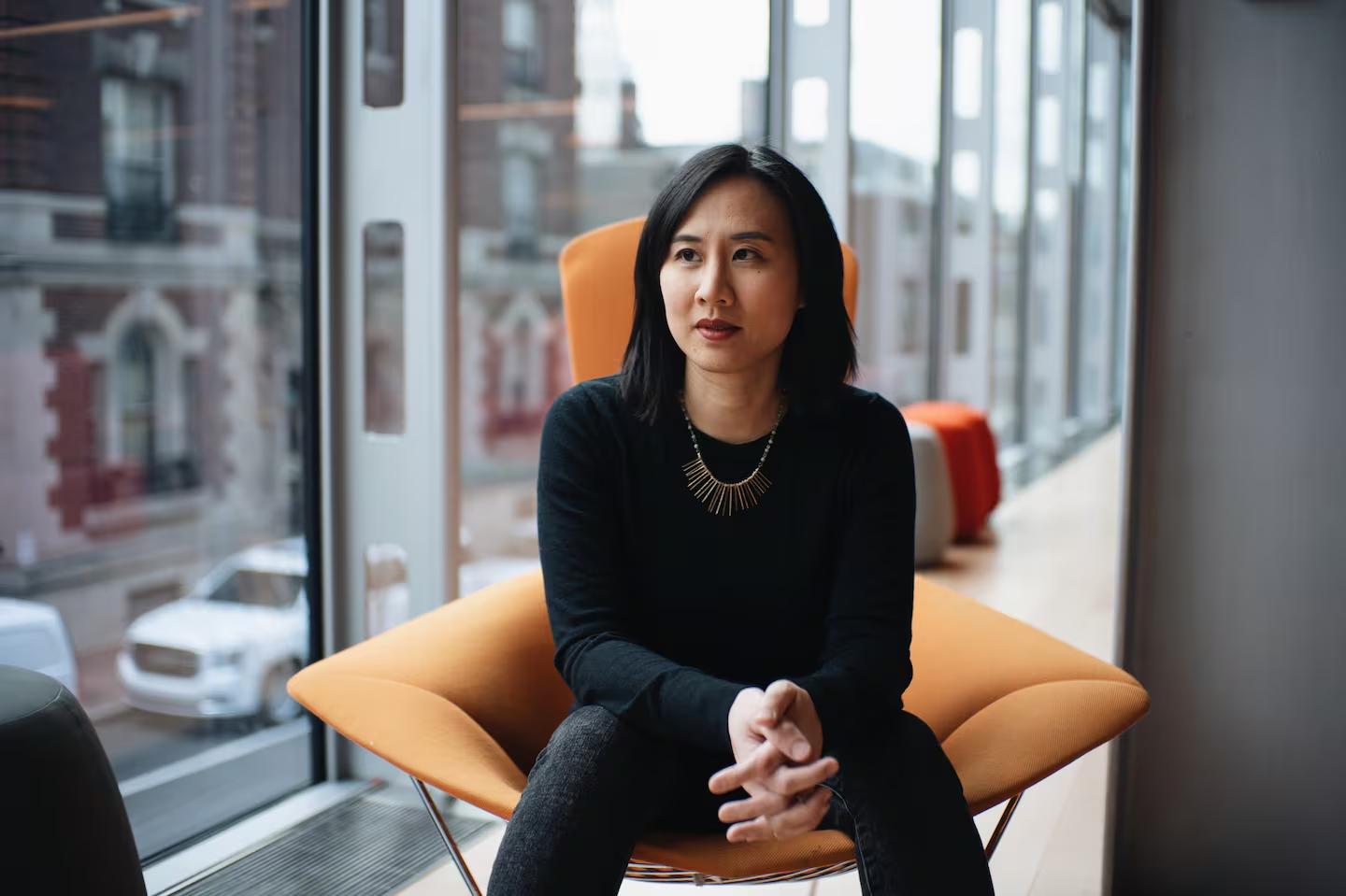
“Unless you’re directly involved in the lawsuit, I don’t think most people really know where to get information,” said “Little Fires Everywhere” author Celeste Ng. “Even if you are part of the lawsuit, I don’t think that it’s clear where to find out information. I think everyone’s just kind of in the dark.”
The settlement does nothing to ease the concerns of how AI may drastically alter the craft of writing — a sentiment that can be translated to other workers in nearly every industry.
In some respects, authors may see AI as less of a threat to replace them than other professionals. After all, if you ask AI to produce a full-length novel, it’s generally not very capable of writing with a high level of creativity.
“Human experience is the stuff that novels and all art are made of,” says William Landay, the Boston-based author of “Defending Jacob.”
But what’s real is the oversaturation of bookshelves and online stores — seen in the sharp rise of self-published books over the last few years. The security of marketing and other publishing jobs is at risk, even if authors may still feel somewhat protected.
“To market [a book] and promote it and talk in-house and do the flaps, it’s really valuable,” said Zigman, who worked in publishing at Random House before becoming a full-time writer. “To think that all of that is very likely being done by AI is sad to me.”
The future of books in the age of AI, and perhaps the future of LLMs, will be sculpted by the outcome of prospective lawsuits. Whether the technology is transformative or a regurgitator of copyrighted work remains to be seen in court, but authors, no matter their general stance on AI, are expecting their due.
“The only reason they’re as good as they are today is because they were trained on books,” Rasenberger said.
Read more Another Red Sox setback: Garrett Crochet dealing with lat issue, will get MRI




Post Comment