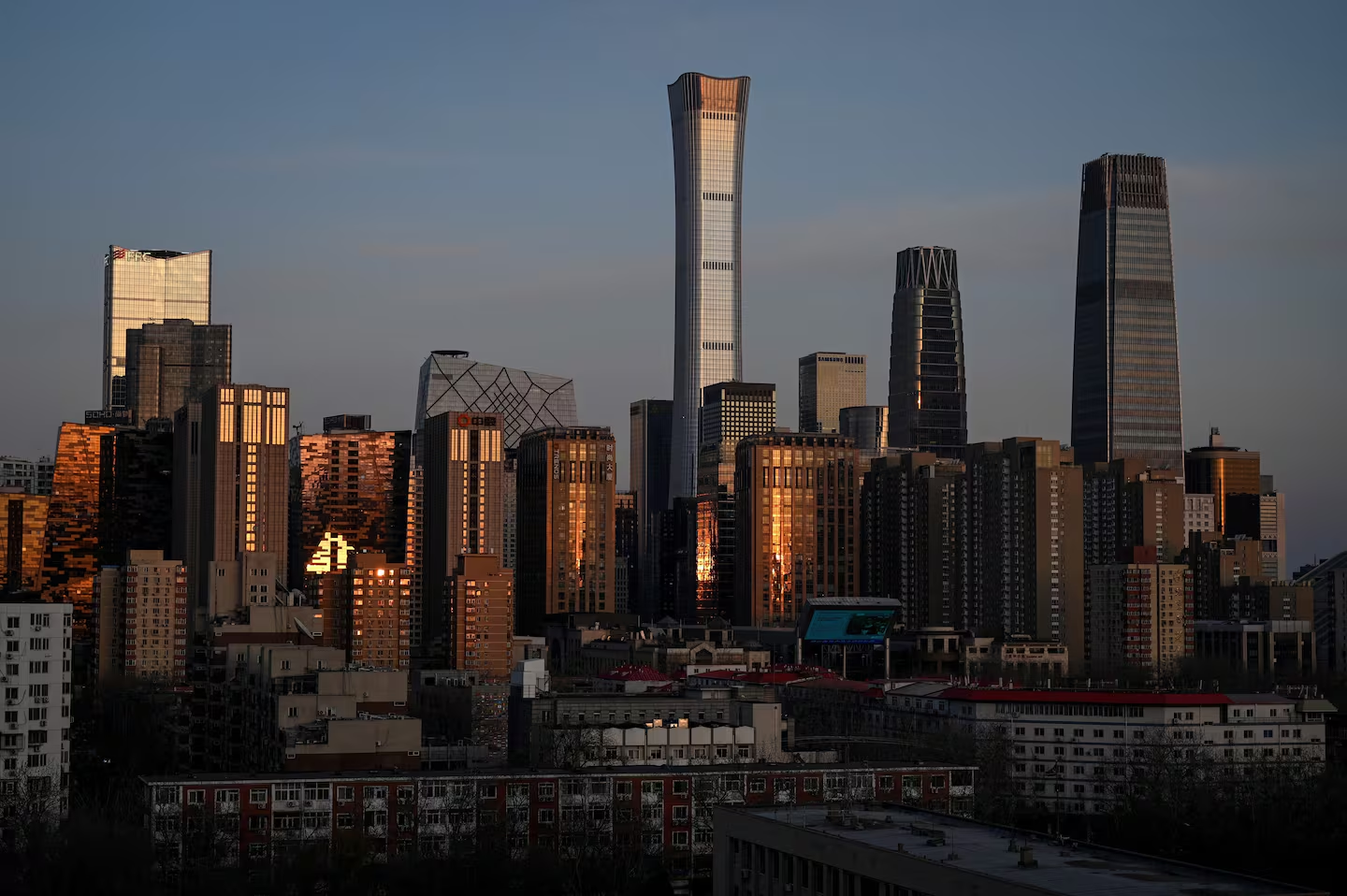
China’s biotech ascent forces US industry to choose: Is the country an ally or an existential threat?
This story is republished from STAT, the health and medicine news site that’s a partner to the Globe. Sign up for STAT’s free Morning Rounds newsletter here.
Read more The world capital of french fries has a problem: too many potatoes
There’s a schism in America’s drug business, playing out in punchy direct messages, feisty group chats, and the occasional heated in-person exchange.
The problem is China. Fledgling startups and pharmaceutical giants alike are addicted to Chinese drugs, filling their pipelines with would-be blockbusters developed at enviable speed and bought on the cheap. They’ve spent some $60 billion on Chinese molecules in the first three months of 2026 alone, according to state figures. That’s on pace to double last year’s total, which was already 10 times larger than the one from 2021.
No one disagrees that it’s good business. And more drugs moving swiftly through development means hope for patients around the world desperately awaiting new medicines.
But, according to more than a dozen interviews with industry executives and investors, the question of whether to partner with Chinese firms — or see them as rivals — is tearing biotech apart, pitting peers and partners against one another and souring relationships in an otherwise close-knit corporate community.
On one side are biotech loyalists who believe pharmaceutical giants and A-list venture capitalists are frittering away a jewel of American industry by bolstering Chinese companies, threatening the very existence of a trillion-dollar sector. They point to rare earths and electric cars, sectors where China was happy to handle low-cost dirty work for Western incumbents until it built up enough domestic expertise to dominate those markets on its own. Why would drugs be different — and what happens when the next cancer breakthrough comes from the labs of a state-owned Chinese biotech company?
“They get you dependent on something and then they use it as leverage,” said the chief executive officer of a U.S. biotech company. “They’re the coke dealers of globalism.”
On the other side are committed drug developers who see China’s rapid rise as an evolution rather than an existential threat — and who don’t particularly appreciate accusations of corporate treason. To them the doomsayers sound like dinosaurs in the making, crying Cold War because they can’t compete on the merits.
“The uncomfortable reality is when these things happen, there are winners and losers,” said one investor who has built startups around Chinese-invented drugs. “That’s table stakes for full-contact American capitalism.”
There is also a middle group, made up of a small number of investors who believe the emergence of Chinese biotech has created a prisoner’s dilemma: It’d be fine if everyone spurned engagement with Chinese firms, but so long as your rivals are shopping in Shanghai, you’d be foolish to put yourself at a disadvantage. These investors want the government to step in and block future Chinese drug deals.
“Until I’m not allowed to do it, of course I’m going to do it,” one biotech investor said. “There are too many for-profit actors in this setting who are willing to launder their ethics to make $100 million on each deal.”
What all three factions have in common is an aversion to speaking out. Most of the investors and entrepreneurs who spoke to STAT did so on the condition of anonymity out of fear that their unadulterated views on the China situation would put them in line for reprisal — from Chinese partners, well-heeled VCs, pharmaceutical powerbrokers, or a Trump administration with a track record of punishing individual firms.
There’s one executive more than comfortable shouting into that vacuum. Jason Kelly, the 45-year-old CEO of Ginkgo Bioworks, has spent the past few months making the case — on podcasts, to the fleece-vested viewers of TBPN, and in front-facing videos posted to his X account — that biotech’s China situation is dangerously untenable. Like Paul Revere in a lab coat, Kelly argues the U.S. needs to slam the door on Chinese licensing deals, speed up the process for domestic clinical trials, and radically reform the American scientific method to compete with lower-cost laboratory labor overseas.
What Kelly is selling, in the literal sense, is a solution to that final demand. Ginkgo, at its Boston headquarters, has constructed an automated lab in which interconnected robots perform the scientific grunt work that underpins every major drug discovery, shuttling samples up and down a track like model trains. The goal is to persuade startups and major drugmakers that Ginkgo’s machines, which don’t need sleep or health insurance, can cheaply and reliably replicate the tasks that would otherwise be outsourced.
“The ugly secret in biotech is that all the startups are moving to China,” Kelly said on a walk through the buzzing shop floor of Ginkgo’s robot-staffed lab, which the company says is the largest in the world. “We need to embrace autonomy. We can’t compete on hands pipetting with China.”
He is, to some of his peers, a less-than-ideal messenger for the crusade to save American biotech. Ginkgo has had to pivot since its 2008 foundation, as the company’s animating ambitions sounded a lot more plausible when interest rates were zero. Ambitions were narrowed, costs were cut, and a few hundred people were let go. If you bet 10 bucks on Ginkgo when it went public in 2021, you’d be holding a single shiny quarter in 2026.
Kelly is talking his book when he insists automated labs are integral for biotech’s survival: The robots he believes can save American science also happen to be Ginkgo’s best bet to stay in business.
“I think we have to admit that we are paying scientists three times as much in the U.S., and I do not understand how we plan to be competitive,” Kelly said. “So yes, I’m selling a solution to that problem — but I do think it’s a real problem.”
Even skeptics of Kelly appreciate what he’s doing. Robots or otherwise, no one else in the industry is publicly pressuring the U.S. to block investments in Chinese biotech. As one investor put it, “My belief is our entire industry is dead in 10 years if things don’t change, so why not?”
‘Not a random, overnight change’
Once you start looking for China’s fingerprints on the American drug industry, you can’t escape them. The biggest IPO in biotech history? Built on Chinese-invented medicines. Buzzy startup launches? Chinese drugs. The latest billion-dollar buyout? Chinese drugs. Pharma’s new arms race in cancer treatment? China, China, and China.
“This was not a random, overnight change,” said So-Yeon Kang, a Georgetown University professor who has studied China’s ascent. The country spent years deliberately working its way up the pharmaceutical supply chain, she said, first by making chemical raw materials and then by manufacturing medicines, all while learning from the multinational firms happy to take advantage of a bargain. Now, by inventing drugs with Western acquirers in mind, “China is competing in the supply chain of ideas,” she said.
A decade ago, Chinese-invented molecules accounted for just 8% of the global drug pipeline. As of 2025 that number was north of 40%, according to a recent analysis published in JAMA by Kang and her colleagues. Over that same period, the U.S.’s share of the world’s medicine chest fell from nearly half to less than 35%. By pretty much any metric of biotech productivity — research spending, patent applications, clinical trials — China has overtaken the U.S.
The truly cutting-edge stuff remains largely the domain of American labs, Kang said, at least for now. Where Chinese firms have cornered the market is on so-called best-in-class drugs, taking ideas already in the scientific zeitgeist and making them longer-acting, for instance, or more potent. They’re building better mousetraps rather than reinventing pest control.
And American drug hunters, at companies big and small, want in. Venture capitalists and business development teams have been making increasingly frequent pilgrimages to China in recent months, bragging about their close ties in Shanghai and Suzhou, investors said. Analysts at Leerink Partners have dubbed the resulting nexus “the Wild Wild East.”
Biocom, the trade group representing biotech firms in California, led a squadron of local executives on a trip to China just last month, brokering introductions for companies eager to forge relationships in the country’s burgeoning scene. To Tim Scott, Biocom’s CEO, human disease doesn’t recognize borders, so why shouldn’t international competitors work together once in a while?
“It’s not a Cold War game of chess; it’s a game of Twister,” Scott said. “We’re all over each other, and we have to just accept that and make the best of it.”
The math is hard to beat. As one venture capitalist explained, you can spend $10 million on a best-in-class drug from China, or you can hire 25 people in the U.S. and pay them some $40 million over three years to get to the exact same point. In general, going with China works out to a roughly 50% cost savings, he said, meaning the same monetary investment can fund double the work.
Read more Experimental pill promises new hope for deadly pancreatic cancer
“We’re going to make half as many medicines if we need twice as much money to make all of them,” he said. “So is the goal to subsidize the Kendall Square labor ecosystem, or is it to maximize drug productivity?”
That framing misses the point, according to Olivia Kosloff, a senior fellow at American Economic Liberties Project. American biotech companies aren’t competing on price with rival firms in a free market; they’re getting pulverized by a state-sponsored effort to amass geopolitical influence.
“China is not a neutral global partner,” Kosloff wrote in STAT. “The Chinese government has pursued an industrial policy of entering an industry at the commodity level, undercutting global prices to attract investment, moving up the value chain, and eventually driving global competitors out of business.”
The endgame isn’t cheaper drugs, one biotech investor said. It’s a future in which cancer drugs are bargaining tools and the U.S.’s access to lifesaving medicines depends on its willingness to kowtow to Beijing.
“We are seeding a future supply chain crisis,” the investor said. “‘Sorry, grandma’s refill’s not going to happen because China took Taiwan.’”
A plan of attack
Jason Kelly, self-appointed spokesman for biotech’s Minutemen, has a three-pronged plan to avert biotech disaster. Step one is uncontroversial: The U.S. needs to speed up the process of conducting early-stage trials, an undertaking already in motion at the Food and Drug Administration. Then it needs to invest in making American drug discovery more efficient, embracing new technologies like, say, automated laboratories crafted by Ginkgo Bioworks.
Step three is the divisive one: Kelly wants to forcibly break his industry’s reliance on China.
Under the , enacted last year, American firms can’t invest in certain technologies — mostly fast drones, faster computers — tied to China and other “countries of concern.” The Trump administration could, if it wanted, add biotech to the COINS list of sensitive global industries, effectively banning all this molecular outsourcing. And Kelly believes the U.S. should pull the trigger now, before more American money finds its way into Chinese pockets.
“This isn’t just about ceding ground on manufacturing,” Kelly said. “It’s about the frontier. It’s about who owns the future.”
He’s not alone. Earlier this year, seven Republican lawmakers, including Sen. Tom Cotton (R-Ark.), a notable China hawk, sent to Treasury Secretary Scott Bessent urging him to add biotech to COINS, warning that inaction “risks hollowing out a critical American industry while strengthening that of a foreign adversary.”
The Treasury Department did not respond to requests for comment.
If the administration doesn’t take action, Congress could try. Proponents of the idea said it has broad support among lawmakers and the aides who handle the actual labor of legislation. But getting it over the line might require outflanking the powerful pharmaceutical lobby, they acknowledged.
The Pharmaceutical Research and Manufacturers of America, which spent a record sum on lobbying last year, is not on board with the idea that putting restraints on U.S. drugmakers would slow their Chinese counterparts.
“We’re not going to regulate ourselves to success here,” said Robert Zirkelbach, PhRMA’s chief public affairs officer. “The way we win is by making America the most attractive place in the world to invest.”
To some biotech investors, Kelly’s COINS plan simply would deprive American drug developers of promising potential medicines while insulating an industry from the kind of competition it should crave. Instead of crying out for government intervention, biotech should double down on big scientific ideas, investing in areas where the U.S.’s head start on China can be measured in years instead of months. “We should all put on our big boy pants and try to solve hard problems,” one VC said.
John Crowley, biotech’s man in Washington, is on board with streamlining clinical trials and investing in new technologies. But the CEO of BIO, the trade group representing U.S. biotech companies, sees COINS as an imperfect solution unlikely to solve a very real problem. Capital is stateless, rational, and fluid, Crowley told STAT. If Chinese researchers are doing good science, someone’s going to fund it.
“It would be a fool’s errand to try to stop what’s happening in China,” Crowley said. “Let’s look in the mirror. How do we win in biotech? How do we outcompete China?”
The upside of robots
Ginkgo’s robots toil away on the top floor of a retrofitted warehouse in Boston’s Seaport, a building commissioned in 1918 to supply the U.S. Army in World War I. That history is not lost on Kelly, to whom biotech is an integral part of national security, and Boston is its capital.
The local industry is in visible decline. Greater Boston’s laboratory vacancy rates, which were effectively zero as recently as 2023, have soared to nearly 30%, according to from real estate firm CBRE. Demand has tanked, and much of the available inventory comes in the form of subleases from companies actively downsizing. Biotech jobs in Massachusetts declined year over year for the first time in two decades, per the most recent report from industry group MassBio.
“That’s really what got me started on being more public about this,” Kelly said. “I’m not going to just sit here and watch Kendall Square melt. We should all be doing something about it.”
One might wonder how building machines that do human jobs could be a net positive for biotech employment. Here, Kelly turns to history again. In the late 1940s, IBM introduced the world’s first mass-produced electronic calculator, promising the nearly one-ton machine could do the work of 150 engineers tethered to their slide rules. Over the ensuing decades, the computational machines got smaller and more powerful — and the demand for engineering talent exploded in turn.
“That’s because by automating it, we dramatically increased the return on investment for what was in those engineers’ heads,” he said. The same thing could happen to biotech.
On the sidelines of his automated lab, called Nebula, Kelly reached for a dry-erase board to sketch out Ginkgo’s future. Technologists have historically grappled with the balance between automation and variability, he said. In transportation, the subway is an unbeatable way to automate the trip between two fixed points. But if you want to get each rider to a variable location — their doorstep, for instance — your best bet is to put each one behind the wheel of a car. Or at least that was true until Waymo came along, Kelly said, and solved the autonomy-variability problem with a car that drives itself.
Ginkgo aspires to be the Waymo of biotech research. Other companies have figured out how to automate specific laboratory tasks, creating subways of scientific labor. But most experiments still require human hands shuttling liquids back and forth between machines scattered across laboratory benchtops, leading to inefficiencies and traffic jams. Nebula removes the human element, Kelly said, allowing scientists to order up variable experiments and rely on automated lab techs to ferry them home. When running at full steam, the automated lab offers a ten-fold increase in research output per square foot while occupying about one-third the space, according to Ginkgo.
“I don’t see how this isn’t wildly better,” Kelly said.
It had better be. Ginkgo has spent the last two years cutting, pivoting, and offloading parts of its business in an effort to minimize its cash burn and lay eyes on a future in which it makes more money than it spends. The automated lab is the engine of its survival. The short-term sales driver is inviting researchers to order up robot-led experiments from an online menu. The broader vision is to prove Nebula’s value such that the likes of Merck and Pfizer pay Ginkgo to come to their corporate campuses and build bespoke Nebulas for them.
“My argument is you’re better off building an autonomous lab versus outsourcing your whole operation,” Kelly said. “The race I’m running is can I prove it before the whole industry moves to China?”



Post Comment