Scores of donated organs go to waste. Two Mass. companies are causing a ‘tidal shift’ to save them.
Earlier this year, a patient in North Carolina successfully received a donated heart from a donor in California, in what’s become a seemingly ordinary, though still nervy, feat in the high-stakes world of organ transplants.
Read more Coco Gauff’s French Open title defense ends while Naomi Osaka’s fashion show continues in Paris
But it wasn’t that long ago that sending a critical organ such as a heart on a 2,000-mile, eight-hour plus journey across the country without supplying it with a constant flow of blood was impossible. Four to six hours max outside the body was the limit for most surgeons.
But something of a small revolution has occurred in the field, centered around one of the more prosaic components of such a sophisticated medical operation: the traveling container that holds the donated organ.
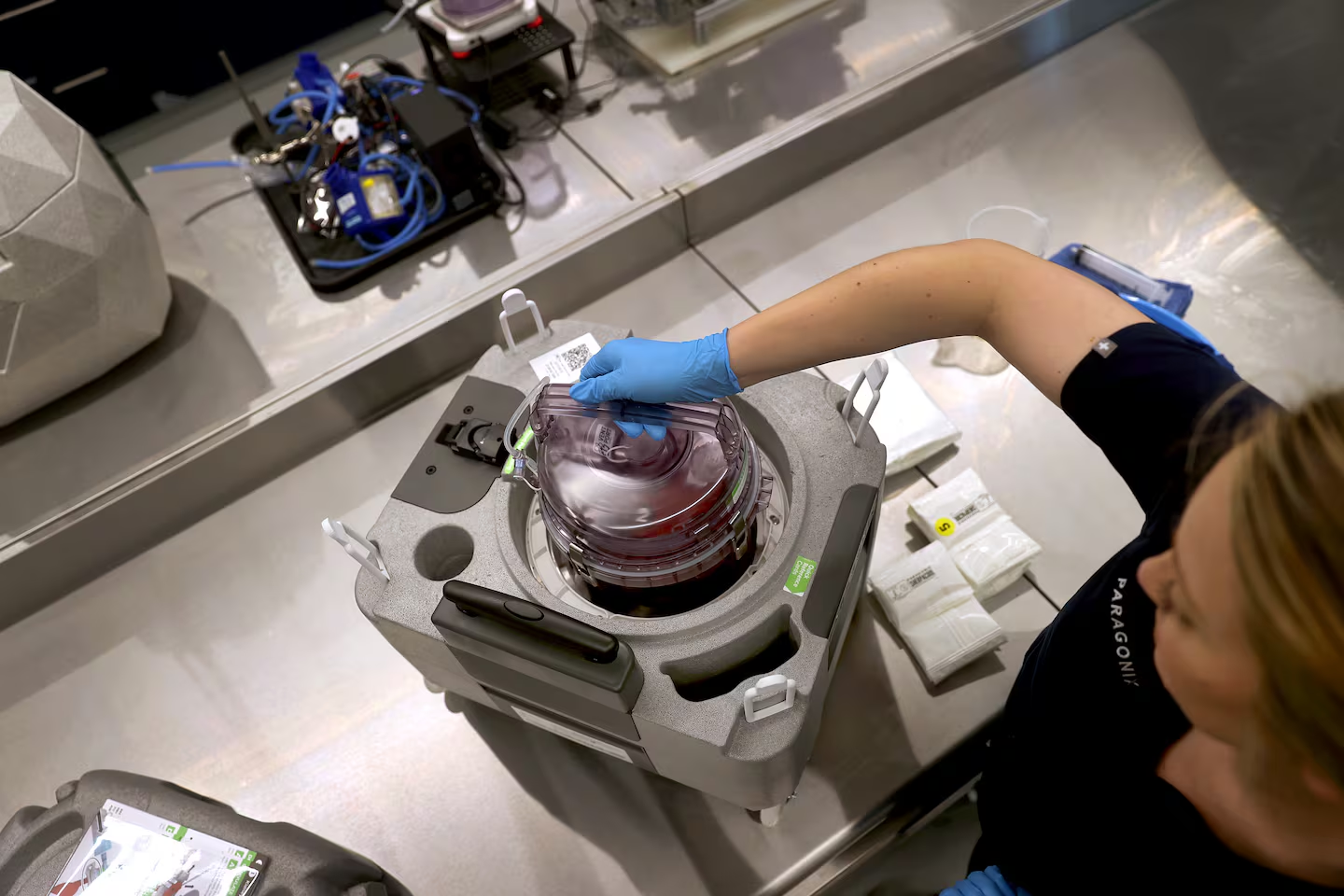
And behind it are two companies based in Massachusetts that have developed high-tech containers that significantly extend the viability of the donor organ. The devices maintain internal temperatures and even continuously run fluid or air through the organs to keep them pumping while in transit.
“The increase in transplants and increase in organs that are safe for transplant because of these technologies is so profound,” said Dr. Charles Strom, chief of surgical services of New England Donor Services, the organization that coordinates organ and tissue donation across the region. “We’re seeing a tidal shift in how many lives can be saved as a result.”
The donated heart was transported from California to North Carolina by Waltham-based Paragonix Technologies, which just a few years ago was a tiny startup and is growing so much it was bought by a larger Swedish medical concern. The second company is TransMedics, currently in Andover, and one of its transport devices wasable to keep a heart stable outside of the body for more than 15 hours, according to the company.
For most of the history of organ transplantation, surgeons were hesitant to accept a donor heart that had been outside of the body for more than about four hours. Any longer and the heart — traditionally transported in a cooler with crushed ice — could become damaged.
“We were limited as to how far we could go,” said Dr. James Markmann, vice president of the Penn Transplant Institute in Philadelphia, who said he was part of the first transplant of a liver that was continuously pumped with fluid during transport at Massachusetts General Hospital in 2016. “Now, there’s really not a limit, except for the cost of how far a flight it is.”
The new devices are becoming so popular they are displacing the once-ubiquitous red and white coolers that looked more at home on a beach than in a hospital.
More than 100,000 people in the US were waiting for donor organs as of May 2025, according to Organ Procurement & Transplantation Network data. About 5,000 of those waiting live in New England, according to the Massachusetts Department of Public Health. Patients might need an organ transplant if they have an organ failing due to injury or illness, like chronic kidney disease or cystic fibrosis.
It can take years for a patient to receive a donated heart, kidney, liver, or lungs. Sometimes, they die waiting.
The transplant system has come under intense scrutiny in recent years for how and when organs are allocated. In 2025, TheNew York Times reported a recent sharp increase in donor organizations bypassing patients at the top of waiting lists and giving organs to people who had been waiting for less time or were less sick out of ease or convenience. That triggered an ongoing effort to modernize federal services for allocating organs.
Sometimes donor organs end up getting wasted because they’re too far away from a suitable recipient, or because some hospitals are hesitant to use organs that have been out of the body for longer than the recommended time. CBS News reported in 2025 that nearly 12,000 potentially life-saving organs were discarded in the US the year prior.
More advanced transportation systems could be a solution — albeit an expensive one — to that problem.
For the companies dedicated to keeping organs viable for longer, business is on an upswing.
Paragonix and TransMedics, while similar in their mission, use different preservation techniques. Paragonix keeps organs at a stable cold temperature, while TransMedics pumps warm blood through the organs. Paragonix has single-use devices for donor hearts, lungs, kidneys, livers, and pancreases. TransMedics transports lungs, hearts, and livers using reusable machines and single-use sets of sterile equipment.
Read more Eric Cole gets another shot at first PGA Tour win after 63 in third round at Colonial
The devices are outfitted for use with pediatric organs, as well, although the TransMedics system is typically only used for larger pediatric organs.
“Pediatric heart transplants, they’re only hundreds of cases a year, but they are the most vulnerable patient population,” said Paragonix president and cofounder Lisa Anderson.
Paragonix’s devices look like something between a cooler and a giant egg outfitted with a screen on the front that gives internal temperature readings and connects to an app accessible by transplant surgeons. At its core is a sealable container, designed for each organ. In the container used for heart transport, called a SherpaPak, a donor heart is attached to a connector at the top of the device to suspend the organ in a cold preservation solution.
Some of Paragonix’s coolers simply keep donor organs at a stable temperature — not too warm, not too cold — so as to extend the time they can be kept out of the body. A more sophisticated line of coolers continuously runs fluid or air through the organs to keep them pumping or inflated while in a car or plane.
The Paragonix single-use products range in price from $10,000 to $20,000. The TransMedics Organ Care System can cost significantly more, coming in at $65,000 per transplant.
The devices add to the already hefty price tag of organ transplant, which is typically covered by insurance. Each donation involves two surgeries — one to procure the organ from the donor and another to transplant it into the recipient — and transportation that can require a chartered flight with a trained transplant team. Paragonix and TransMedics also offer full procurement services by in-house surgeons and transportation teams for an additional fee.
“That opens up a huge opportunity for patients in the Southeast and Midwest that may die on the waiting list because nobody has the capabilities to bring them organs to these remote areas in the country,” said TransMedics CEO Dr. Waleed Hassanein. “We manage the entire process and we have the logistics network to ensure that that organ will be delivered to the patient in need.”
As use of these devices becomes more common, the cost will eventually taper off, said Keren Ladin, an organ transplantation researcher and director of the Research on Ethics, Aging and Community Lab at Tufts University. Still, that could take years.
“It’s broadly an access issue. These are expensive,” Ladin said. “Not all transplant programs have the same access to these devices and can use them efficiently and effectively.”
Paragonix recently built a new testing facility to develop next-generation devices. Just seven years ago it had fewer than 10 full-time employees, and has grown to 180, nearly half of whom are based in Massachusetts. In 2024 it was was acquired by Swedish medical technology company Getinge for $253 million in cash and up to $224 million if it reached certain performance milestones.
TransMedics, meanwhile, is a publicly traded company that reported a substantial increase in net income over the previous few years as the popularity of the devices grew. It plans to move to Somerville next year.
A number of transplant centers in New England have used equipment from either company, including Mass General Brigham, Tufts Medical Center, and Boston Children’s Hospital.
Massachusetts’ storied history with organ transplantation has kept the state at the forefront of new transplant technologies, Ladin said.
“It’s a ripe environment for innovation,” Ladin said. “I think we are well positioned to continue in that vein.”




Post Comment