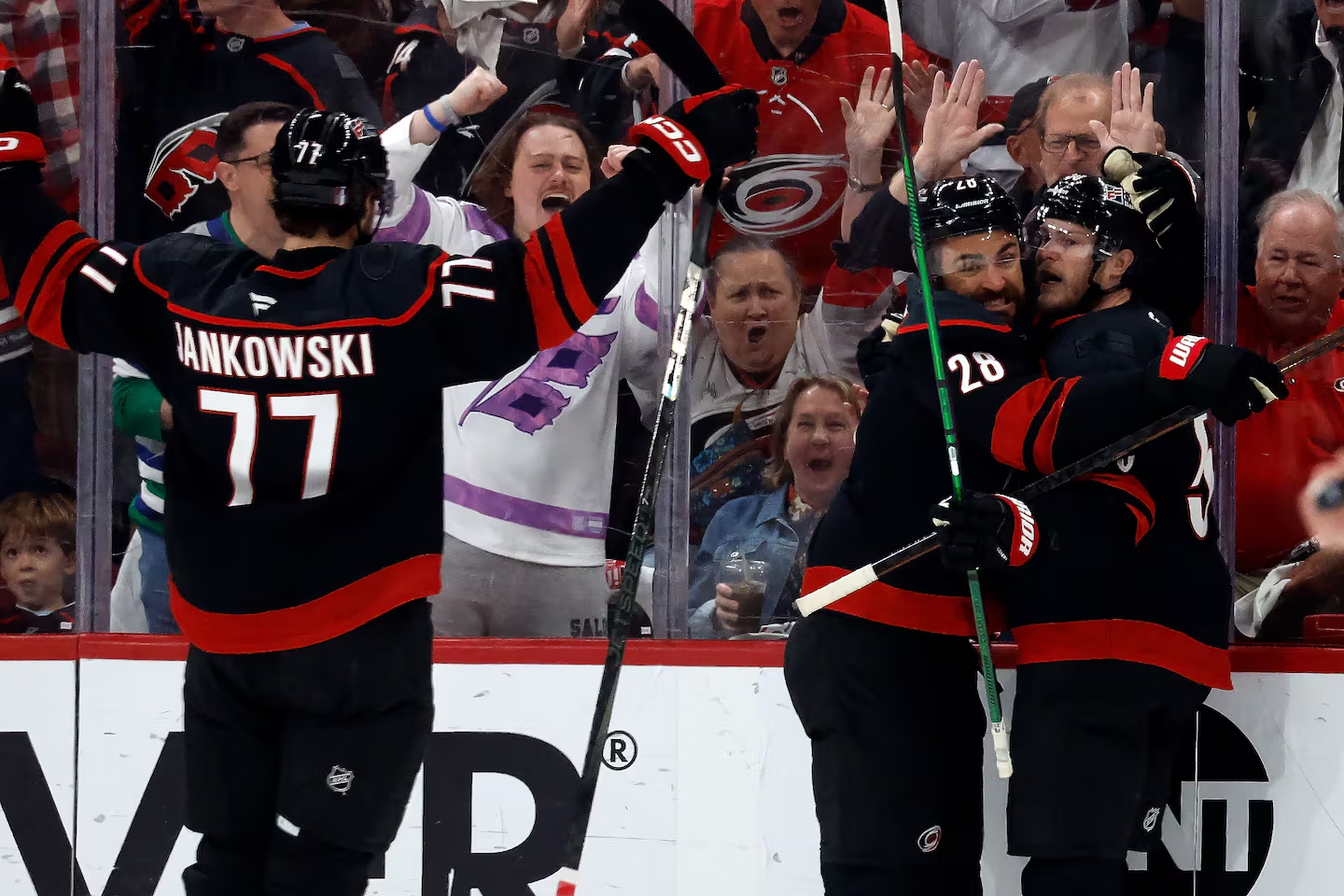
The Hurricanes are in the Stanley Cup Final, and a lot of credit goes to ‘the best fourth line in hockey’
Game 4 of the Eastern Conference finals, a 4-0 shutout of the Canadiens, was a bit more like it for the Hurricanes. Star forwards Sebastian Aho and Andrei Svechnikov scored goals in Montreal, wrapped around strikes by Jordan Staal and Logan Stankoven.
Read more Trump squeezes immigrants by cutting them off from jobs, health care, and housing
Aho delivered on the power play and Svechnikov dumped his into an empty net. Fairly easy lifting, for the most part, but some reassuring, encouraging signs of life for the two big boys at the top of theHurricanes’ offensive order.
Until then, Aho and Svechnikov had been relatively muted by the Canadiens, which is to say coach Rod Brind’Amour’s best players simply were not his best players. That’s not unusual in the postseason, when opposing top lines tend to cancel one another out at even strength, the fate of the series left up to the respective special teams to determine.
Other than its Game 1 win, Montreal’s offense went into a deep sleep — a total of four goals — over the next three games. This from a team with the creative Martin St. Louis as bench boss.
Overall, it was the effective play in Games 2 and 3 of the fourth line, comprised of Eric Robinson, William Carrier, and Mark Jankowski (the ex-Providence College Friar) that shifted the momentum dramatically the Hurricanes’ way. The Former Forever .500s clinched the series Friday with a 6-1 Game 5 win and will oppose the Golden Knights on Tuesday in Game 1 of the Stanley Cup Final. It’s the first trip to the Final in 20 years for Carolina, which is 12-1 this postseason.
“The best fourth line in hockey,” lauded Wayne Gretzky during TNT’s broadcast of the series clincher.
Jankowski, a member of the 2014-15 Friars squad that won the NCAA championship, provided the primary feed on Nikolaj Ehlers’s Game 2 overtime winner. Robinson helped to make the goal develop with a strong drive to the net.
In Game 3, it was the Robinson-Carrier-Jankowski trio that drove the puck deep into Montreal’s end, where a pressured, fumbling defenseman Lane Hutson coughed it up, Svechnikov stepping in to pop it by goalie Jakub Dobes for the OT winner.
“It would be nice if we were up, 2-1,” a somber Hutson, a former Boston University Terrier, lamented after the Game 3 loss. “But we’re not, because of me. So it’s frustrating. We’ve just got to battle and battle to the end.”
Prior to Game 4, the Hurricanes’ fourth-liners cobbled together 2-6–8 in production across three games. All that from a threesome that pulled down an aggregate $5.7 million this season, or a budget-friendly average of $1.9 million apiece. All three have at least one more year on their contracts. Svechnikov and Aho, by the way, bank an average of $8.75 million.
Carrier was a member of Bruce Cassidy’s Golden Knights squad that won the Cup in 2023. He told NHL.com in Montreal early in the week that it was Vegas’s loss to Washington in the 2018 Final that taught him the vital role that a fourth line can play in delivering the Cup.
“It pushed me to bump my game up,” noted Carrier, recalling the lesson he learned in the loss to the Capitals.
Washington that spring bagged what remains the franchise’s lone Cup in part because of the fourth line that had Jay Beagle between Devante Smith-Pelly and Chandler Stephenson. When Alex Ovechkin & Sons finally hoisted high the Cup, that fourth line boasted postseason totals of 11-12–23. Throughout the regular season, they put up 20 goals and 56 points.
A large part of the Hurricanes’ secret sauce was their suffocating, fast-and-ferocious forecheck. It was the foundation of their sweep of the Senators in Round 1 and the Flyers in Round 2, and it helped to flip the conference finals their way after the Game 1 loss.
In eight games across Rounds 1-2, Carolina yielded but 10 goals, adhering to the simple premise that the best defense is to keep the opposition pinned up against the wall in its own end. The Robinson-Carrier-Jankowski combination was at the core of that forechecking charge, often finishing off with punishing hits around the net and the rear wall. They fully channeled the game Brind’Amour delivered over his stellar 21-season playing career.
By the end of Game 4, all of the Canadiens’ blue liners, Hutson included, looked as if they’d spent the night swimming against an inescapable riptide.
The Hurricanes have turned front-end pressure, with or without the puck, into an art form. Sounds basic. If it were such a simple formula, it begs the question, why is no one else executing it?
GONE TOO SOON
Lemieux leaves a four-time champion’s legacy
Sad, stunning news Thursday with the passing of Claude Lemieux, the four-time Cup winner who crafted a career as the NHL’s all-time most effective and prolific pest.
Originally a Canadiens draft pick, Lemieux was 60 years old and died by suicide.
As a player, Lemieux was a surly, controversial agitator and often smashed through the accepted margins of physical play, particularly in the postseason. Early in his four-plus-season tenure with the Avalanche, the winger’s menacing hit from behind on Kris Draper in the 1996 Western Conference finals left the Red Wings forward with multiple facial fractures and sparked an ugly, bloody era of feuding between the franchises.
For all his tactical, calculated nastiness, Lemieux rarely answered with his fists when opponents challenged him for his antics. Rather, he typically turtled in those situations, which only provoked more ire from infuriated opponents.
“Pepe,” as he was known, had it down to a T: strike the match, light the inferno, and cover up on all fours as the house he set afire burned to the ground.
“Obviously, I feel terrible for the family,” said Bruins president Cam Neely, who had his share of on-ice tete-a-tetes with the irascible Lemieux. “I don’t know what was going on, but feel terrible for the family. It’s awful, just awful. You know — [a] competitor, and I hated playing against him. But obviously, his career speaks for itself, especially playoff hockey.”
Most of all, reflected Neely, “It’s just really sad and you just ask yourself, ‘Why?’, And probably just never get any answers.”
Lemieux won his first Cup with the Canadiens, as a 20-year-old rookie in 1986, his second with the Devils in ‘95, and his third the following year with the Avalanche. Devils general manager Lou Lamoriello brought Lemieux back to Exit 16W early in the 1999-2000 season, setting the stage that spring for Cup win No. 4. Lemieux was voted the Conn Smythe (MVP) winner in the ‘95 playoffs and finished with 234 career playoff games, good for No. 5 all-time and the equivalent of nearly three regular seasons.
He was last seen in a rink Monday when the Canadiens chose him to be their honored torch bearer prior to Game 3 vs. the Hurricanes. Stoic, with torch lifted high in his right hand, he looked proud, confident, and fit as he strode in among the delirious crowd at Centre Bell.
That final image of Lemieux in that moment made Thursday’s news all the more jarring.
Perhaps Lemieux’s most memorable moment on Causeway Street came March 2, 1995, Devils vs. Bruins, in what was the last season of play at the old Garden.
Only 3:29 into the first period, with the Bruins holding a 1-0 lead, Lemieux smacked his stick blade across Neely’s face. Inadvertent? Well … it was always hard to tell with Lemieux.
Neely, a man of little room for nuance, immediately took after Lemieux, who artfully ducked a menacing left hook the envy of Marvin Hagler. Lemieux then turtled, causing the irate Neely to drag him face-first, on his knees, toward the corner and then bash his face up against the Boston Globe banner ad on the dasher wall. One press box wag that night noted Neely gave Lemieux a nose for news.
“Good copy for you, right?” said Neely, reminded of the impromptu Lemieux-Globe encounter.
The penalties, once meted out, spoke to a classic confrontation with Lemieux. He was sent off for two minutes for high-sticking, while Neely was sent off to the showers with 17 minutes in penalties for instigating, fighting, and a game misconduct.
“You know, to this day, I’m still [ticked off] I got kicked out of that game,” said Neely. “Like, looking back, was that necessary, to get kicked out?
The Bruins, with the 29-year-old Neely gone, rolled to an easy 7-2 win. Adam Oates (1-4–5) and Bryan Smolinski (3-1–4) led the way. They really didn’t need their Hall of Famer-to-be right winger.
“I suppose that’s true,” said Neely. “But it got the building rocking.”
ETC.
BU autopsy confirms Byers’s CTE
Lemieux’s passing coincided within hours of word that Lyndon Byers was confirmed via autopsy to have CTE, the neurodegenerative brain disease that has been diagnosed posthumously in many pro athletes who played contact sports, particularly football and hockey.
Boston University researchers have been at the vanguard of studying CTE in recent years. The Byers family donated the former Bruins winger’s brain to BU’s CTE Center upon his death last July 4 at age 61. Research found he had Stage 3 CTE.
Robust, fun-loving, and ever-energized, “LB” enjoyed a long post-career run as a local radio personality. In a statement Thursday, his wife, Ann, noted that the radio work became an increasing challenge for her husband as his “cognitive symptoms intensified” in his later years.
Neely, who will turn 61 next Saturday, grew up in the game in Boston alongside Byers, a fellow western Canadian.
“One of my dearest friends,” noted Neely. “His health really took a turn, prior to his passing, for a number of years. His back [injury], and I’d hear stories about his memory, hallucinations, and stuff like that. Obviously very concerning … young son, beautiful wife, just such another sad case.”
Neely said he gives Byers’s family “great credit” for donating his brain to BU with the hope that research will help others in the future.
“I think the more information we can all gather from professional athletes the better,” said Neely. “It would be nice if we could figure that out before someone else passes — hopefully somewhere down the road that will happen.”
In her statement upon the release of the CTE results, Anne Byers noted the decline in her husband’s mental health in the years leading to his death.
“He was so fun and vibrant,” she stated, “but toward the end it got to the point where [he] didn’t want to socialize or even leave the house. He battled severe depression, had episodes of hallucinations, and his struggles with short-term memory loss made it difficult for him to navigate the day on his own.”
Neely acknowledged that the Byers autopsy findings and Lemieux’s death will spark speculation that Lemieux might have suffered with CTE. The BU research center reported it has found CTE in 19 of the 20 brains of ex-hockey players donated to the study.
Prompted to provide a fun memory of his friend, Neely thought back decades to a trip to Montreal, where the Bruins faced the Canadiens at the old Forum.
“The shoe check,” said Neely.
Unaware that teammate Bob Sweeneywas hiding under the table, Byers made his way through the buffet line during the club’s pregame meal at the team hotel down the street from the rink. As Byers loaded his plate, Sweeney surreptitiously lathered the tops of his fellow forward’s shoes with a thick coat of ketchup.
As Byers returned to a table to enjoy his feast, teammates began clinking glasses, making him aware that he’d been slimed.
“‘How the [expletive] did this happen?!’ ” Neely recalled Byers blurting out. “No one coughed it up, but he found out it was Swoop.”
Retribution came quickly. Byers that night got tossed from the game, sending him early into an empty Forum dressing room and unfettered access to teammates’ lockers.
“Middle of winter,” said Neely, “and he cuts off, I’d say, the bottom six inches of Swoop’s suit pants.”
Fast forward to the team bus for the ride back to the hotel.
“There’s LB, like a little giddy kid, telling everybody what he did,” said Neely. “You know, ‘Wait till [you] see Bob come out.’ So everyone’s excited to see Swoop come out and how he’ll handle this, you know, with half his leg showing.”
To everyone’s surprise, particularly the miscreant Byers, Sweeney boarded the bus in a trench coat, his pant legs rested neatly atop his shoes.
“LB’s like, ‘What the …?!’ ” said Neely. “And Swoop yells, ‘OK, who’s the [expletive] that cut my pants?!’ ”
At which point, per Neely, Sweeney flashed open his trench coat to reveal that he had the waist of his pants buckled “halfway down his thighs,” allowing the illusion that his pants remained a tailor’s fit at the shoe top.
“So as much as LB was proud of himself,” said Neely, “it kind of backfired on him.”
Loose pucks
NHL teams can commence buying out individual player contracts, a rarity, as early as June 15, with that first buyout window ending June 30 at 5 p.m., less than 24 hours prior to the start of July 1 free agency. A second buyout window opens later in the offseason, but only for clubs who end up settling contract terms with restricted free agents via the arbitration process. Extremely doubtful that the Bruins opt for the buyout route with anyone on their roster. If his deal weren’t so rich, lengthy, and lucrative, Elias Lindholm certainly would be a candidate. The plan now appears to be for the Bruins to live with him lower in the order at center, though it remains an open question (and need) as to who will fill the vital No. 1 role to dish to the likes of Morgan Geekie and David Pastrnak. Lindholm remains on the books for five more years at a $7.75 million per season … How about Shayne Gostisbehere as Charlie McAvoy’s left-side defense partner? The ex-Union College standout, age 33 and a key to the Hurricanes’ backline, is on target for unrestricted free agency. His expiring three-year deal carries a $3.2 million average annual value. For, say, three years/$12 million total, he could be worth the investment. As noted in this space repeatedly, the Bruins need to wring more pop out of the blue line corps, particularly from McAvoy in the No. 1 pairing … The four players to suit up for more than Lemieux’s 234 postseason games: Chris Chelios (266), Nicklas Lidstrom (263), Corey Perry (244), and Mark Messier (236). Ring count: Chelios (three), Lidstrom (four), Perry (one), and Messier (six) … Old pal Jack Edwards, long the play-by-play voice of the Bruins on NESN, on Thursday will be inducted into the Massachusetts Broadcasters Hall of Fame. If anyone in the NHL broadcast community worked harder at their craft than Edwards, or enjoyed it more, the list of names would fit neatly into the pinkie finger of Bobby Lalonde’s glove, with abundant wiggle room. Edwards joins other Bruins voices previously inducted, including Bob Wilson, Fred Cusick, and Dale Arnold. Which is to say Bruins viewers/listeners have been spoiled for decades.



Post Comment