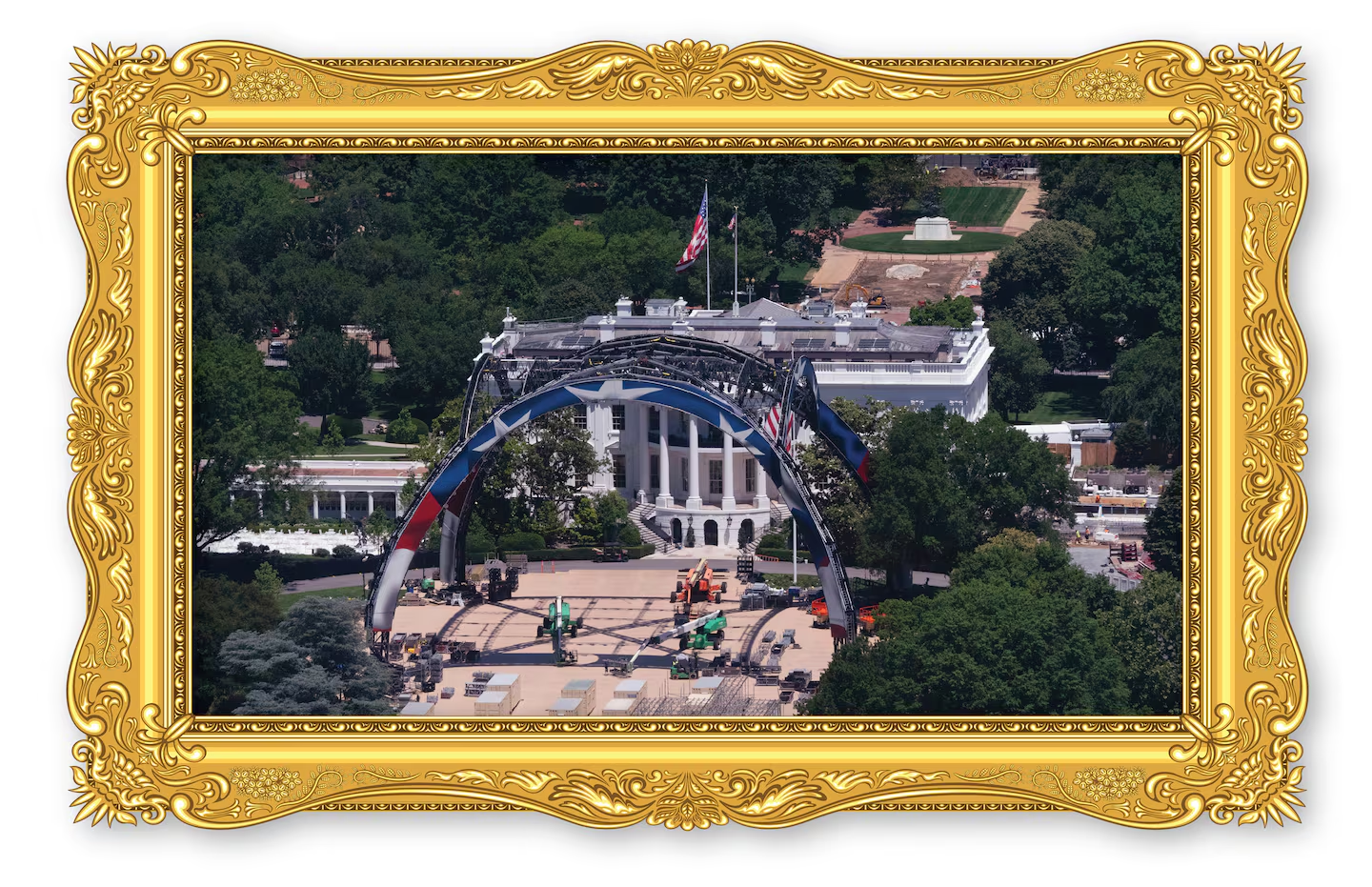
Trump is using the presidency to ‘get what he wants’ for an extreme makeover of the nation’s capital
By
Share
Send this article to your social connections.
- X
- Bluesky
- Threads
-
WASHINGTON — Taking a tour of our nation’s capitalthese days requires some flexibility. Most of the city’s landmarks still boast their customary glimmering marble structures, heroic statuary, and carefully manicured landscapes. But as of late, road closures, heavy machinery, and miles of fencing have encroached upon Washington’s iconography.
Read more Celebrini and Crosby score as Canada eliminates Team USA in men’s World Hockey Championship
That creep of construction is emblematic of a President Trump-directed makeover being thrust upon the capital — one sealed with the promise that by the end of his second term, D.C. will be more beautiful than ever. While aesthetic merits are arguable, one conclusion is without doubt: if he is successful, Trump’s imprint on Washington will be felt long after he leaves office.
“Architecture and power and politics are tied in together,” John Odhiambo Onyango, chair of Howard University’s department of architecture,said of Trump’s effort to leave his mark. “Buildings are symbols of power because they stay for a very long time.”
From the mind of the builder-in-chief, potential changes radiate some 2 miles across the capital, reading like a MAGA tourist’s map of Trump’s physical legacy in Washington:beginning in the gilded confines of the Oval Office, past the seven-story-high flagpoles looming over the White House, detouring around an empty “American flag blue” Reflecting Pool, and government buildings draped with banners of Trump’s face, culminating across the Potomac River with an extravagant granite arch that seems lifted straight out of a Paris postcard.
Though redecoration of the White House is a common feature of presidential transitions, Trump’s maximalist approach is not. His office is festooned with gold accents, portraits of somewhat obscure 19th-century presidents, and shiny diplomatic gifts. The West Wing Colonnade, which connects the Oval Office to the executive mansion, had its flagstone flooring replaced with black granite at Trump’s behest to minimize his risk of slipping.
The corridor wall passed on his daily commute is outfitted with a “Presidential Walk of Fame” that features photos of each president accompanied by corresponding informationalplaques, many written in partisan prose by Trump himself. Joe Biden’s “portrait” is not of the former president but an image of an autopen,for instance, with a plaque that declares him, “by far, the worst President in American History.”
Just outside, Trump paved over the White House Rose Garden to createa patio space with lawn furniture reminiscent of his Florida home, Mar-a-Lago,and later added statues of George Washington, Thomas Jefferson, and Benjamin Franklin. Looking upward, the massive 88-foot-tall flagpoles that protrude from both White House lawns are hard to miss.
Still, no change has left a bigger footprint than the demolition of the White House East Wing a few hundred feet away.
The gargantuan, 90,000-square-foot ballroom set to replace the old structurehas also taken up a lot of space in Trump’s imagination. The president often deviates from the stated subject of public appearances to discuss the minutiae of the project: its “hand-carved” Corinthian columns, bullet-proofing measures, “magnificent” porch, and specializedAC system. A recent Washington Post analysis found Trump spoke publicly about the ballroom on a third of all days in 2026. Even in the wake of a failed assassination attempt at the White House Correspondents Dinner in April, Trump used the situation to underscore the necessity of the ballroom.
“When this opens, I’ll be here for a very short period of time,” Trump recently told reporters while standing in front of the ballroom construction site. “This is really being built for other presidents, it’s not being built for me. And I’m a really good builder. . . . This, this — there will never be anything like this.”
Michael Cohen, who worked as a personal lawyer and “fixer” for Trump for decades before the two had a falling out during his first term, said he’s not surprised by the president’s preoccupation with Washington’s aesthetics.
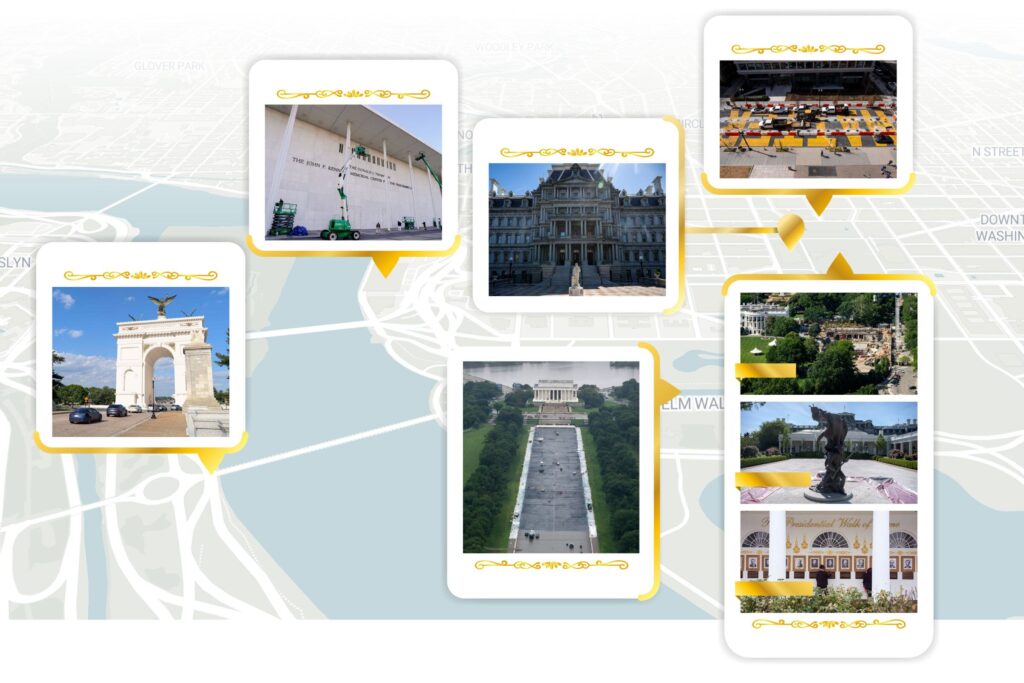
black lives matter plaza
Kennedy center
executive office building
Proposed arch
East Wing
rose garden
Reflecting pool
Walk of fame
Photos: Kennedy center by Al Drago/Bloomberg; Executive office building by Jim Watson/Getty; Black Lives Matter plaza by Jacquelyn Martin/AP; Proposed arch by U.S. COMMISSION OF FINE ARTS; Reflecting pool by AP Photo/Mark Schiefelbein; East Wing by Graeme Sloan/Getty Images; Rose garden by AP Photo/Mark Schiefelbein; Walk of fame by AP Photo/Evan Vucci. Graphic Ashley Borg
White House
© OpenStreetMap contributors
3
2
6
1
5
4
1
2
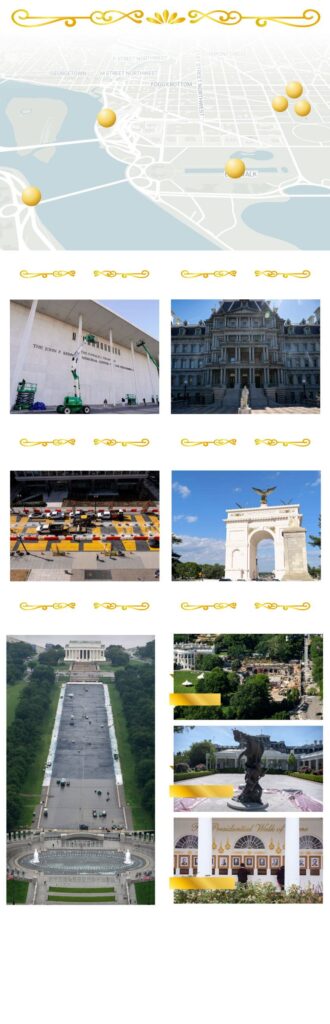
Kennedy center
executive office building
3
4
Proposed arch
black lives matter plaza
5
6
Reflecting pool
White House
East Wing
rose garden
Walk of fame
Photos: Kennedy center by Al Drago/Bloomberg; Executive office building by Jim Watson/Getty; Black Lives Matter plaza by Jacquelyn Martin/AP; Proposed arch by U.S. COMMISSION OF FINE ARTS; Reflecting pool by AP Photo/Mark Schiefelbein; East Wing by Graeme Sloan/Getty Images; Rose garden by AP Photo/Mark Schiefelbein; Walk of fame by AP Photo/Evan Vucci. Graphic Ashley Borg
“Trump is, and has always been, extremely detailed and involved when it comes to real estate projects,” Cohen told the Globe. “In fact, he micromanages all aspects, from the type of marble to the look of columns to even the color combination of carpets.”
Most of the projects Trump is spearheading have also attracted plenty of public feedback, much of it negative. At an early March National Capital Planning Commission meeting reviewing the ballroom project, the panel received more than 30,000 written public comments, the vast majority of them critical of the ballroom’s grandiose design.
“The White House is — if not the most important — one of the two or three most important structures in the nation,” said Alex Krieger,a Harvard urban design professor emeritus. “So you would think that any of its wings would not get to be bigger and taller or more lavish, with more architectural detail, than the White House itself.” The proposed ballroom is nearly double the size of the 55,000-square-foot White House executive residence.
Even so, the commission in April voted to approve the ballroom. Similar to other obscure boards across Washington this term, Trump has stacked the commission with his allies.
Phil Mendelson, chair of Washington’s City Council and an ex-officio member of the planning commission since 2012, said there is “a huge contrast” between the level of interest Trump showed in the panel during his first term compared to this one.
“He is a developer at heart and he’s in a unique position where he can play the role of developer and throw around the authority of the president of the United States,” said Mendelson, a Democrat. Trump “is uniquely able to control the process and get what he wants.”
Strengthening the president’s control of the project is the fact that he has raised $400 million in private funding for the ballroom, including donations from tech giants Apple, Meta, Amazon, and Palantir, plus wealthy families like those of Commerce Secretary Howard Lutnick andformer Marvel Entertainmentchief executive Ike Perlmutter.
More recently, however, Trump has pressedCongress to allocate security funding for the ballroom. Senate Republicans initially tried to insert money for the ballroom’s security features into a larger funding bill, but it was removed due to the Senate’s complex legislative rules.
Congressional approval means more than just extra funds for security.The project is tied up in a lawsuit brought by the National Trust for Historic Preservation that argues Trump broke the law when he razed the East Wing and began construction on the ballroom without congressional input.
“The current resident of the White House is a steward of a building that belongs to the American people,” said Carol Quillen, chief executive of the trust, “and by our Constitution, authority over it belongs to Congress. And so, for me — as somebody who’s a proud American and who loves our democratic republic — who decides is a really important question.”
Walk several hundred feet north from the massive pit where the East Wing once stood, through security checkpoints and steel gates, across Pennsylvania Avenue, and the brick paths of Lafayette Square stretch out toward you. Or they used to.
The public park, often occupied by protestsand famous for itspink magnolia trees in the spring, has been inaccessiblesince January. Trump reportedly wants the park’s masonry paved over out of concern that future protesters could pick loose bricks off the ground and hurl them toward the residence.
In May 2020 —amid mass protests against the police killings of George Floyd and countless other unarmed Black people — some protesters reportedly threw projectiles at Secret Service agents posted near the White House.
Just north of Lafayette Square, on land that technically belongs to the District of Columbia, the words “Black Lives Matter” were painted in bold, yellow letters by a group of muralists in June 2020 with the backing of D.C. Mayor Muriel Bowser.
The mural was one of the first things torn up and replaced when Trump returned to power in 2025.
“It did hurt a little bit,” said artist Keyonna Jones, who helped paint the project, “because how deep [Trump’s] intention is to try to erase things is pretty impressive, for lack of a better term.”
Walk two blocks west and a few hundred feet south on 17th Street, and just outside the West Wing gates sits the Eisenhower Executive Office Building, which houses most White House staff. A Christopher Columbus statue has been erected outside one entrance at Trump’s direction and more changes may be in store.The Trump administration has proposed painting the mostly gray building white to bring it in aesthetic alignment with the president’s home.
The DC Preservation League has filed suit to stop the move, arguing that the exterior of the building, which is made of Maine granite, would be damaged if introduced to the moisture found in paint.
Rebecca Miller, executive director of the local preservation organization, said that in the 23 years she’s worked there, friendly relations with the federal government had been the norm. That is, until the painting plans were announced.
“We’re pro-change, we’re pro-development,” she added. “But these are publicly owned resources, these aren’t the personal portfolio of the president.”
Continuing south on 17th Street, past the fenced-off green expanse known as the Ellipse, and onto the National Mall, we turn west to find the iconic rectangular pool that sits between the Lincoln Memorial and the Washington Monument drained and fenced off. But what the Reflecting Pool has lost in hydration, it has gained in pigmentation: Trump is having the bottom of the pool repainted “American flag blue” in honor of the country’s 250th anniversary.
As we travel past the Lincoln Memorial, across the Memorial Bridge over the Potomac River, we hit a grassy traffic circle that sits on the edge of the D.C.-Virginia border, directly in front of Arlington National Cemetery. If Trump has his way, it will soon be home to the most high-profile of his semiquincentennial commemorations: a 250-foot triumphal arch.
The monumental idea was inspired, in part, by an article in the conservative publication The American Mind, written by art critic Catesby Leigh. Leigh argued that a temporary monumental arch in honor of the semiquincentennial would help D.C. evoke other major Western capital cities like Rome.
Leigh, a proponent of classical architecture, cofounded the National Civic Art Society, which advocates for monuments, memorials, and public architecture in the classical tradition. Trump has called on multiple people with close ties to the society, like architect and founding director of the society Michael Franck, to guide his National Garden of American Heroes sculpture project near the National Mall.
Steven Semes, an architecture professor at Notre Dame and former member of the society, said he stepped away from it at the beginning of Trump’s first term because he began having “serious qualms” about the policy direction of the group.
“I’m glad I did,” he added, “because I think the organization has become more and more dedicated to promoting the projects that we see now, which I do not support.”
As a practitioner of classical architecture, Semes said it’s not the arch’s design that repelled him, it’s the colossal size and placement. It’s a view shared by a group of Vietnam War veterans who are suing the Trump administration, arguing that the arch was illegally commissioned without congressional approval and that the structure would interfere with the entrance to the cemetery, disrespecting those buried there.
“An inarticulate, inanimate building can actually tell a story,” Semes said, but the only story Trump’s projects are telling “is a kind of a self-celebration, which I don’t think is appropriate for a US president.”
Even Leigh, who suggested the arch, has revoked his support for the project after seeing Trump’s version, citing its scale and permanence.
Krieger of Harvard thinks Trump’s insistence that his projects be the biggest and most beautiful “has less to do with deep aesthetic sensibility, and more to do with hubris.”
The US Commission of Fine Arts was established in 1910to be an aesthetic check on presidential excess in Washington’s landscape. The design board was made up of seven experts who had review authority over all construction in the district.
Krieger, a Barack Obama appointee, was a member of the commission from 2012 to 2021. He said the body formerly “had the highest esteem” as an expert panel, but the current, Trump-appointed iteration — which includes the deputy director of Oval Office operations, a filmmaker, and a literary magazine publisher — is “there because they are just supporting the president.”
Most of Trump’s proposed projects have ambitious end dates, meant to be complete before his second term is over. Krieger said the design board’s unanimous rubber stamp has allowed Trump’s projects to move forward at a much faster clip than a thorough review would allow.
Neil Flanagan, an architect and public historian raised in D.C., believes Trump’s manipulation of review boards lays bare both the fragility of their authority and the president’s inclination toward flouting democratic traditions.
“We’ve expected the president to follow these norms, this kind of deference to experts, working with all the agencies, working with Congress, working with the D.C. government — and there’s just kind of a little negotiation,” he said. “I think what we see is none of that’s working.”
Back across the Memorial Bridge and north along the river bend sits another iconic building targeted for a Trump makeover. In fact, his name is already affixed to it.
The Kennedy Center is slated to close in July for two years so the administration can begin its $200 million plan to strip the building down to its steel frame.
Trump ousted the Kennedy Center board and replaced them with his supporters early in his second term. By December, the board, of which Trump is the chair, voted to rename the institution the Donald J. Trump and the John F. Kennedy Memorial Center for the Performing Arts. In a sign that Trump anticipates his renovation wishes will be granted, in March, he installed Matt Floca, a facilities manager, as the center’s president.
Miller, of the DC Preservation League, which has joined with a coalition to sue the administration to stop the construction, said the stacking of review boards with Trump loyalists “makes it feel like the public process is a farce.”
“This is our shared heritage,” Miller said. “Particularly with the Kennedy Center, it’s a living memorial to an assassinated president. I mean, how would people feel if this was the Lincoln Memorial? Is this up for grabs?”
Read more FIFA and the 250th are coming. Time to get out of town?


Post Comment