A ballot question to eliminate party primaries in Massachusetts is dividing state Democrats
A group of Massachusetts Democrats is pushing a ballot question this year that would eliminate the state’s party primaries, arguing a dramatic overhaul of how residents vote is necessary to create more competitive elections in a state where many top lawmakers often cruise to reelection uncontested.
Read more US ambassador to Israel says Israel sent Iron Dome batteries, personnel to UAE to defend country
But the measure is drawing opposition from within both political parties and sowing fractures among Democrats especially — pitting progressives and members of the party’s governing body against some of their own who are pressing to eliminate a system that has long delivered Democrats to success.
Activists in the party’s left wing are planning to raise money in a bid to persuade voters to reject the plan, which would allow the top two vote-getters in a preliminary election, regardless of party, to advance to the final. They fear it would box out lesser-known candidates who struggle with fund-raising.
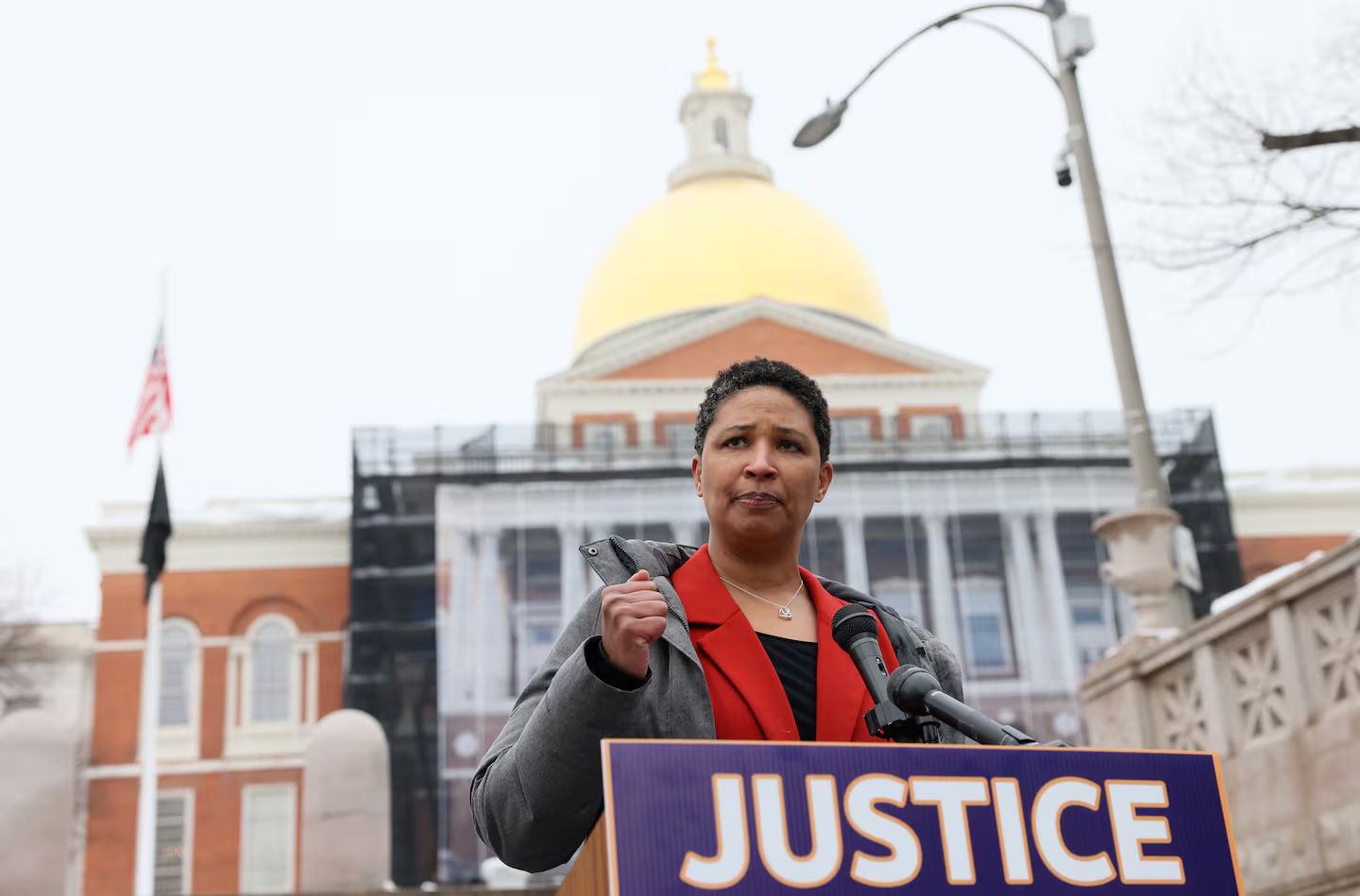
The ballot question’s top supporter, Harvard University professor and one-time gubernatorial candidate Danielle Allen, said it would give voters more choices in races up and down the ballot.
“We have so many elections that are decided in the primary, so then the general is really not competitive. . . . A huge bulk of voters don’t have a meaningful vote,” she said.
The Democratic State Committee, the party’s more than 400-member governing body, voted late last month to formally oppose the proposal. The resolutionit passeddeclared there was not “conclusive evidence” that the so-called all-party primaries are even effective in making elections fairer.
Two state committee members have turned to the court system to block the question, filing a lawsuit that challenges the constitutionality of the measure. The Supreme Judicial Court heard arguments in the case this month.
The ballot question would eliminate political party primaries for state elections and instead establish a primary system in which all candidates would be listed on a single ballot. Voters could only vote for one candidate. The top two candidates would advance to the general election.
The proposal also requires candidates for governor and lieutenant governor to run together in a primary, similar to how they currently are listed as a team on the general election ballot.
Some progressive Democrats chafe at the wealthy finance and technology executives who are helping bankroll the initiative.
Currently, registered voters who are not enrolled with any party can vote in either a Democratic or Republican primary, though those elections tend to pull from the party’s more extreme electorates and often draw lower turnout than general elections.
“We have an open process. This is a red herring,” Jordan Berg Powers, a political consultant who previously led the progressive group Mass Alliance, said of the ballot measure.
Powers, who is leading the , argued that if voters approve it in the November election, “you’ll see more billionaires spending money to get their favorite candidates in.”
“It’s just not true that people can’t vote,” he said. “People can vote. Most people don’t enroll in a party, and they can vote in [a primary in] September how they wish.”
The ballot question has drawn support from some influential Democrats aside from Allen. That includes Steve Grossman, the former state treasurer and one-time gubernatorial candidate who is still a member of the state committee; state Auditor Diana DiZoglio; and former governor Deval Patrick.
Allen dismissed the Democratic State Committee’s objections to the proposal, saying the Democratic Party in Massachusetts “is so much bigger than the state committee.” She pointed to a poll from Emerson College released Thursday that found more than half of the likely Democratic primary voters surveyed backed the ballot question.
“It’s really, really important to remember that, fundamentally, the Democratic Party is the voters,” she said. “It’s in the people, in the voters. It’s not really in the kind of apparatus.”
Read more ‘We have had enough’: Black Bostonians are directing ire about Wu at her allies on the City Council
Grossman, who describes himself as a progressive Democrat, said members of the party’s left wing opposing the question could be “concerned that progressive issues and progressive ideas won’t be actively pursued.” But he said the question will drive “significant” voter engagement.
“I’m a big believer in change, not for change’s sake, but change that is going to enhance political empowerment,” Grossman said. “If there’s anything we’ve learned during this Trump era, is that we’ve got to do everything we can to preserve, protect, and enhance democracy and political engagement.”
Supporters need to gather more than 12,000 signatures by June 17to put the ballot measure before voters this fall.
The measure is facing a legal challenge from Democratic State Committee members Martina Jackson, a Newton activist, and Ann Roosevelt, a Cambridge resident who also is the wife of Jim Roosevelt, a prominent Democratic lawyer.
Their lawsuit contends that the ballot question “cannot survive constitutional scrutiny” because it limits voters’ choices and the right to run for office by reducing general election ballots to only two candidates, a notion some justices expressed skepticism toward earlier this month.
The ballot question campaign raised nearly $2.2 million last year, including hundreds of thousands of dollars from executives at top financial and technology companies, according to campaign finance records. The campaign does not need to disclose its fund-raising for this year until September.
Donations so far include $550,000 from David Peeler, a senior adviser at the private equity firm Berkshire Partners, and $290,000 from Andrew Balson, a managing partner at another private equity firm Cove Hill Partners.
Balson referred a request for comment to Doug Rubin, a consultant working for the ballot question campaign. Rubin declined to comment on Balson’sdonations.Peeler did not respond to a Globe inquiry sent to an email address listed in his name.
Jonathan Cohn, policy director for Progressive Massachusetts and a former state committee member, said all-party primaries increase the power of candidates who can self-fund their own campaigns.
He pointed to a 2018 congressional race in California, which also has a “top-two” primary system and where the open seat initially drew more than a half dozen Democratic candidates.The lineup eventually winnowed to those who could bankroll their bid. Gil Cisneros, who scored a $266 million lottery jackpot with his wife in 2010, won the election.
In California, among those vying in the crowded race for governor this year is hedge-fund billionaire Tom Steyer, who’s already spent more than $130 million on the campaign, most of it from his own pockets.
“It increases the power of big money,” Cohn said of the “top-two” primary system.
Cohn also said opposition to the ballot question has united factions of the Massachusetts Democratic State Committee that were at odds last year amid an insider battle over the party’s platform, which saw a push to spell out support for LGBTQ+ protections, rent control, transgender individuals, and efforts to address systemic racism.
“Across all factions, people thought that the ballot question was a bad idea,” Cohn said.
Jesse Littlewood, the ballot question’s campaign manager, said a “top-two” primary gives voters more candidates to choose from. And he pushed back at opponents on the Massachusetts Democratic State Committee, saying there is a disconnect between some members and voters.
“This [ballot question] would create a condition where there’s just more dynamism, more opportunities for challengers — and more opportunity to connect back to voters,” he said.


Post Comment