‘A legend’: In a city divided by racial strife, Roscoe Baker helped create the Boston Neighborhood Basketball League
Rev. Dr. Michael Haynes, of Roxbury’s Twelfth Baptist Church, was immensely passionate about his neighborhood.
“‘There’s gold in the hills of Roxbury,’ Rev. Haynes always used to say,” said Alfreda Harris, a Roxbury native, community advocate, and worshiper at Twelfth Baptist. “You talk about athletes — oh my goodness. And just good folks. That’s gold.”
Haynes’s brother, Roscoe Baker, was good as gold.
Tributes flowed last week for Baker, a Roxbury-raised resident of Dorchester who died May 17 of complications from an April stroke. He was 88.
Friends remembered him as a local basketball star, a community icon, a champion of the city’s young dreamers. One of Boston’s best all-around athletes of the 1950s and ’60s, he spent the following decades showing others how to be great.
“People called him the unofficial mayor of Boston,” said his daughter, Jillian Baker. “He was a tall guy with a big personality who really cared about his students, the community, the homeless, and how sports can be an avenue for youth to excel.”
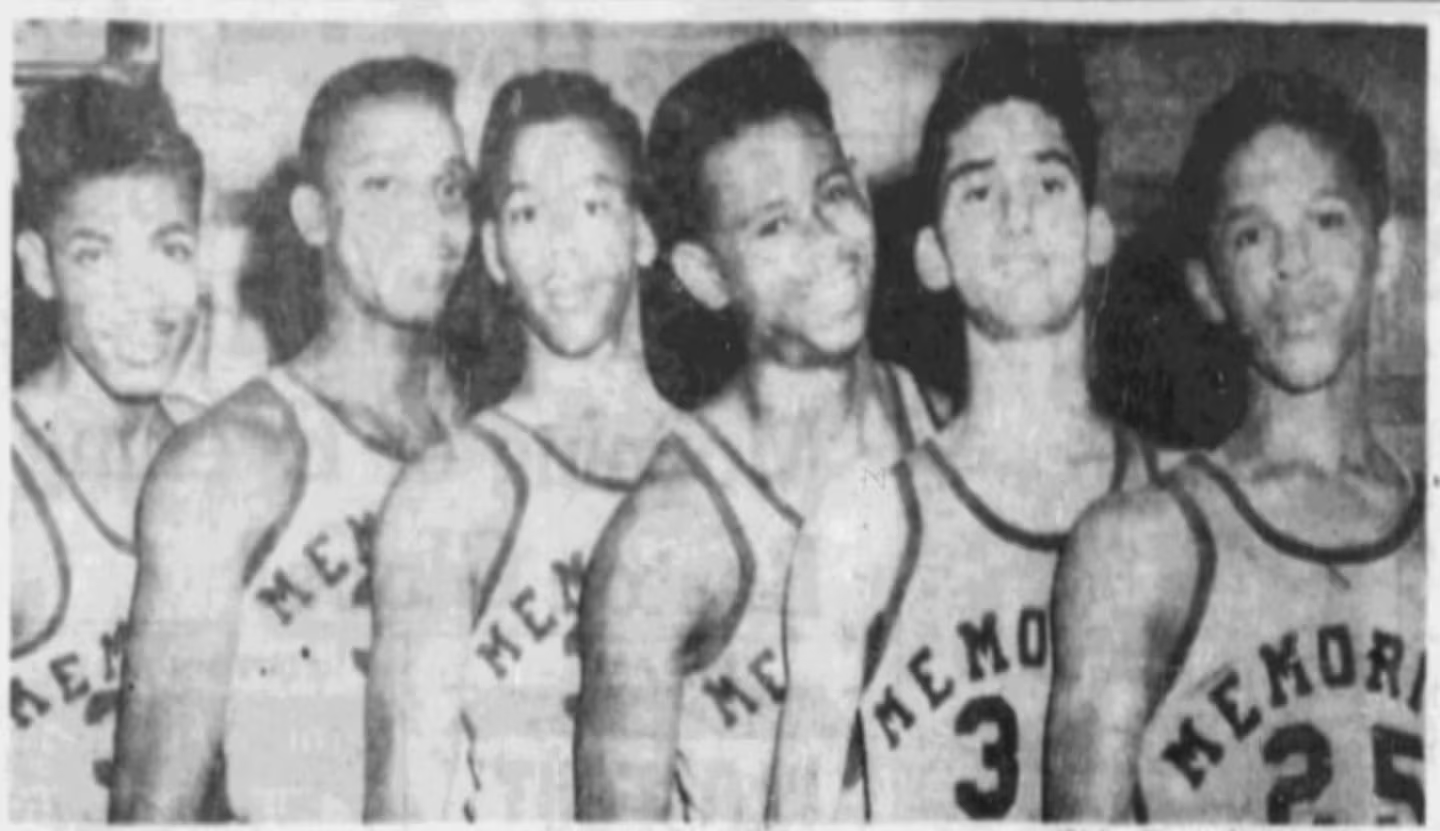
Baker was a multisport star at Roxbury Memorial High, as a basketball guard, football quarterback, baseball pitcher, and track athlete. He led Delaware State basketball in scoring as a senior in 1961. Upon returning home, he filled it up for the semi-pro South End Bruins, coached by Jack Crump.
“Roscoe was a legend,” said teammate Ray Flynn of South Boston, the future Boston mayor. “I admired him. It was his sportsmanship on the court.”
Baker became a player-coach and a referee, working hundreds of college games over 50-plus years (including as one of the first officials in the Big East). In 1974, he did a Celtics-Bulls game at the Garden next to friend Ken Hudson, the NBA’s first Black full-time official.
Those two also combined, with others including Harris, Clarence “Jeep” Jones, Wayne Embry, and Rudy Cabral, in 1969 to create the Boston Neighborhood Basketball League. In a time where the city was torn apart by racial strife, the BNBL brought together different neighborhoods to compete on the outdoor courts.
“It took away the negativity of the busing era,” Harris said. “If you rode around the city at night, you’d see kids playing under the lights, teams of mixed races, making friendships that lasted for life.”
That group in 1972 formed the Boston Shootout, which quickly became America’s premier grassroots basketball tournament. Over the decades, it attracted the likes of Adrian Dantley, Tree Rollins, Patrick Ewing, Chris Mullin, Grant Hill, Kobe Bryant, Antoine Walker, and Paul Pierce.
In the hottest summer days, “it had a calming effect,” said Albert Holland, former principal at Burke High (now Holland Tech). “It really helped Boston move from a point where we were angry at each other to a point where we could sit together and watch great basketball.”
Baker was born in Thomasville, Ga., on July 29, 1937, to Edwina Baker Curtis. He grew up in the Roxbury home of Barbadian immigrants Gustavus and Edna Haynes, whose four sons each answered their callings. Vincent was a journalist and jazz historian. Roy was a world-renowned jazz drummer. Douglas was a musician and World War II veteran.
Michael, the oldest, served 40 years as the pastor at Twelfth Baptist, and was a friend of Dr. Martin Luther King Jr. He was in high school when he invited Baker, then a grade-schooler, to live with the family. Baker’s mother, a singer, was moving out of the area. “He wanted to stay and play sports,” said his daughter, Jessica Moore. “I think he saw a future and an opportunity for himself, even at a young age, in Boston.”
Read more RFK Jr. posts video of himself handling snakes, wife sounds alarm in bizarre clip: ‘Bobby, please’
The community leader Mel King once told the Globe that Rev. Haynes constantly challenged him and other Black men around him to serve the community and understand their power, to “recognize our capacity to make a difference.”
Baker, who taught at Timilty Middle School after graduating college, in 1968 became the first Black director of the Roxbury Boys Club. Among those he guided were two young girls from Roxbury, Andrea Swain and her sister, Lisa.
Hanging out at the club in the early ’70s, they wondered why they were not allowed to swim. Baker encouraged them to speak out. Girls soon joined various activities at the club. In 1981, the Roxbury Boys Club allowed girls as full members, and changed its name to reflect that — the first Boys Club in the country to do so. Soon, other affiliates did the same.
“He gave me a voice,” said Swain, 61, now chief impact officer of the Boys & Girls Clubs of Boston.
In the early ’80s, Burke High was in dire straights. Drugs and gangs rattled the pillars on its facade. Its academics were crumbling. In 1986, Holland brought in Baker as a teacher and dean of discipline to help him turn the school around.
“Encouraging kids to go to class and to do the right thing, he was just a special person that cared about individuals, and everywhere he went, he’d make you laugh or put a smile on your face. He left such an imprint on your heart,” said Brandy Cruthird, a late-80s basketball star at what is now the Dr. Albert D. Holland Technical High School.
The original plan at Burke, she added, was to dedicate the school gym to Holland, but Baker’s passionate speech about Holland’s impact helped convince decision-makers to rename the entire school.
Charlie Titus, 76, grew up in Columbia Point, and later Roxbury, in the ’60s. He remembered a community that was united in its struggle for progress, and pushed forward by leaders such as Baker.
Titus listened, staying in school and on the court. He wound up becoming UMass Boston’s first athletic director, founding the men’s basketball team, and coaching for 29 years. He is in the St. Michael’s College and UMB Halls of Fame.
“That doesn’t happen to me without people like Roscoe Baker, Mike Haynes, Jeep Jones,” he said. “They were 24/7 youth workers. Their days never ended. They were always around, taking us places, taking us down south to the HBCUs, to jobs. They were just there — they were a part of your life.”
Baker leaves behind his daughters, Jessica Moore, of Boston, and Jillian Baker, of Los Angeles; a son, Roscoe Baker Jr., of Kissimmee, Fla.; three grandchildren; and numerous family members and friends.
A funeral will be held Friday, May 29, at the Twelfth Baptist Church in Roxbury, with a viewing from 9:30-11 a.m., and a service from 11 a.m.-noon.


Post Comment