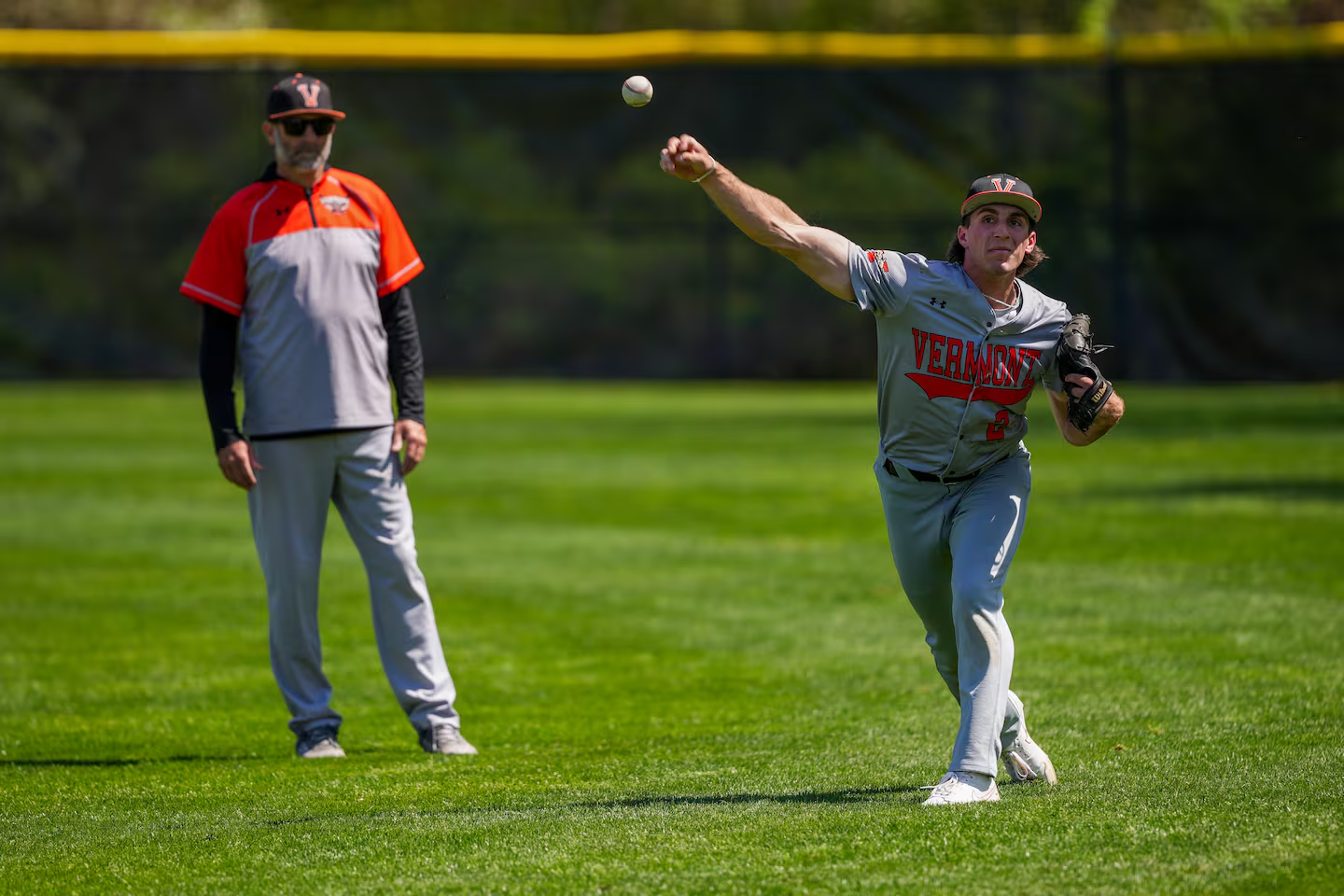
Mud roads, pedal boats, cornfields, and … Rick Porcello? A Vermont pitcher’s unlikely path to prospect prominence.
CONCORD, N.H. — Until a recent mid-May Saturday afternoon, several of the more than two dozen scouts who jockeyed for position behind the backstop at St. Paul’s School had never set foot in New Hampshire.
Read more Supreme Court rejects Meta’s appeal in Vermont social media addiction case
But then, there hadn’t been many pitchers like Vermont Academy righthander Kaiden McCarthy to prompt a visit.
Prospects almost never come out of Vermont, in no small part due to the short season that limits opportunities both for players to develop and for scouts to see them perform. McCarthy found a way to forge a path as a proud outlier.
“Vermont holds a special place in my heart. I was born and raised here, and I like to be able to show [scouts] I’m from Vermont and I love this place,” said McCarthy, who frequently rewarded scouts who made the drove the final 1½ miles down a muddy road to his house in Chester, Vt., with jugs of maple syrup. “Vermont’s not known for baseball that much, so it’s kind of cool to try and build a legacy here.”
How do you become a prospect when there’s little baseball infrastructure? For McCarthy, the answer came through creativity.
When McCarthy became curious about how hard he was throwing as a 10-year-old, a family friend in the police department drove to a local field in a cruiser, parked behind the backstop, and offered radar readings.
The righthander developed his arm strength by long-tossing with his older brother, Dylan (a Division 1 pitcher), on a cornfield down the road from their house. Over time, the two tracked their velocity like other kids track their heights, with Dylan using Post-It notes to track how hard he was throwing at different ages, and Kaiden opting for a white board on which he’d ‘X’ off each milestone and note the age at which he hit it.
He wanted to reach 65 miles per hour by age 11; instead, he topped 70. Other goals quickly fell — 85 m.p.h. in middle school, 90 m.p.h. as a high school freshman, 95 as an underclassman.
“He’s the ‘One-More’ Kid,” said his mother, Shanna McCarthy. “It’s always, ‘OK, that’s awesome. Now what’s next?’”
Those efforts were aided by strength gains forged in unusual fashion: Kaiden dragged a pedal boat up and down his driveway.
Eventually, McCarthy and his family committed to long hauls to seek more advanced training — two-hour drives in each direction twice a week to Latham, N.Y., in his early teens, and then three-hour hauls once a week to Coventry, R.I., this past winter, to work with UConn alum Mason Feole. He also spent summers playing travel ball in the south with the USA Prime National team.
“There’s no facilities around,” said Matt McCarthy, Kaiden’s father and the pitching coach at Vermont Academy. “So doing that stuff, he’s accustomed to it and it doesn’t bother him.”
Yet while innovation, doggedness, and a willingness to chase challenging levels of training and competition proved a hallmark of McCarthy’s journey to prospect status, the baseball world also came to him in fascinating ways.
Matt McCarthy went to high school with Red Sox VP of sports medicine services Brad Pearson. Pearson offered the McCarthys suggestions about exercise routines and throwing programs as they were growing up.
Just over 10 years ago, another remarkable intersection of worlds took place. For years, Red Sox chief baseball officer Craig Breslow organized Wiffle Ball tournaments in Essex Junction, Vt., as a fundraiser for his Strike 3 Foundation, which provides grants to support childhood cancer research.
In 2015, Red Sox pitcher Rick Porcello, a participant in the fundraiser, lined a ball to shortstop. Kaiden McCarthy, then 7 years old, shocked everyone by catching it.
“You realize, ‘Oh, an MLB player actually picked me up after I caught the ball and ran me around the bases,’ ” laughed McCarthy. “It’s the best memory I probably have as a child.”
That memory became a prelude. In retirement, Porcello — the 2016 Cy Young winner with the Red Sox — has settled in the Upper Valley region of Vermont, and he’s become a source of counsel to McCarthy and his family in recent years.
“It’s pretty crazy how things have kind of come full circle,” said Porcello. “I didn’t realize at the time that the kid was going to be the best high school baseball player in Vermont, and potentially a first-round draft pick. … I’ve seen him throw enough to know that he’s the real deal.”
It would be a surprise if McCarthy went quite that high, but he’s certainly a consideration for the early rounds of this year’s draft, helping to explain the scouting presence at the Lakes Region championship game on May 16.
With evaluators eyeing every movement of his pregame routine and aiming both radar guns and Edgertronic cameras on every pitch, McCarthy — working on a limited pitch count in the final high school start of his career — rewarded the pilgrimage with seven strikeouts over three no-hit innings. His fastball ripped through the zone at 95-99 m.p.h. (a couple of scouts had McCarthy touching 100) as the headliner of a four-pitch mix that also includes a curveball, slider, and changeup.
The outing was in line with McCarthy’s performance during his brief 2026 season. Over five starts, the righthander allowed two runs on three hits over 19⅓ innings while striking out 42 batters and walking six (five of which came in one outing). Despite the brevity of his season, McCarthy overwhelmed opponents and showed the mound attributes to justify steady scouting traffic to the Green Mountain State, and excitement about one of the bigger prep arms in this year’s draft.
“I would definitely say I haven’t been seen the most [of any pitching prospect], but I feel like what I’ve done in front of scouts, how I’ve performed, and how I’ve shown myself has definitely helped out a bunch,” he said. “It’s not the most [scouting attention], but I feel like I’ve made the most out of it.”
In July, McCarthy — a 17-year-old who reclassified as a high school senior this winter, thus becoming draft eligible this year; he’ll take part in MLB’s Draft Combine in Arizona in June — has a chance to become the highest drafted high school player ever out of Vermont, a mark currently held by 2021 fourth-rounder Owen Kellington. But McCarthy also has a compelling fallback opportunity to pitch at the University of Tennessee.
He’ll navigate the life-changing decision with his family and his representatives from Octagon Baseball — a choice that has almost never been afforded to a Vermont high schooler.
“Even when there’s three feet of snow on the ground, they’re over at the local rec center, going through bullpens and running pitching clinics,” said Porcello. “Just because it’s Vermont and it’s cold a lot of the year, it doesn’t mean that you can’t eat, sleep, and breathe baseball, and that’s certainly what I’ve seen come out of him and his family.”
Read more Trump gathers Cabinet as he looks to seal deal to end war that some backers worry will embolden Iran



Post Comment