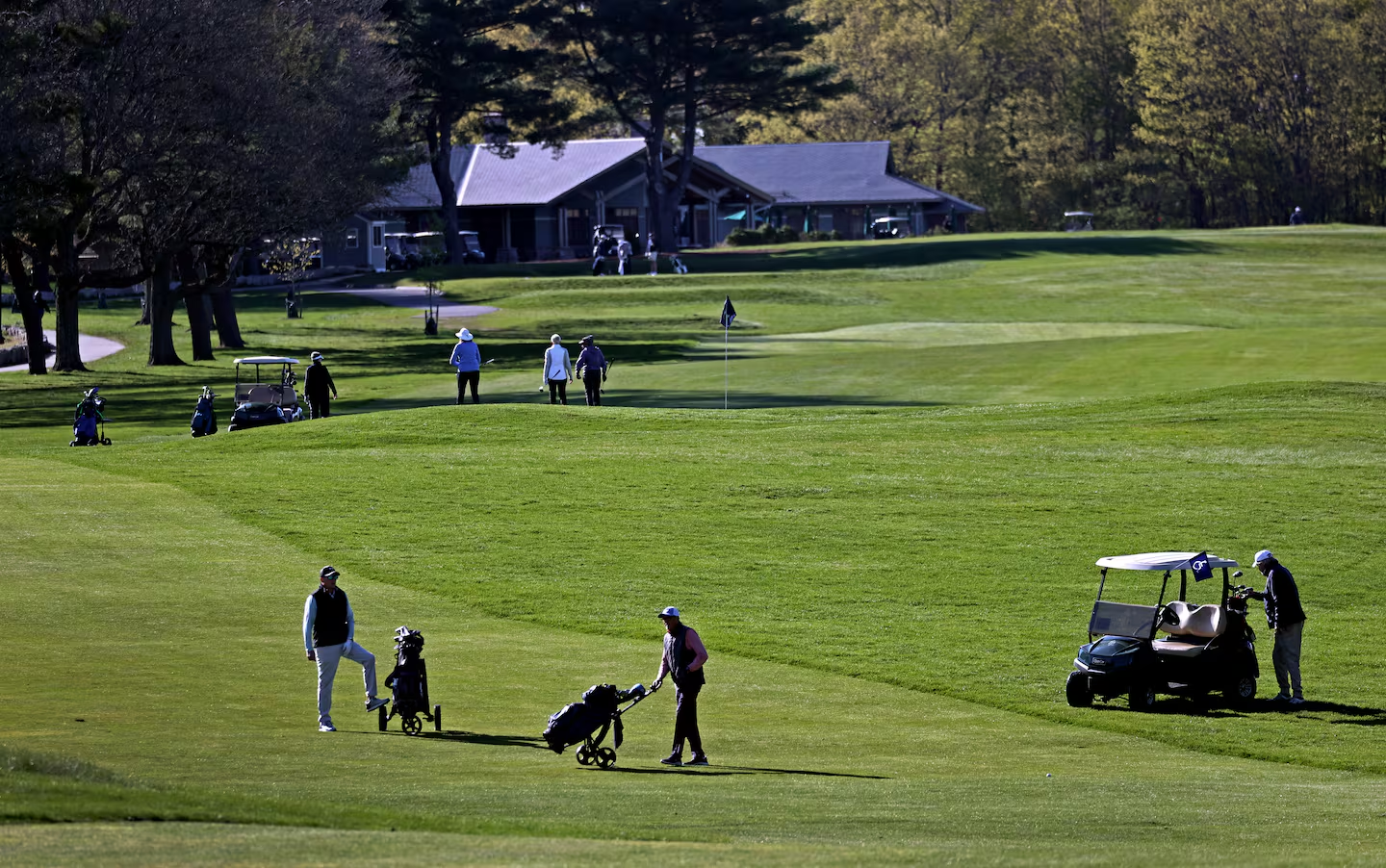
There are 36 golf holes in Boston. They are all owned by the city. And they are a treasure.
About 25 years ago, a golfer from Hyde Park started complaining about the conditions atthe city’s two golf courses. This is not a particularly unusual declaration for golfers, who will seize onany excuse for their poor play.
Read more In Massachusetts governor’s race, it’s the economy, stupid. For Healey, it’s abortion, too.
What was unique is that the man was Tom Menino, then the mayor of Boston, and so he pulled a very Tom Menino move. He fired the management company that was running the city’s municipal courses, George Wright in Hyde Park and the William J. Devine course at Franklin Park; put out bids for a new management company; refused all bids; and instead announced the courseswould be run by the city’s parks and recreation department.
More than a few people thought this was a disastrous idea.
“He said, ‘Fix the courses and stop complaining,’” Scott Allen, the city’s director of golf, recalled Menino barking at him on the phone in 2003. “So we did.”
Decades later, that directive from the late mayor has led to a remarkable Bostonsuccess story. Both courses are lauded by golfers for their great conditions. They’re economically self-sustaining, with each course turning a profit of roughly $1 million per year, according to Boston Parks and Recreation, which reinvests the proceeds in maintenance and improvements at the courses. And with handsome discounts for residents, they offer an affordable entryway for Bostonians to play the world’s most maddening game, which has exploded since COVID, especially outside its traditional “old white guys” demographic.
William Lodge, 65, has seen this himself. He’s president of the Franklin Park Men’s Inner Club, an organization whose membership of 80 golfersis mostly Black and Hispanic. He described the course as a welcominghome away from home for people from the surrounding neighborhoods who love the game.
“We call ourselves ‘the neighbors,’” Lodge said, “and it’s about more than golf, it’s about being there for each other and the community.” He saidthe golfers at the course have become noticeably more diverse in the game’spost-COVID boom.
Before COVID, each course hosted about 30,000 rounds per year, according to Allen. Last year, they each hosted more than 51,000.
“We cater to the middle class on down, though we get some highfalutins from Brookline trying to sneak in here occasionally,” said Joe Leary, the operations manager at George Wright, where a Globe reporter teed off early on a recent Friday morning for a hard-hitting assignment to play both courses in a single day.
Leary is what might be described as a character; he’s also the guy who has taught countless kids how to golf at the 42 free clinics he hosts at George Wright each year. In his thick Boston accent, he warned this reporter that the course makes people realize they are not as good as they think. He was correct.
The word golfers use to describe George Wright is “gem.” The other words they use are “wicked hard.”
George Wright was designed by legendary course architect Donald Ross, and under city management, has returned to a “championship” level. This is thanks in no small part to the army of teenagers they hire each summer — 40 at each course — and put to work bright and early, doing everything from filling divots to mowing greens to clearing brush. “We teach them to take pride in an honest day’s work,” Leary said, and many of those kids earn scholarships through a caddy scholar program. Some stay on to work full-time at the courses after graduating.
All that work was honored in 2018 with something unprecedented. George Wright became the only public course to ever host the prestigious Massachusetts State Amateur Championship, the 123-year-old tournament better known as the Mass Amateur. George Wright will host the men’s championship again in 2028. The women will play at Franklin Park, which has a 36-year-old women’s golf league that is so popular it has a waiting list to get in.
“The team at Franklin Park works really hard to make sure it is accessible to all,” said Julie Clifford, the president of the Fairway Ladies of Franklin Park, which has more than 100 women in its weekend league. “We have more and more women who want to play, and the course feels wide open to any age, gender, or ethnicity. We’re very fortunate.”
Read more Points leader Tyler Reddick on the pole for Coca-Cola 600 after rain washes out qualifying
To experience that “all sorts” character at each course, this reporter booked rounds where he would be paired with three random golfers. Hopefully not those highfalutins.
George Wright did not disappoint, for I teed off with a cigar-chomping retired insurance man named Tim McCarthy, who was playing alone and was sneaky good. And a guy from the Seaport named Derek Coburn, who was playing with his dad, Dana. After a few holes, Derek told me that his dad rarely plays, but he was able to lure him out for a special father-son round. That’s because Derek was getting married the next day.
“These courses are such a treasure for city residents,” Derek Coburn told me. “I can sneak out before work, get in 9 holes, meet all sorts of people, and they’re in great shape and very affordable.”
He was half considering sneaking out the following morning for a quick 9 before the wedding.
For city residents, 9 holes will run you $30 on a weekday or $35 on a weekend. A full 18 is $46 on a weekday and $55 on a weekend. If you are unfamiliar with golf pricing, this is a steal, and there are reduced rates for seniors and kids. If you’re under 18, a full round will cost you just $18 on a weekend, a buck a hole.
It’s the same price at the William J. Devine course at Franklin Park, where Jay Galiguis was working near the first tee box. He started there in a summer job when he was 15; he’s about to turn 45.
“I love this place because, rich or poor, everyone is allowed here,” he said. “We welcome all walks, especially kids and those people who just saw it on TV and decided they wanted to try.”
Franklin Parkis certainly the more beginner-friendly of the two city courses, with fewer trees and a wide-open layout that means less time in the woods hunting for balls. Hypothetically.
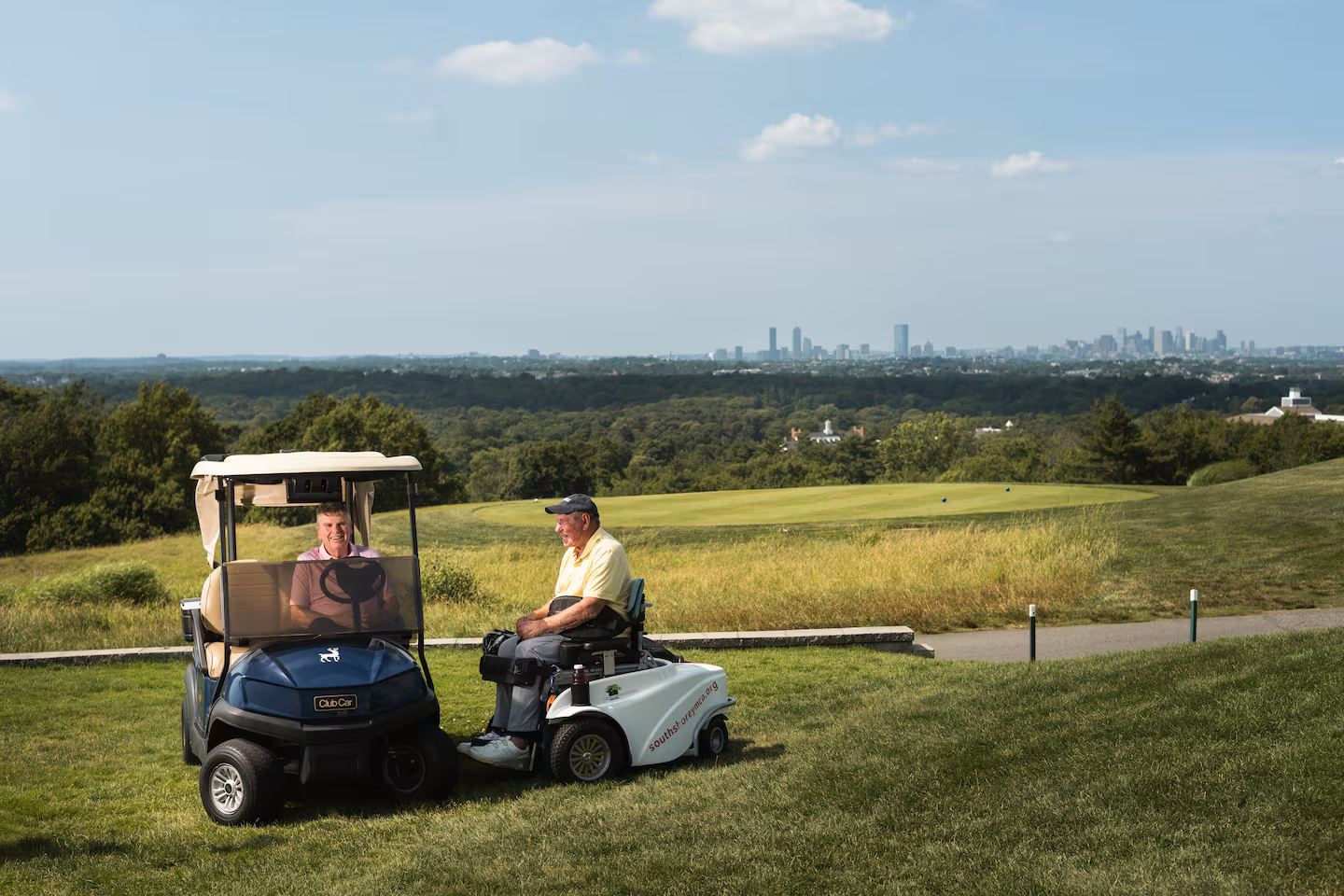
After I finished the 14th hole, one of the golfers I had been paired with, Jack Donius, stopped our group to take a moment and appreciate the view. “I don’t think there’s another golf course where you can stand in one spot and see this much,” he said.
We were up on a bluff, and from there you can see the downtown skyline over the trees. But that was not what he was talking about.
The Franklin Park course is so open that we could see nearly every golfer on the course, which meant we could see every variety of Bostonian in one view. Young and old. Men and women. All walks of life. Plus kids rolling down a hill, bicycles and scooters zipping through the park, and a neighborhood tailgate developing in the parking lot on a warm Friday afternoon.
Twenty-five years ago, a lousy golfer from Hyde Park declared that this place could be great. Today, this lousy golfer declares that it is.
Read more Scotland’s soccer connections to New England run deep


Post Comment