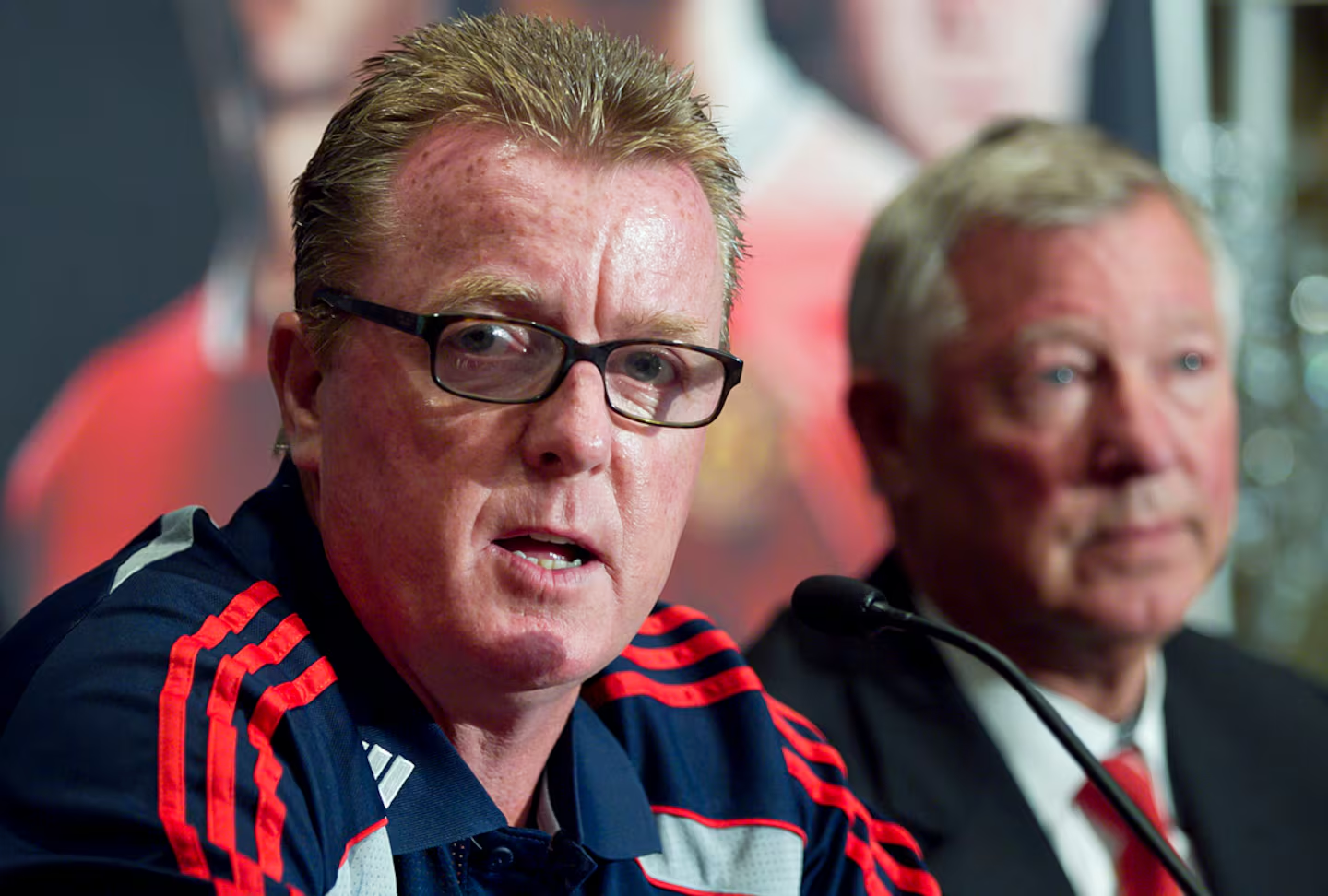
Scotland’s soccer connections to New England run deep
Scotland opening World Cup play against Haiti in Foxborough on June 13 will act as a reminder of the country’s influence on soccer in the United States and New England.
Read more George Russell clashes with Mercedes teammate Kimi Antonelli in Canadian GP sprint win
In the first World Cup in 1930 in Uruguay, the US team was coached by Scotland-born Bob Millar, who moved to the United States to play for J&P Coats and the Fall River Marksmen in the American Soccer League. The lineup included Scotsmen Andy Auld, James Brown, Jimmy Gallagher, Bart McGhee, and Alexander Wood. They were among more than 80 Scotland-born players to compete for the US men’s national team, from Neil Clarke (1916) through Stu Holden (2008).
The Scottish accent on the US game goes back to its origins in the late 1800s. According to Iain Campbell Whittle of The Scots Football Historians Group, textile magnate William Clark can be considered the “father” of soccer in the United States. Clark founded the Clark ONT (Our New Thread) team in 1883 in Newark, and served as captain in its inaugural game. Clark’s team won the first three editions of the American Football Association Cup, forerunner of the US Open Cup, and several of its players competed for the first US national team in 1885.
By the turn of the century, Scots probably outnumbered the English in soccer management positions and on the playing fields in New England. They kept the game alive year-round, setting up five-a-side games that emphasized precise passing at the Caledonian Games ($125 to the 1915 winner) in West Roxbury. They provided the backbone of the American Soccer League from 1921-31. The Boston & District League, one of the country’s top semi-pro leagues, listed 200 Scottish players on 1922 rosters, according to a Globe story. That’s along with the Boston area’s 10-team Scottish Clans League.
But the Scottish contribution — Whittle calls it “the Scottish inheritance” — transcends numbers. The Scots refined soccer, using subtle maneuvers to counterattack the direct, physical style of the English. Creativity and skill were emphasized, opening horizons for the game to expand. And the Scots didn’t just get style points — they outplayed England in the early years of the British Home Championship.
“There was disagreement over the best way to play,” said Tom McCabe, history professor at the University of Notre Dame in London. “You see the word scientific being used, and that means using geometry, angles, combination play, and, for that, it is the Scottish influence. Passing and moving, their particular brand of soccer. They were working class, in the mines, so they weren’t big, didn’t have the nutrition, didn’t do training on the side, like English gentlemen, who were men of leisure and had a better diet, time to train. It’s an interesting turning point in the evolution of the game. Scots even talk about Enlightenment ideas of community and work. Where the English game was more dribbling and violent, Scots have to show up for work, so they’re passing and moving.
“They’re on to something there. They saw the game differently. It was not just played on festival days, but a weekly thing. You’ve got to go to work the next day. So, there’s that element, and it’s more beautiful, a game with a kaleidoscope of options, constantly changing — rather than boot it and chase it, and dribble till you lose it. Scots see passing and moving, that’s our innovation, we brought that to the global game.”
Soccer might not be the same without Scottish influence. The game, Whittle said in an email, “was invented in England but raised by us to what we know today, a global phenomenon. No Scots, no soccer.”
Prominent Scottish players in New England:
Andy Auld: Scored twice in US debut in 1925; played for Providence Clamdiggers/Gold Bugs in ASL.
Barney Battles: Dual international (United States, Scotland). Grew up in Charlestown, played for Bunker Hill Celtics, Boston Wonder Workers, Hearts (holds the club season scoring record with 44 goals).
James Brown: One goal for the United States in the 1930 World Cup, played for Manchester United, started soccer program at Brunswick School (Greenwich, Conn.).
Charles Burgess: Coached Harvard to 1913 and ’14 intercollegiate titles; as Woodland Golf Club pro, mentored Francis Oiumet.
Gordon Burness: Dual international (Canada, United States). Teamed with brother Harry on Boston Wonder Workers and Lusitania Recreation of Cambridge.
Bobby Clark: Scotland 1978 World Cup; Dartmouth coach, won 2013 NCAA title with Notre Dame.
Neil Clarke: One US cap. Won three US Open Cup titles, lost in 1918 final with Fall River FC.
Read more Si Woo Kim hangs on to Byron Nelson lead, with Scottie Scheffler, Wyndham Clark chasing
George M. Collins: Boston Globe soccer editor (1914-50); managed US team in 1924 Olympics.
Tommy Fleming: Played for Fore River Shipyard; won four US Open Cup titles with Bethlehem Steel; ASL titles with J&P Coats, Boston Wonder Workers; coached Quincy High School to 1932 New England championship.
John Gilchrist: Scottish international; Celtic FC, Fore River.
Billy Gillespie: Played for, coached (and worked at) General Electric in Lynn; ranks 10th on Manchester City all-time scoring list (132 goals).
Malcolm Goldie: One US cap; Bethlehem Steel, combined with Archie Stark (record 67 goals in 1925-26 season); coached MIT 1933-41.
Bill Harper: Scottish international goalkeeper; Arsenal FC; Boston Wonder Workers; Fall River Marksmen; New Bedford Whalers.
Joe Kennaway: Dual international goalkeeper (Canada, Scotland). Providence Gold Bugs, Fall River Marksmen, Celtic FC (1931-39). Coached Brown University (1946-59).
George Lambie: Refereed three American Cup, three US Open Cup finals.
Jackie Lyons: US international (1928 Olympics); Fore River.
Jock Marshall: Dual international (Scotland, United States), captained Scotland in early 1920s. Yale coach (1950-65), final game with Bulldogs 6-3 win over Harvard on John Kerry hat trick.
Alex McNab: Dual international (Scotland, United States). Mentored 19-year-old Billy Gonsalves on Boston Wonder Workers front line in winning 1928 ASL title. McNab, Bill McPherson, and Gonsalves (considered among best all-time US players) combined to win six successive US Open Cup titles.
Alexander Meiklejohn: American FA treasurer, AFA Cup competitor; played for George Wright team on visit to Niagara for games of Canadian ice hockey/American ice polo (January, 1895); Brown University ice polo team center; captain All-Rhode Island XI v. Australia in 1913 cricket test match; Amherst College president (1912-23); 1963 Presidential Medal of Freedom.
Bob Millar: J&P Coats and Fall River in the ASL; played for the United States in 1925, coached the United States in the 1930 World Cup.
Tommy Muirhead: Scotland captain, played for Boston Wonder Workers in 1924, their initial season.
Steve Nicol: Scottish international, won 1984 European Champions Cup with Liverpool FC; Revolution coach 2002-11.
Andy Stradan: Converted a penalty kick in 1-0 win over Estonia in Paris, US Olympic team’s debut; played for Fisherville and Fore River.



Post Comment