The World Cup was beautiful, but soccer’s rules could use some improving
Dear Soccer,
Congratulations on completing the 23rd FIFA World Cup. For five weeks, the beautiful game overtook the United States and opened our eyes to a compelling tournament and an international soccer scene full of joy and wonderment.
Read more Rested Revolution return to action after nearly two-month break on Wednesday
It was also, for many of us Americans, the most we have ever paid attention to the sport. And it exposed a few aspects of the game that could use, I want to say “fixing,” but let’s use “improving” to be more positive.
I’m not even talking about the areas of soccer that Americans have long mocked, such as the incessant flopping or absence of a fixed clock. I accept them as part of the fabric of the sport, particularly the clock.
I’m talking about rules that affect fairness. About introducing a little gray area to a rulebook covered in black and white. Adding a little offense to a tournament that averaged 2.96 goals per match (2.89 if you remove that ludicrous third-place game). Reducing the impact of arbitrary decisions by the referee and VAR. Making sure the punishments fit the crime.
The area that drove me bananas throughout the World Cup was the application of offside. Obviously, no one wants cherry-picking. But it is preposterous that several goals were taken away because VAR determined that a pinkie or toenail was offside. And that the ball can be inside the goal box, yet a player can still be deemed offside if he is behind the second to last defender. Soccer is the only sport that rewards the defense for getting caught flat-footed or losing track of the offensive player behind it. Imagine the NFL wiping off a 20-yard touchdown because the wide receiver got behind the final defender before the quarterback threw the ball. It’s anti-fun.
The way hockey does offside is far superior. The puck has to enter the offensive zone first, but once it does, players can skate freely. Soccer could easily do this — just create, say, a 30-yard line, and once the ball crosses, players can roam where they please.
Globe colleague Amin Touri, who knows futbol like I know football, believes this would lead to defenses packing it in near the goal and actually decrease scoring. I tend to think hockey-style offside would still prevent cherry-picking but lead to more creative offense, and perhaps more space to shoot at the top of the box. I’d love to see this settled on the pitch in a lower level of soccer, like how the UFL serves as a testing ground for the NFL.
That’s wishful thinking, of course. I fully understand soccer is not going to make wholesale changes to one of its bedrock rules.
But FIFA should adopt new language and a new standard for offside, because the current iteration is too heavy-handed, particularly with the absolute standards introduced by VAR. Hockey, again, is the better model.
In soccer, the standard is, “If anything is off, it’s offside.” In hockey, it’s, “If anything is on, it’s onside.” As long as any part of the body is onside, even a toe, the play is good.
Again, it maintains the integrity of the rule — no cherry-picking — but gives the benefit of the doubt to the offensive player rather than the defense. Yes, sports are entertainment, and scoring is more fun for fans than not scoring.
Read more What a Troy Jackson vs. Susan Collins Maine Senate race matchup might look like
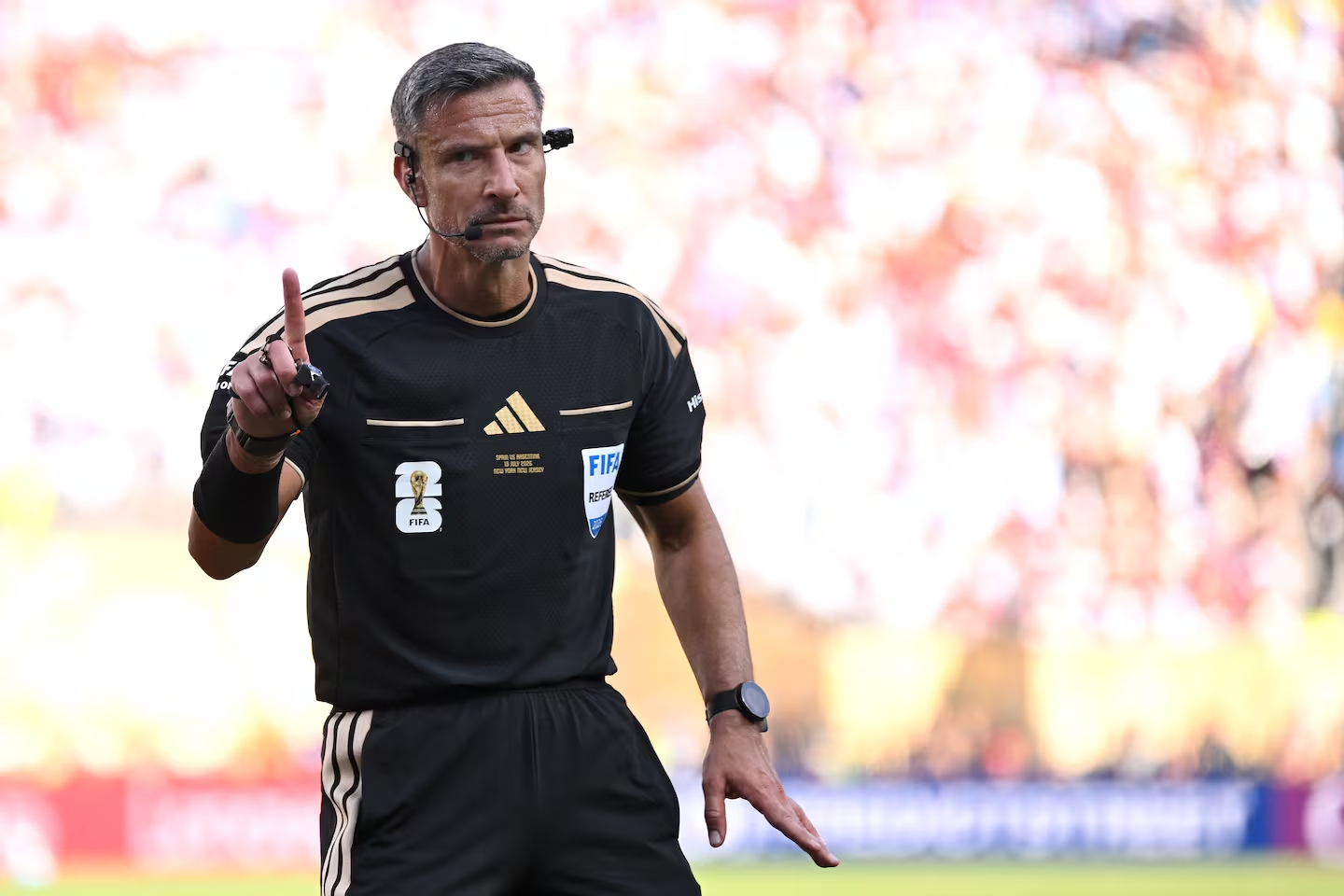
In Sunday’s World Cup final, the referee was correct to waive off Spain’s second goal because Ferran Torres was offside by a head and shoulder, but that should have been a highlight-reel goal. Torres’s feet were even with Argentina’s defender, and he didn’t have an unfair advantage.
Now that we’re at it, the penalty rules are insane, too. There is little differentiation between incidental and egregious penalties, clean or dirty.
The punishment for a foul inside the box, a free kick from 12 yards with a success rate between 70-80 percent, is out of proportion with the crime, especially considering how hard it is to score.
It’s absurd that Spain’s Lamine Yamal can come crashing into a play with no chance of scoring, yet receive a penalty kick (which Mikel Oyarzabal converted) because a French defender unwittingly kicked Yamal below the waist during a clearing attempt.
At minimum, soccer needs to introduce more penalty outcomes inside the box. Cheap fouls or those that inhibit an immediate scoring chance should result in a penalty kick (again, like hockey). But coincidental fouls should result in a PK from the perimeter of the box (18 yards) or even an indirect kick.
The red card punishment is overly harsh, too — the player gets kicked out of this game, plus the next game, and his team has to play a man down for the rest of the match.
A red card instantly tilts the balance of the match, making it nearly impossible for a man-down team to break a tie or come back. Kick the player out of the match, but allow his team to replace him at some point, especially since several yellow and red cards weren’t called in real time and were only assessed using instant replay.
Stop me if you’ve heard this before, but hockey gets it right. It awards penalties and power plays but doesn’t make a team play a man down the entire game, out of a sense of fairness.
Most or all of these suggestions will be dismissed as the rantings of an ignorant American who hates soccer. But I thoroughly enjoyed the World Cup and watched it with impartial eyes.
It’s OK to acknowledge that something good can still improve. Soccer is a beautiful sport, but its rules need a little help on the margins with fairness and encouraging offense.
Read more How did Patriots quarterback Drake Maye spend his offseason?





Post Comment