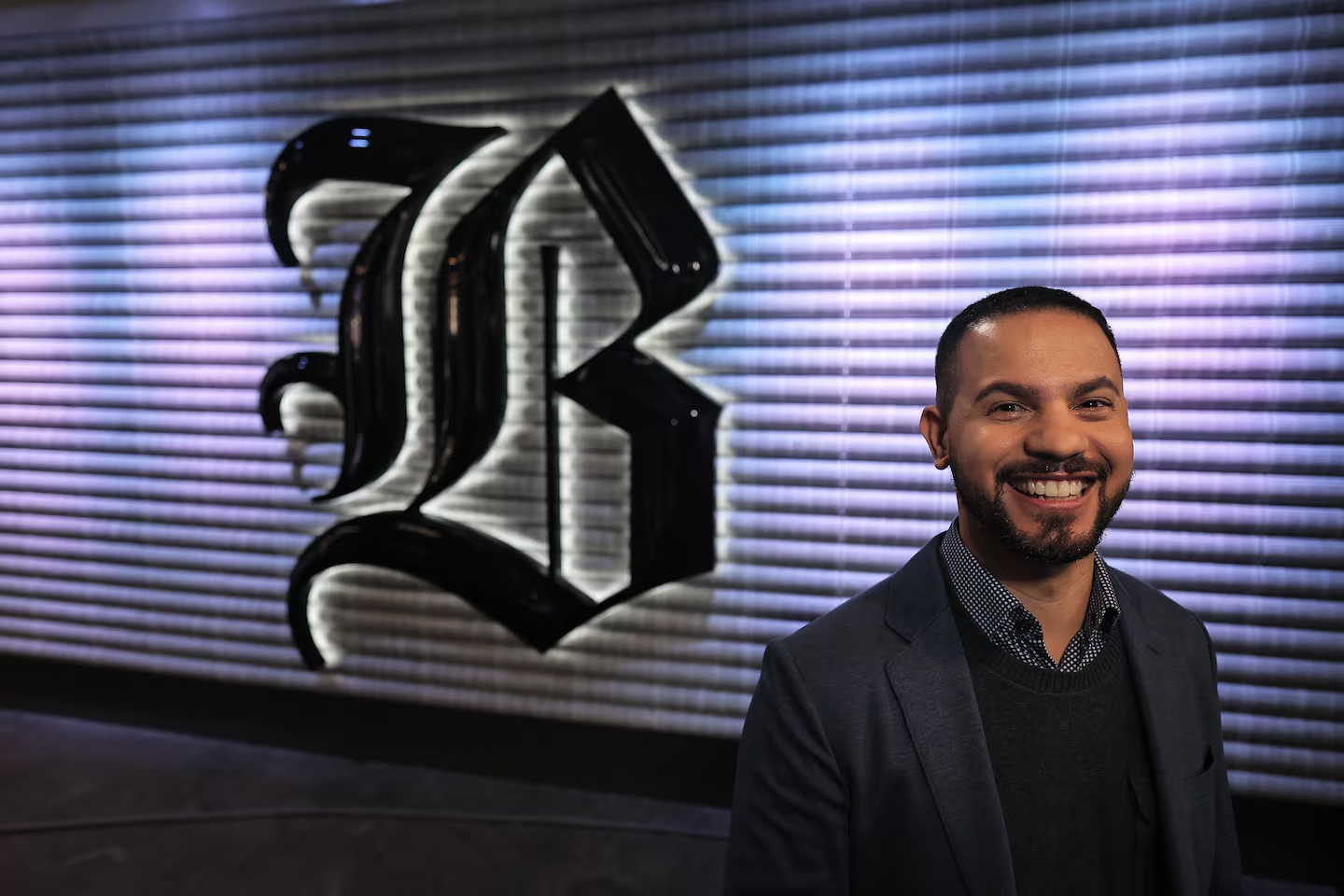
Globe’s Christopher L. Gasper details his cancer surgery and recovery: gratifying, rewarding, humbling, and eye-opening
The sportsosphere loves a comeback story. I just never thought I would be writing about my own.
Read more Miami picked as preseason ACC football favorite; Bill Belichick’s North Carolina 15th and BC 16th
Returning to work after a more than six-week absence because of June 2 surgery for prostate cancer has been gratifying, rewarding, humbling, and eye-opening. It feels familiar and foreign at the same time, mirroring my body. I’m still me, but different — changed, chastened, more sanguine.
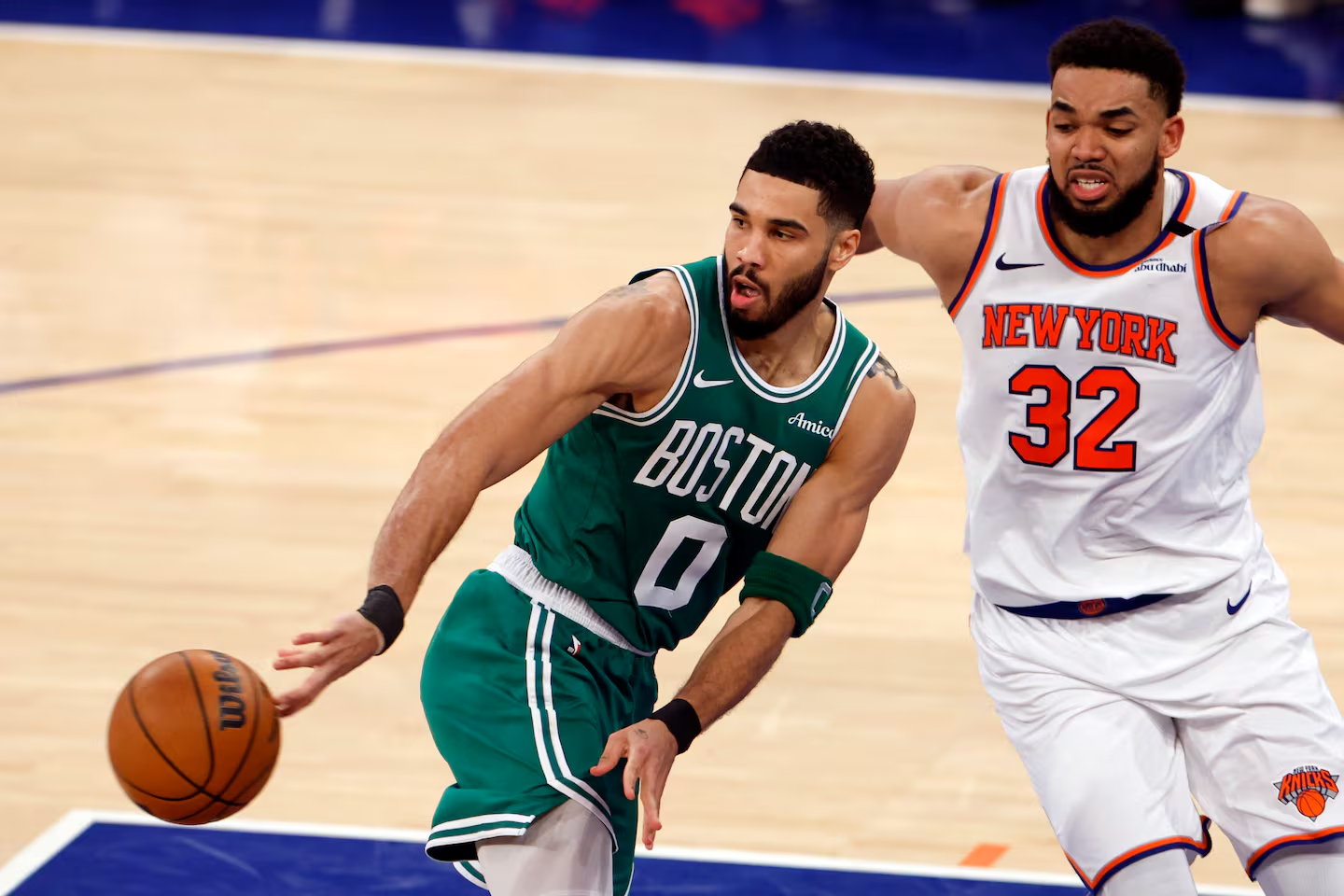
I find myself brimming with empathy for athletes who suffer serious injuries and get taken away from their livelihoods such as Celtics star Jayson Tatum, who sat out for 298 days while rehabbing a torn Achilles. Your vocation and identity are snatched from you. The realization sets in that the pursuit you made the center of your world just goes on without you. You wonder when, and if, you’ll return to who you were.
Your world gets small. Simple functions that you once took for granted — in my case, bladder control, sitting upright, traversing up and down stairs — become daily tests of willpower and pain tolerance, then celebrated milestones.
I received an outpouring of support from family, friends, colleagues, former athletes, fans, and fellow prostate cancer patients, including dozens of Globe readers. Yet, there were times I felt completely isolated, propped up in bed watching a World Cup I couldn’t cover, unable to opine on the Jaylen Brown trade, or filled with thoughts about the Red Sox’ remarkable resurgence instead of the book I was reading.
Like every athlete, I was confident I would beat the 4-6-week timeline for returning from my prostatectomy, performed by Dr. Douglas Dahl of Massachusetts General Hospital — my Drake Maye. Nope. It took me about 6½ weeks.
However, I drew inspiration from my experience covering sports. I thought about folks such as Bill Belichick, Tom Brady, Kevin Garnett, Kobe Bryant, and Patrice Bergeron, trying to channel their resolve and determination.
When I left Newton-Wellesley Hospital (shoutout to the wonderful nurses, even the one Giants fan), they wanted to wheel me out in a wheelchair. I thought, what would Brady or Kobe do? Pridefully, and perhaps foolishly, I walked out with my rapidly filling leg bag, flooded by a catheter, strapped to my thigh and the empty wheelchair trailing behind me. Unfortunately, there was a glitch at the parking garage payment kiosk that delayed my wife. Minutes turned to months, but I made it.
In the early days at home, I walked gingerly in my pajamas, wearing a path on the narrow hallway hardwood floor like a convalescent King’s Guard patrolling outside Buckingham Palace. Back and forth, I forced myself. Instead of a bayonet, I was holding a Foley bag filling with my micturition. (This is one time there’s no complaining about sending you to the dictionary.)
Rather than the changing of the guard, there was only the changing of my Foley bag by my wife, Elizabeth, who did all the dirty work (literally). Luckily, my wife is a nurse by trade and very caring and patient by nature. Elizabeth, you’re the real MVP.
This recovery continues to test my patience.
But I’m thankful for the newfound perspective it has provided. One of the reasons I agreed to write this is that with all that time to think, I realized I was in denial about my cancer and my health for a long time. I used work as an excuse to put it in a box and delay deciding on a treatment.
Call this the downside of emulating the single-minded focus of sports figures. Prostate cancer is highly curable when detected early, so like Belichick winning a coin toss, I simply deferred.
Read more Draymond Green agrees to a 1-year, $27.7M contract to remain with the Warriors, AP source says
The 2025 Patriots season became a built-in excuse to stiff-arm choosing an avenue of serious treatment — radiation or surgery. After getting diagnosed last summer, I was under “active surveillance.” I convinced myself I couldn’t do anything until the season ended.
But I felt drained covering Super Bowl LX in the San Francisco Bay Area and after that. An April MRI revealed my cancer had spread and my Gleason score had climbed. No more delaying or denying. It spurred a robotic laparoscopic radical prostatectomy.
The surgery removes the prostate while sparing the vital nerves around it that play a part in sexual function. As Globe colleague Mark Shanahan, who wrote a much more eloquent account of dealing with prostate cancer, detailed, as recently as the early 1980s every prostatectomy led to impotence.
Shanahan was part of a prostate cancer brotherhood that helped guide me before and after my surgery. That group includes former Boston mayoral candidate Josh Kraft, who does tremendous prostate cancer advocacy. (His brother, Kraft Group president Jonathan Kraft, helped connect me with Dr. Dahl at MGH.)
Unfortunately, there’s still a stigma around prostate cancer and trepidation about testing, especially for “younger” men. The old bromide goes that more men will die with prostate cancer than from it. I got it at age 45, a game-changer.
In an email, Dr. Dahl shared research showing that from 1990 to 2022 there was a 70 percent increase in prostate cancer diagnoses for those ages 20-54.
“Recent studies have confirmed a benefit to screening, particularly in younger men,” said Dr. Dahl. “… There is substantial risk of loss of life and loss of quality [of] life, particularly in younger men who do not get diagnosed at a curable stage. Screening should ideally begin for men in their 40s with significant risk factors, and at 50 for most other men.”
Thankfully, my since-retired primary care physician at Boston Medical Center, Dr. Warren Hershman (an avid Celtics fan), was adamant about screening at 45, given my ethnicity and family history. If sharing my experience spurs just one person to seek prostate cancer screening, then this column was worth it. It’s a simple blood test.
Starting in September, I have prostate-specific antigen (PSA) tests to determine if the surgery got all the cancer. Further treatment could be required: radiation and/or hormone therapy. One. Day. At. A. Time.
But I’m back with a newfound appreciation for and perspective on sports. There are always more important victories to recount.
Read more In first game since the All-Star break, Sun drop third straight


Post Comment