Employers face another unemployment tax rate hike as Healey slow-walks a financial fix
Welcome back to Trendlines. The secret password is “flock.”
New Federal Reserve chair Kevin Warsh would like financial markets to react to economic data without explicit guidance from the central bank on its future plans. Investors are doing just that, pushing the yield on the 30-year Treasury bond to 5.21 percent on Thursday, a 19-year high. With Warsh staying mum, investors are drawing their own conclusion: inflation is a problem and they’re not sure how the central bank will respond.
Read more AI data centers in space? A system to cool chips could help.
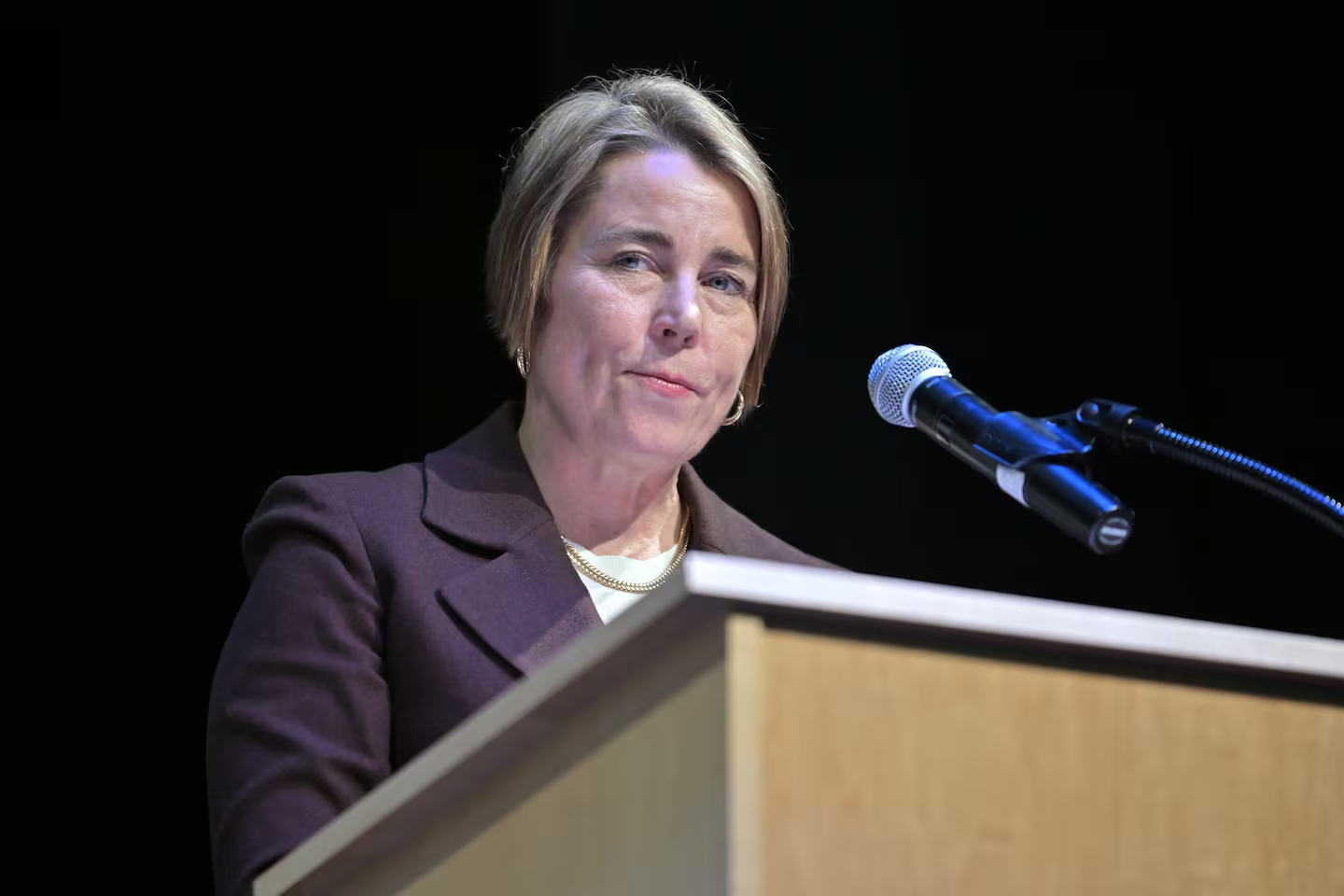
Today, Governor Maura Healey vowed 18 months ago to work with business leaders to bolster the state’s financially shaky unemployment insurance system. She has yet to offer any reforms. Plus: that ’70s pickup truck. But first…
➡️ The Latest
- Traffic surveillance cameras are drawing a fierce privacy backlash across Massachusetts.
- US economic growth slowed to 1.5 percent in the second quarter as a decline in net exports offset strong consumer spending.
- Devens-based Commonwealth Fusion Systems, one of the leading startups racing to perfect clean fusion energy technology, raised $1 billion in new funding.
📉 No action
It was January 2025, and Governor Maura Healey had just hit employers with bad news: they were on the hook for $2 billion to resolve a jobless claims blunder made by the previous administration.
To soften the blow, she vowed to work with business leaders on proposals to overhaul the state’s financially shaky unemployment insurance system. Massachusetts employers often cite high unemployment taxes — which fund some of the nation’s most generous benefits — as an obstacle to job creation.
At the time, I cautioned that meaningful change was unlikely because there was scant consensus among employers, labor, and lawmakers on how to fix the safety-net program, even though all sides agreed it was broken.
And sure enough, 18 months later, with the threat of AI job losses looming, the governor has put no reforms on the table and employers face yet another tax increase triggered by declining unemployment trust fund reserves.
“There have been off-the-record meetings with interested parties in attendance. . . but to date no recommendations, no report,” Jon Hurst, chief executive of the Retailers Association of Massachusetts, told me in an email.
Why it matters: Now is the time to bolster the unemployment system’s finances — while unemployment is low by historical standards and potential AI-related layoffs are in the future.
Local employers pay higher unemployment tax rates than their counterparts in most other states, but they’re still not enough to cover benefits. It’s a structural deficit — $970 million last year alone — that Healey, like Charlie Baker before her, seems in no rush to close.
Asked about the lack of progress on reform, a spokesperson for the Executive Office of Labor and Workforce Development said the administration “continues to engage key stakeholders while it works to identify long-term solutions focused on the stability of the [unemployment] trust fund and the system as a whole.”
The big picture: Most economists don’t expect AI to cause widespread unemployment, but some jobs are more vulnerable than others.
These include relatively high-paying fields such as software development, accounting, finance, and law — all big sectors in the state.
Since weekly benefits are pegged to a laid-off worker’s income, an increase in job cuts among higher-paid workers would drain the unemployment trust fund more quickly. So would longer stretches of unemployment, which might be the case if AI permanently disrupts specific occupations.
The state projects the will drop into the red by the end of 2028. But that estimate assumes a relatively stable unemployment rate — that is, no recession or AI Armageddon.
Rewind: During the crush of COVID layoffs, the state inadvertently tapped $2.5 billion in federal money to pay jobless claims that should have been covered by the unemployment trust fund.
After negotiating with the feds to lower the amount owed, Healey said the trust fund would have to repay about $200 million a year for 10 years.
Employers were livid. They don’t want to put more money into the system until the state lowers unemployment benefits to be more in line with other states and makes it harder for people with erratic work histories to qualify.
The governor knew she had to offer the prospect of relief.
“This presents an opportunity for us to come together and have those conversations about what needs to happen with [unemployment] going forward,” Healey said after the repayment deal with the federal government was announced.
Employers were skeptical; Beacon Hill had repeatedly broken promises to fix unemployment. Today, they are angry.
“Very disappointed to see no action taken yet,” Christopher Carlozzi, Massachusetts director of the National Federation of Independent Business, said in an email.
Read more UEFA members to boycott FIFA competitions in protest of World Cup private investors plan
Final thought: The state has improved unemployment operations.
The Department of Unemployment Assistance, which handles claims, rolled out a new online benefits system, cut telephone wait times, and reduced incidents of fraud. However, it still struggles to process claims within the 21-day window the US Department of Labor considers timely.
But the politics of unemployment benefits reform are difficult. Reducing payments and eligibility — the two obvious places to start — will never be popular among voters, even if the trust fund is running out of money.
Beacon Hill has kicked the can down the road for years. It’s going to take a fiscal crisis to spur an overhaul.
🎙️ On the Record
“Imagine being so bored with life that you spend your pastime trying to report a photo on [Instagram] that makes you feel uncomfortable.”
— A post on the Instagram page of Four Winds Craft Guild, a Nantucket craft retailer, after the social media platform took down an earlier company post of a “No Influencers” sign at the store. The original post created a viral controversy, with some influencers claiming the sign is discriminatory and puts down an entire industry.
🏛️ The Fed
Status quo: The Federal Reserve on Wednesday kept interest rates unchanged despite growing pressure to more directly tackle inflation after five years of overshooting the central bank’s 2 percent target.
🏥 Hospitals
Treatment plan: The Legislature is poised Thursday to approve the state’s seizure of Norwood Hospital by eminent domain, clearing the way for a new owner to finish rebuilding it.
Case study: Mass General Brigham fumbled the merger of its flagship hospitals, a former executive wrote in a commentary published in the journal Academic Medicine.
Hush money: Cerberus Capital Management, the former private equity owner of bankrupt Steward Health Care, agreed to pay creditors an undisclosed sum as part of a settlement whose details are sealed by court order.
🍴 Food Scene
Yes, chef: Barbara Lynch, once hailed as one of Boston’s most influential chefs before the collapse of her restaurant empire, is putting together a new business that will offer intimate dinners at her home, a recipe subscription series, and culinary travel tours.
It’s a wrap: Boloco, the Boston-based burrito chain, said it would close its last remaining location, at 50 Congress St. in the financial district.
Last call: Hennessy’s Bar, an Irish pub near Quincy Market in Boston, served its final beers Tuesday after 30 years in business.
💼 C-suite
Kicked upstairs: PR maven George Regan said he would lighten his day-to-day responsibilities at his eponymous Boston firm, remaining chairman while promoting general manager Christian Nakkashian to president.
Trading spaces 1: Greenberg Traurig LLP will move to the new South Station Tower from One International Place, where it has operated since the firm opened a Boston office in 1999.
Trading spaces 2: Panera Bread will relocate its headquarters from the St. Louis area to Weston next summer, as it pursues a turnaround plan.
🔢 By the Numbers
$8 million
— The cost to rebuild and reposition the famed Citgo sign in Kenmore Square.
🛻 The Closer
Are you looking for an electric pickup truck but can’t afford a Rivian or a Cybertruck? The Globe’s Aaron Pressman recently took the Slate EV pickup for a test drive. It’s a two-door, no-frills model with a 1970s vibe and a list price starting at $24,950. Aaron writes:
Getting out on the road, the Slate doesn’t feel cheap. With a range of 205 miles and a claimed zero-to-60 mph time of 8 seconds, it matches the specs of EVs that cost thousands more. The ride is smooth, even over some bumpy Rhode Island beach roads, but not exactly nimble or sporty.
The Slate is getting attention: about 180,000 people have placed nonbinding reservations, and 10,000 people put down nonrefundable deposits of $250 to $300 in the first two hours after the company opened pre-orders last month.
📆 On this date in 1965, President Lyndon B. Johnson signed the Social Security Amendments of 1965, which led to the creation of Medicare and Medicaid.
Read more Trump says he may pull Blanche’s attorney general nomination until dissenting senators leave office
👋 Thanks for reading. Trendlines will be back on Monday.
✍🏼 If someone sent you this newsletter, you can sign up for your own copy.



Post Comment