Black residents upset at Wu’s policies are directing their ire at a new target: Boston city councilors of color
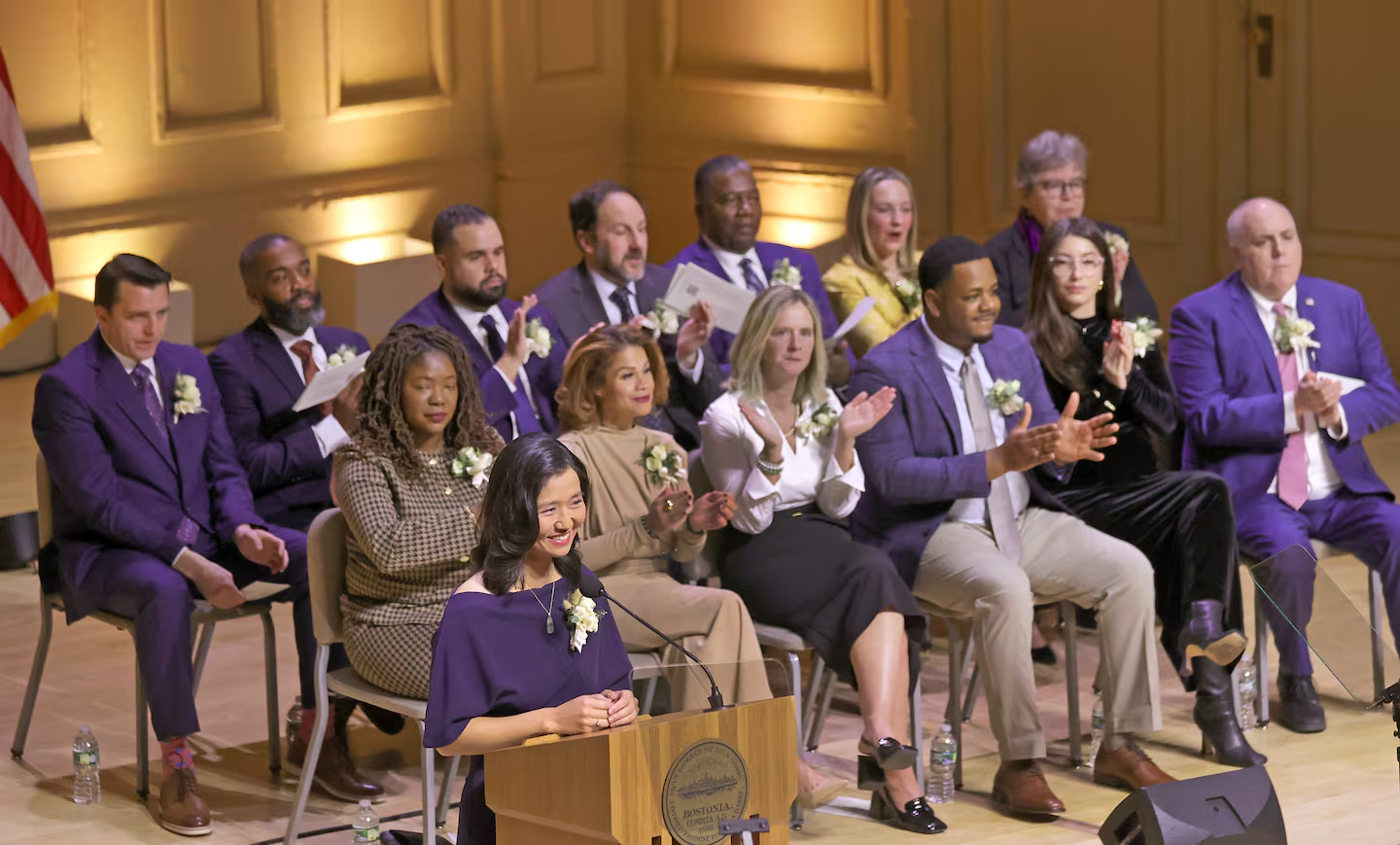
It was billed as a town-hall-style community event, but perhaps felt more like a prosecution for the six Boston city councilors of color in attendance.
Read more Iran and the US are at an impasse ahead of Trump’s China trip
Seated in the front rows of an auditorium at Roxbury Community College one evening in April, the six found themselves on the receiving end of a grilling about their voting records and their stances on some of Mayor Michelle Wu’s more controversial initiatives that have angered parts of the city’s Black community.
“We have had enough as the Black community,” Mac Hudson, an organizer and Mattapan resident, said as councilors Ruthzee Louijeune, Julia Mejia, Henry Santana, Enrique Pepén, Brian Worrell, and Miniard Culpepper looked on. “If you continue on this path, we will work against you. We will make sure we do everything possible to get you out of your seats.”
The tension — and outright political threats — underscored the escalating frustration bubbling up in pockets of the Black community. Among the sore points are the mayor’s push to redevelop White Stadium in Franklin Park, redesign Blue Hill Avenue, block the return of an elected School Committee, and try to relocate the John D. O’Bryant exam school from Roxbury to West Roxbury, which Wu ultimately walked back.
Some prominent Black political activists have long chafed at what they view as Wu trying to sell Black residents on her policies rather than develop initiatives with them from the start.
Wu, in turn, has touted efforts to build collaborative relationships with community leaders and city councilors. And despite those criticisms, she enjoyed deep wells of support in the election last year, easily dispatching challenger Josh Kraft. Although Kraft aggressively courted Black voters, Wu won three out of every four votes in wards 12 and 14, considered the heart of the city’s Black community.
Still, frustrated activists are now going beyond focusing on the mayor, and arebringing pressure on her allies of color on the council, namely Louijeune, Pepén, and Santana, whom they accuse of advancing her agenda without sufficient scrutinyor pushback.
“We want them to be a check on the mayor’s power, and [vote] based on our interests, not hers,” said Rodney Singleton, a Roxbury native and longtime community advocate. The councilors of color, Singleton said, “more than anyone else, should understand our pain.”
For much of the forum, the councilors listened as residents aired their grievances. Exclamations of support or outrage regularly filled the room of some 120 attendees.
Culpepper, the councilor whose district includes Roxbury and parts of Dorchester, Fenway, and the South End, later told the Globe that the frustration Black residents have with elected leaders is valid, and appears widespread.
Candidates “run for office . . . standing for the most vulnerable at the ballot box,” he said. “But then when it comes to the administration and the council floor, [some] buckle.”
Three of the six councilors of colordid not respond to repeated requests for comment for this story. Louijeune declined an interview request. But last fall during the city election cycle, she said councilors still hold the mayor accountable even if they don’t oppose or actively try to undermine her agenda, pointing to changes they made to Wu’s 2025 and 2026 budget proposals.
Louijeune has also at times broken from the Wu-allied bloc of councilors, including voting for a symbolic, nonbinding resolution early last year to halt Wu’s White Stadium project.
Wu’s office defended her record representing Black residents, noting her administration has invested money to support Black businesses, jobs for Black youth, and housing.
In each instance, said Michael Osaghae, a Wu spokesperson, it’s come with “direct input from residents and a comprehensive community engagement process.”
To be sure, like any constituency, Boston’s Black voters are not a monolith, and Wu’s supporters argue that her vocal group of critics does not necessarily represent the opinions of the majority of Black voters.
State Representative Russell Holmes, a Mattapan Democrat who backs both the mayor’s Blue Hill Avenue and White Stadium redevelopments, said he believes working with Wu — particularly in cases when the votes aren’t there on the council to overrule her — is a more effective way for councilors to deliver results.
Read more Democrats vow to fight $1 billion Senate security proposal for White House ballroom
“Holding the mayor accountable cannot simply just be for show,” Holmes said. He said elected officials, the councilors included, ultimately have to listen to all their constituents, not just the naysayers. “I wouldn’t want my city councilor standing up just to be obstructionist.”
Still, many Black residents say they are stillupset Wu vetoed a bill that would have converted the appointed School Committee to an elected one, despite overwhelming approval by voters in 2021 for the change. They also saw Wu’s proposal to move the O’Bryant, the city’s most diverse exam school, to the mostly white neighborhood of West Roxbury as a critical misstep, one Wu later reversed in response to intense backlash.
Several influential Black leaders also remain adamantly opposed to Wu’s effort to redevelop Boston Public Schools’ White Stadium in partnership with a professional women’s soccer team. And Black residents continue to be split on the $160-plus-million plan to overhaul Blue Hill Avenue, because the federal and state funds backing the project are contingent on the design including a controversial center-running bus lane.
Most recently, Wu sparked an uproar in the Black community when her administration announced its plans to cancel a long-stalled but community-backed lab and affordable housing project on a large plot of land in Roxbury known as P3. Instead, she proposed using the site as a potential location for a new Madison Park Technical High School.
But developments at the start of the year particularly rankled Black leaders. Those who spoke to the Globe all pointed to the vote for president of the City Council in January as a key motivating factorto mobilize to hold councilors’ feet to the fire.
The morning of the vote, former state senator Dianne Wilkerson, a leader of the coalition seeking to hold the councilors accountable, said she was sure Worrell would be the next council president, which would make him just the second Black man ever to hold the title. Councilor Gabriela Coletta Zapata, the front-runner who had claimed she had the votes for weeks, unexpectedly dropped out the night before — after three of her supporters defected to Worrell, who then became the only candidate still in the race.
Worrell, whose district includes parts of Mattapan, Dorchester, and Roslindale,had pitched himself as a leader “independent” of the mayor, and built a coalition of support that included her most outspoken antagonists on the council. He is considered well-respected by his peers for his prior leadership of the council’s budget-making committee.
Instead, a white woman,Councilor Liz Breadon narrowly emerged as president after two Wu-allied councilors convinced her to run on the eve of the vote. Three councilors of color — Louijeune, Pepén, and Santana — backed her over Worrell.
“It was a community-wide slap in the face,” Wilkerson said, likening it to a public humiliation of a Black man and the many Black residents who were excited to see him in the leadership position. “I don’t think that the councilors who didn’t support him understood the concern, the anger about what happened.”
Worrell did not respond to requests for comment.
The politicking for the presidency typically happens behind closed doors and well in advance of the vote. But it was unusually public, last minute, and messythis year, and left some councilors frustrated and surprised by the outcome.
“It felt like it was rigged from the get-go, so I was happy to see the pushback from [the] community,” Mejia said. “It was a missed opportunity to really validate Black leadership in Boston.”
Roughly two months later, Wilkerson organized a private meeting in March with five of the six councilors of color— Pepén did not attend — and roughly 30 Black community advocates, to demand the elected officials explain their decision.
Michael Curry, chief executive of the Massachusetts League of Community Health Centers, moderated the closed-door talk, and said the councilors’ responses varied: Some struggled to answer, while others attributed their choice to internal council politics and relationships, he said.
“The bottom line is . . . there’s an obligation of elected officials to meet people where they are and address their concerns,” Curry said.“And if they’re making a decision that is adverse to the interests of their constituents, they’ve got to be able to respond and explain why.”
But he also credited the councilors for being willing to face criticism, both at the private gathering in March and at the public forum weeks later, where they endured more than 90 minutes of scrutiny and confrontation.
“What they got in both of those meetings was raw, unfiltered, passionate feedback,“ Curry said. ”Hopefully they adjust their approach to getting feedback based on those conversations.”


Post Comment