NFL’s shift to streaming is drawing ire from fans, the government, and Trump. But is it wrong?
ORLANDO — How much NFL football are fans entitled to watch on network television?
Read more Georgia primary could be the starting gun for Democratic and Republican runoffs
It’s the question at the center of the latest storm for the NFL to navigate. And it doesn’t have an easy answer.
This is a league that built its cultural and financial dominance thanks largely to the Sports Broadcasting Act of 1961, which provided the NFL with antitrust exemptions and required the league to broadcast its games on free, network television. Older fans fondly remember the days when almost every game was on Sunday at 1 or 4 p.m., and always on NBC or CBS.
But the NFL is now diving head-first into streaming platforms, drawing scrutiny from its fans and government officials on both sides of the aisle, all the way up to President Trump.
“There’s something very sad when they take football away from many, many people,” Trump said recently on “Full Measure with Sharyl Attkisson.” “Very sad. I don’t like it.”
The NFL released its 2026 schedule last week, and it is littered with games on paid platforms. The entire Thursday night schedule airs on Amazon Prime. Netflix will air several games in exclusive windows — the Thursday night game from Australia in Week 1, games on Thanksgiving Eve and Black Friday, and two games on Christmas Day. ESPN, not a streamer but still a paid platform, owns the Monday night package and this season’s Super Bowl. There’s also a Week 16 doubleheader on NFL Network, and a standalone game on Peacock on Saturday night of Week 17. Since 2023, the NFL has also shown some playoff games exclusively on Peacock and Prime.
“We think broadcast [networks] have been an incredible home,” Hans Schroeder, NFL executive vice president of media distribution, said. “We also know fans are increasingly spending their time on other platforms, as well … When we’re going onto Netflix, we’re going onto a platform that is already massively adopted and a huge number of viewers on that platform already, including a huge number of NFL fans.”
The NFL put some of its best games on streaming services — Packers-Rams on Thanksgiving Eve, Broncos-Steelers on Black Friday, Bills-Broncos and Packers-Bears on Christmas Day, and so on.
“I don’t like it,” Trump said. “They’re making a lot of money. They could make a little bit less. They could let the people see. You have people that live for Sunday.”
Trump is far from the only government official concerned about the NFL’s shift to paid models. Several NFL executives met with the Federal Communications Commission in recent weeks to argue why it shouldn’t lose its antitrust exemptions. And Senator Tammy Baldwin (D-Wisc.) in April introduced the For The Fans Act to eliminate blackouts and ensure games are on free TV.
“It shouldn’t take 10 different subscriptions and a second mortgage to watch sports,” Baldwin said in a press release. “My bill will stop the big streaming platforms and sports leagues from blacking out games for fans and ensure local fans always have a single place they can go to watch their team for free.”
Read more Health worker shortage will worsen with federal loan limit, 25 states say in suit
The NFL, though, stands by its policies. League executives note that 87 percent of games are aired on free television. Most notably, 100 percent of games are shown for free in the local markets of the two participants.
For example, when the Patriots play on Prime, Netflix or ESPN, the game is always simulcast in Boston and Providence on a local network affiliate. In that sense, little has changed since the 1970s — a Patriots fan in Boston can always watch a Patriots game for free. Patriots fans that live outside the market, though, must pay to watch.
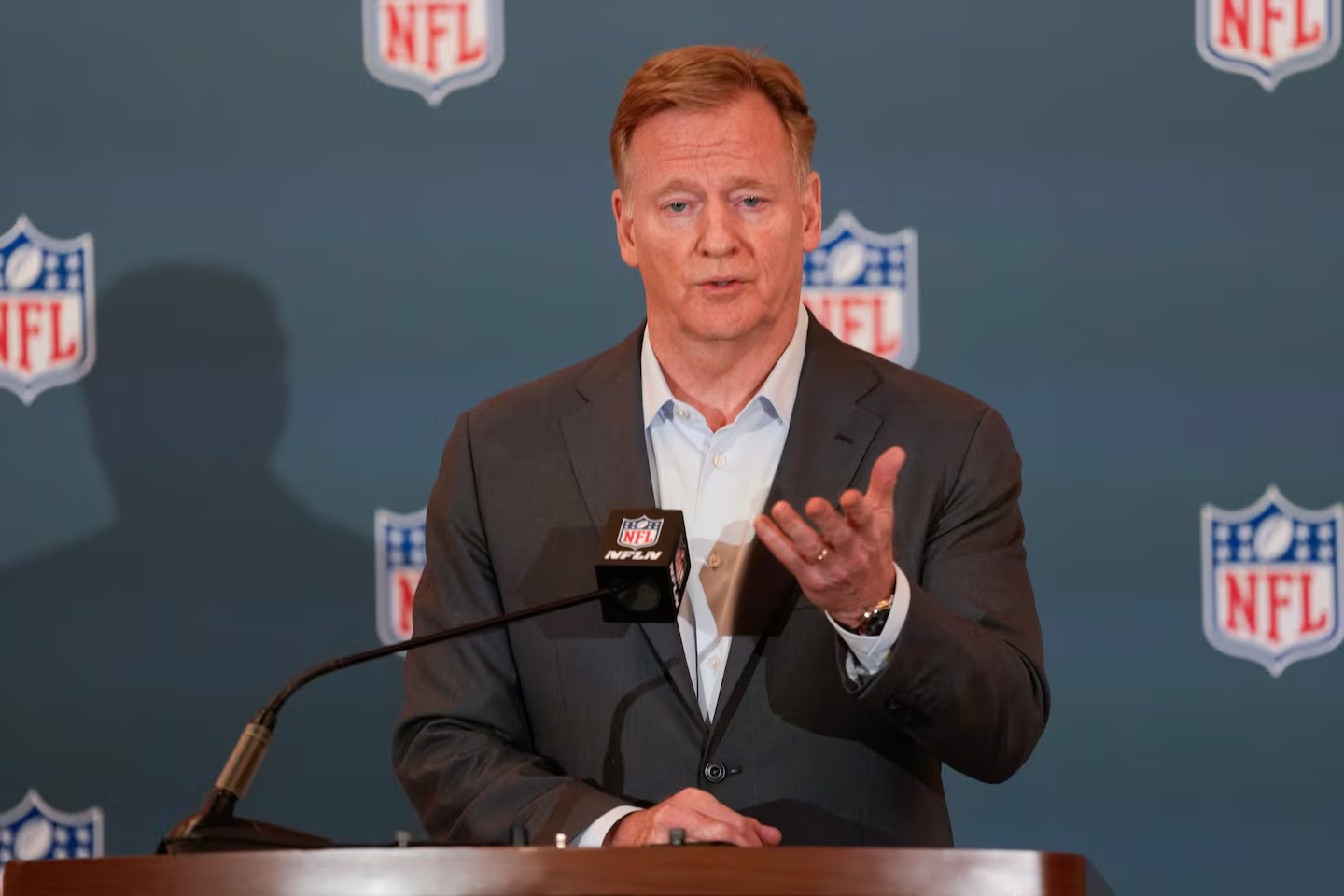
“We’re incredibly proud of our policies, and they are incredibly effective from a fan standpoint,” commissioner Roger Goodell said Tuesday from the NFL owners’ meeting. “Our games are the most available of any games by far of any league. I think 87 percent plus are on free television, 100 percent are on in the local markets. So we’re very proud of that.”
While it is frustrating for fans to have to buy multiple subscriptions, is it wrong? Do fans have an inalienable right to watch every national NFL game when it doesn’t involve their local team?
The Sports Broadcasting Act of 1961 surely didn’t envision an era of streaming platforms, struggling networks, and a Thursday night TV package.
In 2026, if I’m in Boston, why shouldn’t I have to pay a little extra to watch Rams-Packers? The NFL is a business first and can’t be faulted for trying to squeeze extra revenue out of its product.
“We love our model,” Schroeder said. “We think we have the most fan-friendly model there is of any sport or entertainment as far as distribution.”
Baldwin, though, makes a good counterpoint. She estimates that a large swath of Packer-mad Wisconsin lives outside the Milwaukee and Green Bay TV markets, and therefore must buy all the subscriptions to watch their home team. The Packers play two games on Prime and two on Netflix in 2026.
Baldwin estimates that “more than 400,000 Green Bay Packers fans in 13 Wisconsin counties are assigned to an out-of-state local TV market.” The For The Fans Act would require leagues to provide free access to all fans based in the state, and to add locations if teams count multiple states as its local market.
“We’ll always look at it, potentially adjusting that model,” Goodell said. “I think we’ve done a great job with that, but we’ll continue to try to focus on how we can improve if there’s an opportunity.”
Read more Senate advances bill aimed at ending Iran war as Cassidy, after primary loss, flips to support it



Post Comment