If you pay attention to only one primary election this midterm, make it this one on Tuesday
If you pay attention to one midterm contest this year, it should be the Michigan Senate race, which holds what is probably the most important Democratic primary of the year on Tuesday and, for that matter, possibly the most important general election in November as well.
If nothing else, it will no doubt be the most analyzed, especially as the 2028 presidential campaign, which runs squarely through the state, begins almost immediately afterward.
Democrats are in the wilderness, locked out of power in Washington, and trying to find a way back. But they’re in disagreement over how, and no other primary in the country more clearly represents the debate or carries higher stakes.
The Michigan contest features an open seat to replace retiring Democratic Senator Gary Peters. And it comes in a state that has been swingy, with Donald Trump winning it in 2016 and 2024.
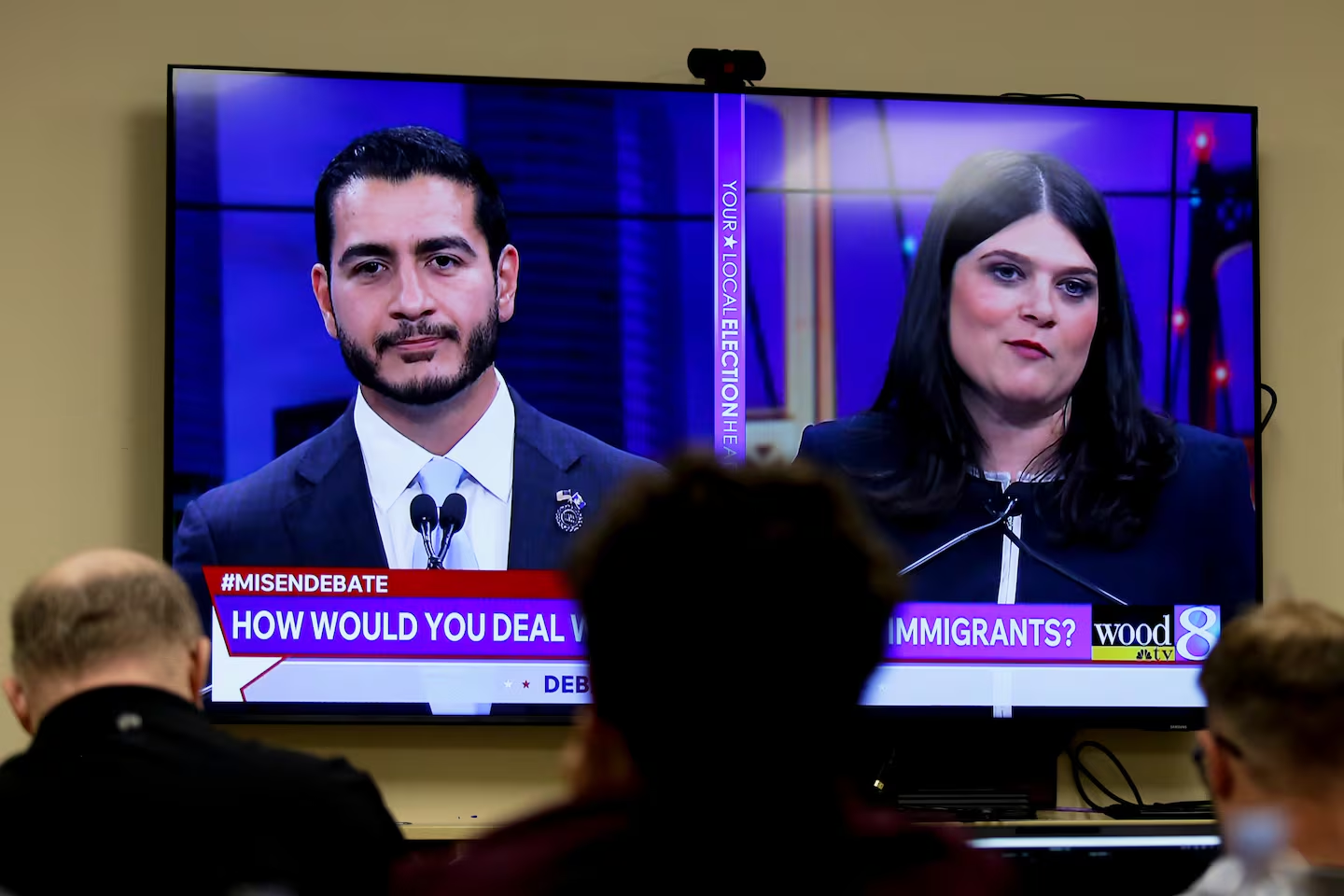
The Democratic contenders are nearly out of central casting for the dynamics that have defined the party all year. And with two candidates left in the race, they offer voters a nearly perfect binary choice.
First, there is Representative Haley Stevens. She was first elected in the 2018 Democratic wave during Trump’s first term, when she ousted a Republican incumbent. She is running on her record in Congress and with the full backing of the Democratic establishment, from Senate Minority Leader Chuck Schumer to the retiring Peters to Governor Gretchen Whitmer.
That backing has also translated into tremendous financial support, including roughly $60 million in super PAC spending on her behalf, about half of it from pro-Israel interest group AIPAC and its affiliated organizations, which has helped put the Middle East front and center in the contest.
Then there is her opponent, Abdul El-Sayed, a former Detroit public health director, Rhodes Scholar, and former gubernatorial candidate (who lost to Whitmer).
Born and raised in Michigan, he is also a Muslim of Egyptian heritage who has been extremely critical of the Israeli government.
While Stevens is backed by much of the Democratic establishment (New Hampshire Senator Jeanne Shaheen also endorsed her on Friday), El-Sayed has the backing of leading progressives, including Vermont Independent Senator Bernie Sanders, Massachusetts Senator Elizabeth Warren, and New York Representative Alexandria Ocasio-Cortez, who appears in his closing primary television ad.
El-Sayed is also enjoying the support of the insurgent Democratic Socialist wing of the party. Democratic Socialists have racked up wins in places like New York City, Seattle, Washington, D.C., Colorado, and possibly Los Angeles this year — all solidly Democratic areas. Winning statewide in a large Midwestern swing state is an entirely different matter.
But recent polling suggests it might be happening. El-Sayed has led by double digits in the last six independent polls, though internal campaign polls have been self-serving and all over the place, further complicating perceptions about who is actually leading.
El-Sayed says he is not a Democratic Socialist. He argues he is actually ideologically closer to Warren than Sanders, believing in the fundamentals of capitalism but that it can work better.
The winner of Tuesday’s primary will take on former Representative Mike Rogers, a veteran Republican with establishment credentials whose performance could also signal a great deal about the post-Trump future of the Republican Party. Rogers also ran and lost an open Senate race in the state in 2024, defeated by moderate Democratic Senator Elissa Slotkin.
What happens here matters. For Democrats to take control of the Senate next year, they must win four seats currently held by Republicans. But at the same time, they have to hold Michigan and two other Democratic-held seats, New Hampshire and Georgia. Of those three, polling suggests Republicans have their best opportunity in Michigan.
Should Stevens win Tuesday and again in November, moderate establishment Democrats (and supporters of the US-Israel relationship) will point to her victories as landmark proof heading into the 2028 presidential primary that Democrats in a key swing state rejected the party’s left flank.
Should El-Sayed win Tuesday and in November, the more progressive Sanders wing (and those who want to reshape the US-Israel relationship) will point to his victories as landmark proof that this message is the path to winning in 2028, especially after establishment Democrats lost to Trump twice.
Should either win the primary but lose the general election, watch for all the explanations that 2028 Democratic primary voters should take heed.
The winner won’t simply determine who is favored in one of the Senate’s most competitive races. The result will become Exhibit A in the Democratic argument over what kind of candidate — and what kind of message — can win back the White House in 2028.
Read more Wings use big run to close third quarter, romp past setting Sun


Post Comment