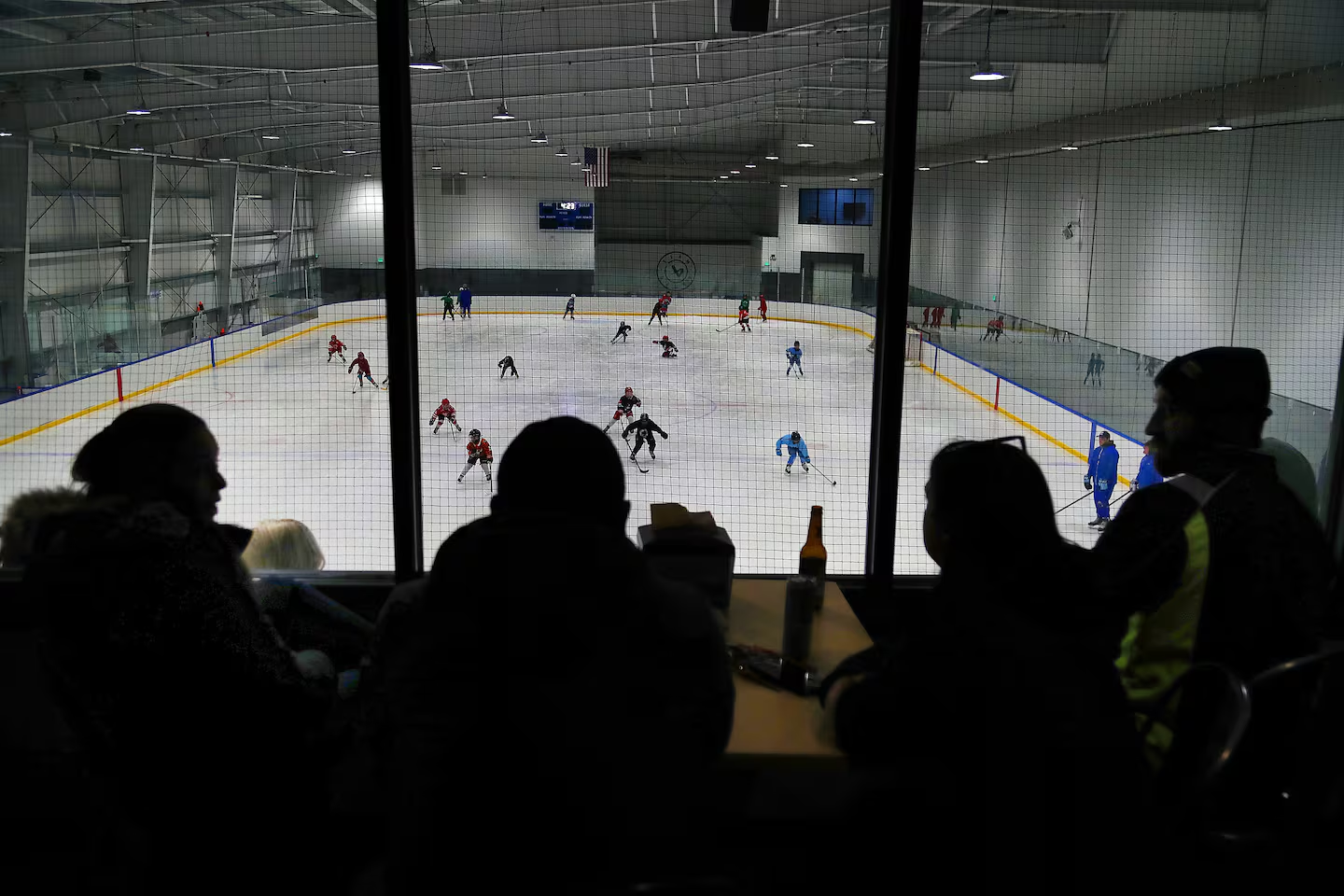
Boys’ high school hockey is ‘having an existential crisis.’ It starts with the rinks.
Some of those in Massachusetts who coach, parent, and play hockey at the amateur level say something is broken in the way we develop players. At the grassroots level, they say, the sport has lost its way.
Clearly, the last 25 years, the ground here has shifted.
Gone are the simple days of playing town hockey, then for the local high school, then heading off to play in college. We are now the wild west of the east.
Private money has taken over the game, charging exorbitant prices for spots on exclusive teams with the promise of making it big. Families dump thousands of dollars into a sport where a bottleneck at the top — so few spots, so many players — has made playing in college a rare feat.
Taking a shoulder-to-chest hit in all of this is the MIAA, once the place where future pros developed. The club teams that grow our best players shrug, saying they’re just serving parents and kids who want more, more, more.
“Massachusetts is having an existential crisis,” said Topher Scott, a former Division 1 college coach who runs the consulting firm Hockey Think Tank, and says similar about his Chicagoland home.
On the outside, Massachusetts hockey is humming along. Most NHL teams have a player from this state. Team USA has no shortage of hometown guys. Our rinks feed rosters and coaching staffs at every level of the game.
Fans gripe about the Bruins, but they’re a heavyweight franchise that rakes in cash. Hockey East games are a fun, frenetic watch, and often feature future NHL All-Stars. There’s a good chance an SUV on your block has a large, smelly bag in it.
By any measure, the business of hockey is booming in the Commonwealth. Minnesota claims the State of Hockey title, but Massachusetts is a solid second.
So maybe it’s the perfectionist streak in those who find fault with the way things are done in Massachusetts. Maybe it’s an intergenerational misunderstanding. They could be right.
The last few months, the Globe had conversations with multiple NHL players, coaches, executives, player agents, high school players and coaches, local and state hockey administrators, and independent analysts. We found heaps of passion and exasperation about the landscape, and a dearth of ideas on how to change it.
Read more from this project:MIAA boys’ hockey has taken a hit, but playing for your community? ‘You can’t beat it.’ | Massachusetts is losing the battle of the ‘State of Hockey’ to Minnesota. What’s working there?
Rinks difficult to access
The root of the current crisis, Scott suggested, is the rink itself. Amid handwringing about the loss of outdoor hockey spaces, indoor rinks have become inaccessible to a growing number of families. Low-cost, idle-time, freewheeling hockey is an activity of the past.
In other words, this is serious business.
The majority of the state’s rinks were once municipally owned and operated. The melting down of the MDC — it was also known for fostering parks and political patronage — in 2003 put dozens of Orr-era rinks up for sale, or out of business. Private interests swooped in, gave some of them much-needed facelifts, and kept building more.
According to Hockey Think Tank’s research, 80 of the 148 rinks in Massachusetts today are privately owned.
This state has some of the highest energy costs in the country. Rather than community centers, rinks have become revenue generators. No longer drained in the summer, operators have 12 months of ice slots to fill.
Massachusetts went from a handful of travel teams for all-stars to more than 60 clubs in “AAA,” the top youth hockey level. More travel teams meant more entrepreneurs masquerading as coaches, and more salesmanship. Words such as “elite” and “premier” became such common labels, they lost their meaning.
AAA hockey, Scott said, is “no longer for the best players. It’s for the best players who can afford it.”
Academies pop up
Publicschool teams have long had to compete with private and prep schools for players, but with other options sprouting up everywhere, public school hockey lost out in the last quarter-century.
Seventy-eight cities and towns have dropped boys’ hockey since 2001-02, according to MIAA records. Fifteen new co-op programs were created. In the last eight years, 240 fewer boys and 237 fewer girls signed up.
Hockey-based academies, following the Canadian model, began to offer students a way to spend as much time on the ice as they do in the classroom — or taking online classes.
“There’s a lot of people hounding these parents because these programs, and I’ll specifically say juniors and the academies, these are entrepreneurs,” said Falmouth High coach Paul Moore, USA Hockey’s coach-in-chief for Massachusetts. “They’re businesspeople. They need bodies. They’re fighting for players. And they’re going to go anywhere to find them because they need people to pay for their product.”
Thus there are promises that 6-, 7-, and 8-year-olds will be scouted at tournaments. Grade-schoolers who play 60 to 70 games or more a season might get 15 minutes of ice time in each one, and a handful of puck touches. Coaches say individual skill is greater, but hockey sense is in shorter supply.
“All youth sports are out of control,” said state Senator Barry Finegold (D-Andover), and “hockey is at the top of the list.”
Parents are loath to buck the system because their kids will bear the brunt. Their spot will fast be filled.
“Every single parent I talk to is stressed out about it,” said Finegold, who aims this spring to hold a summit of the governing bodies of the state’s most popular scholastic sports to try to fix the culture. “They want kids to just be kids. But they have the FOMO [fear of missing out].”
Kevin Kavanagh, executive director of Massachusetts Hockey, says it is a societal issue.
“Has he looked at the [music] conservatories? They’re out of control, too,” Kavanagh said. “We want what’s best for our kids, and that’s a great outlook for a parent, but as a society we haven’t figured out how to reel some of that in yet.”
The cost of travel hockey depends on the age, location, and level of the player. It’s easy to spend $5,000, $10,000, $20,000 or more on year-round travel hockey, given the ice time, equipment, travel, and fees. Nearly every NHLer from here (and all the other hockey-mad states save for Minnesota) trod that path.
All of this has left high school hockey, the kind where all roads lead to TD Garden and the state championship, with a blunted impact.
Taking a different path
The town pride, facing the rival down the road, showing up in an enemy barn as the visiting team? That magic still exists. Crowds have been buzzing at playoff games. It’s just that dozens of the best players are missing.
Of the 39 players from Massachusetts under NHL contract as of late February, 21 did not play any MIAA hockey, instead going the prep school and/or junior route.
Twelve played for MIAA schools as underclassmen before joining junior teams or the US National Team Development Program (NTDP). Four played only junior hockey while attending high school.
Colin Blackwell, of North Andover, was the most recent, and possibly the last, player to be drafted by an NHL team directly out of an MIAA school (St. John’s Prep). San Jose drafted him in the seventh round (194th overall) in 2011, weeks before he enrolled at Harvard.
Read more Seven contracts the Bruins might try to unload this offseason
“I definitely think I took the nontraditional route,” Blackwell, a ninth-year pro now with the Stars, told the Globe after being drafted. “I didn’t have to leave for a prep school or for juniors.”

But even he played travel hockey through age 16. Nearly everyone who makes the league does similar.
Another outlier, of sorts, is Teddy Stiga, Team USA’s golden goal-scorer at the World Junior Championship. He is an 18-year-old Boston College freshman from Sudbury.
He started skating at the Valley Sports Arena in Concord. While attending the Fenn School, he played for Assabet, the Minuteman Flames and the Middlesex Islanders (13U), Boston Junior Eagles (14U, 16U), and then a prep school (Belmont Hill). He left for the US National Team Development Program as a junior, played two years there (and earned a second-round draft pick by Nashville in 2024), and joined BC this fall.
His story might sound familiar to those who follow the game closely, but it is unusual in terms of hisage. Most Division 1 freshmen men’s hockey players are two years older than Stiga, and have two to three years of junior experience, typically in the United States Hockey League (tier 1, the top level of American juniors) or North American Hockey League (tier 2).
“In my era, you went from high school as an 18-year-old kid right to college,” said Moore, who played at UMass Dartmouth from 1981-85. “Those days are over. They want you 20 turning 21, or 21 turning 22, as a freshman in college.”
It is also nearly a requirement for Division 1 recruits to have played AAA club hockey. Some are worth the investment. Others are not.
In 1977, the Metropolitan Boston Hockey League debuted as an all-star league for the best high school players. Games were on Sundays and did not conflict with scholastic sports.
Today there are more than 60 AAA programs in Massachusetts, beginning at Squirt (9-10), Peewee (11-12), Bantam (13-14), 15U, 16U, 18U, and junior (ages 16-20). Outside of school hours, rinks are rocking.
“The growth of the game is awesome,” said Moore. “You’ve got academy and junior teams popping up everywhere, and then you’ve got the prep schools.
“There’s a lot of hockey going on, which isn’t a bad thing. But it’s taking its toll on high school hockey, for sure.”
The MIAA was the path for a couple of Hall of Famers (Acton-Boxborough’s Tom Barrasso and Randolph’s Rod Langway; Jeremy Roenick went to Thayer Academy), and dozens of future NHLers and Division 1 standouts. Now? There are so few spots, and so many players, that a Division 3 or college club spot is the likely path for the best MIAA players.
“Forget Division 1,” said Moore. “We know the percentages and we know the odds. For him to play Division 3 hockey, he has to play a minimum of three years of junior hockey.”
And that comes at a cost — one that’s greater than ever.
“Blue-collar parents are getting pushed out of our sport,” Moore said. “I don’t know how to combat that. I know what we do in Falmouth.”
The town owns and operates its own rink. It runs a boys’ and girls’ club program to help pay the bills, but town hockey and school hockey is the focus. Ice rates are relatively affordable.
The MIAA, executive director Bob Baldwin said, is about serving “the 92 or 93 percent of athletes who play their last game before college.” High school hockey is about sportsmanship and camaraderie, not climbing the ladder toward a pro career.
“We’re proud as heck of those who make it to the next level, and hopefully they’re doing it through one of our schools,” Baldwin said. “But it’s about maintaining programming that teaches the big picture, and the big picture is not that elite-elite player. The big picture is can a group of individuals come together to make it as far and as high as they can? And when you do, when you watch that, it’s a really beautiful thing to watch.”
Is it all too much?
Tim Lovell said he wouldn’t have traded his experience at Norwood High for the world. He gets warm fuzzies about spaghetti dinners, wearing his jersey to school on game days, the buzz of a rivalry game.
Lovell, 50, went undrafted after scoring a bunch at Maine and captaining UMass, and played seven pro seasons — one with the Providence Bruins. He has had quite a second career.
Some 20 years after he began giving walk-on hockey lessons at municipal rinks, Lovell Arena in Rockland has three ice sheets, seating for 1,500, a 375-seat restaurant, four bowling lanes, two golf simulators, a pro shop, and a live video feed.
Next door is a 40,000-square-foot, $30 million prep school with four girls’ teams and three boys’ teams. From August to May, Lovell Academy students skate morning and afternoon, and work out in the gym afterward. The elite teams travel the continent to play games. The training is demanding, and in volume “probably quadruple to five times,” the school’s founder said, of what is done in a traditional prep school program.
Is it all too much?
Scott likened it to letting kids dine on pure sugar.
That kind of lifestyle was apparently good enough for Connor McDavid, and it’s not hard to find kids who want to follow his path. He’d have plenty to do at a facility Lovell referred to as “Candyland.”
“If the athlete loves what they’re doing,” Lovell said, “then the answer is no. I love when people [say], ‘Oh, he’s doing too much. He can’t play two games in a day,’ where, back in the day, you played your game in the morning, and then you were on the pond for like, eight hours.”
Lovell said he’s not changing the world.
“That world’s been here,” he said. “It’s what people want.”
He said about 2,000 kids on 120 youth teams sign up annually. And while he’s making no promises, Lovell is selling the dream.
His coaches have NHL, minor pro, and major college experience, and with that, “they have the contacts and stuff like that at the higher levels,” he said. “They can make a phone call and say, ‘Hey, this kid’s pretty good.’ ”
His most devoted pupil might be Senators forward Adam Gaudette. An eighth-year pro who has a career-high 16 goals, he learned “a lot of skills, edge work, puckhandling, and skating” from Lovell starting at age 7.
The Gaudettes moved from Taunton to Braintree so he could be closer to Lovell, and so he could attend Thayer Academy and play for former NHL star Tony Amonte. To fund three boys’ rise to college hockey, Tara Gaudette helped Lovell in the office, while Doug Gaudette, a lieutenant with the Taunton Fire Department, did plumbing work for Lovell on the side.
“He’s still going over and fixing their toilets, and doing work on their Cape houses,” Adam said, “We were fortunate. It was kind of like a give-and-take thing. The people they were close with, they didn’t care about the money. They cared about us. We helped them when we could and they helped us when they could.”
It wasn’t a town name on his jersey, but he loved the crest.
“I was always with the same coaches, same group of guys,” Gaudette said. “We were playing together since we were 5 years old.
“I still see it now with the young guys in the Lovell program, they were all just little ones and I was coaching them when I was 18 years old in the summer, and now they’re U15, U16 still playing together. It’s great. I’m still tight with those guys today. Some are still playing and some have moved on. It’s something we’ll have to connect us forever.”
Some of them know it now, but all hockey lovers and lifers learn this eventually: All roads in this game lead to beer league.
Read more from this project:MIAA boys’ hockey has taken a hit, but playing for your community? ‘You can’t beat it.’ | Massachusetts is losing the battle of the ‘State of Hockey’ to Minnesota. What’s working there?



Post Comment