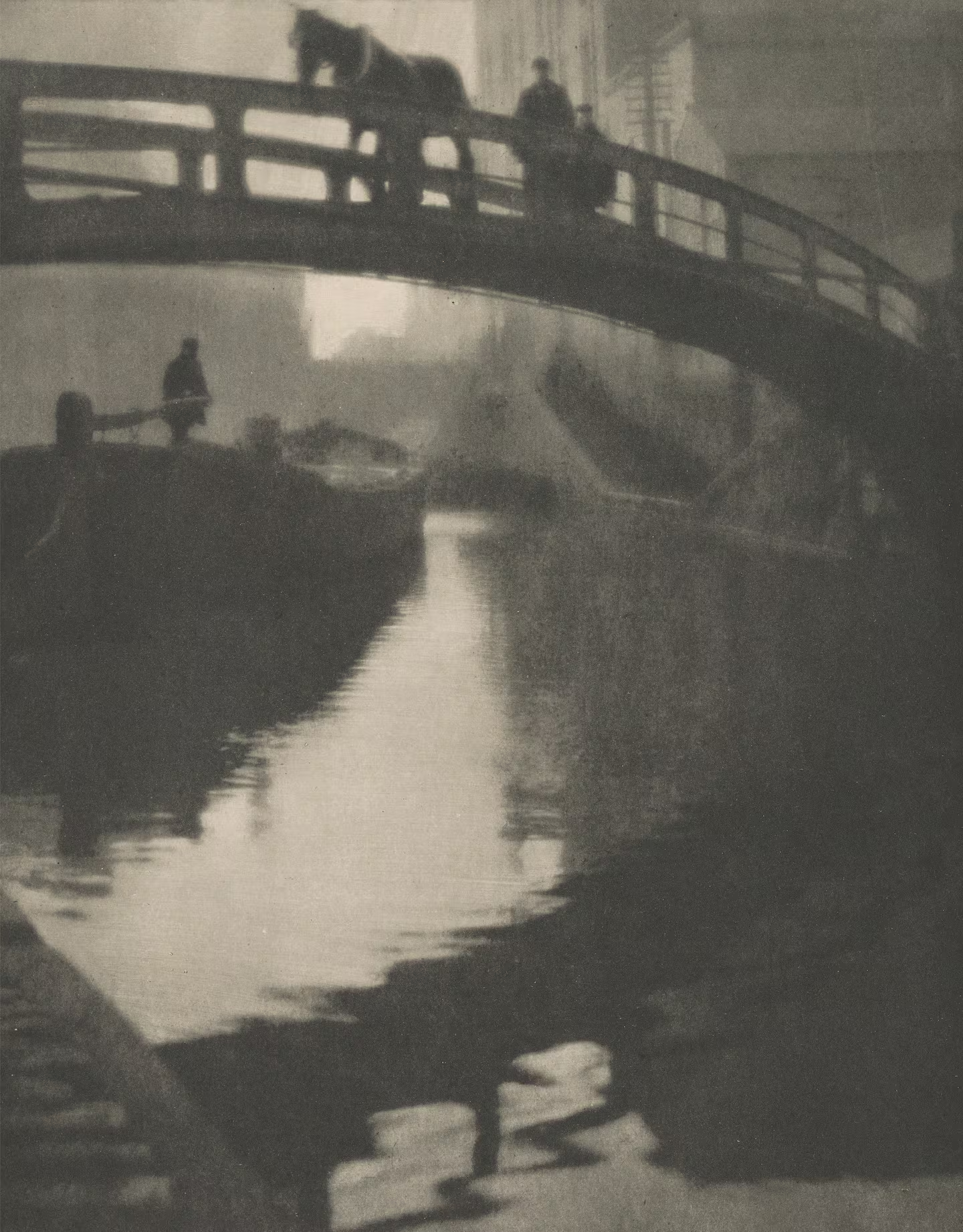
Getting the lay of the land at Yale
NEW HAVEN — “Landscape” is one of those terms that seems simple and straightforward — like “sex” or “death” or even “real estate” — until you stop to think about them. Then you realize: Unh-unh, guess again. Landscapes can be as varied as coal mines and the grounds of country estates, military encampments and housing developments. All of them figure in “Sightlines: British Landscape Photography, 1840 to Now.”
The show runs at the Yale Center for British Art through Jan. 24. It’s being presented a little early in conjunction with one of this fall’s major exhibitions, the YCBA’s “John Constable: The Landscape Reimagined,” which opens Sept. 3.
“Sightlines” (a nicely open-ended title) comprises slightly more than a hundred items, not all of them photographs. The show also includes several lithographs, post cards (from Gilbert & George, no less), screen prints and drawings (all based on photographs), a watercolor, and three photo albums.
Bracingly varied in subject as well as format, “Sightlines” is arranged thematically. Sections include “Places of Belonging,” “Between Art and Science,” and “Bearing Witness” (a concept with great relevance to the W. Eugene Smith show at the Yale University Gallery of Art that gets addressed below).
A landscape that’s unchanging isn’t really a landscape, it’s an outdoor version of set design; and an understanding of landscape photography that’s unchanging puts the genre into a conceptual straitjacket. Even an ostensibly traditional landscape, like Hugh Owen’s “Harvest Scene with Stooks” or Henry Stuart Wortley’s “Clouds,” both from the mid-19th century, doesn’t quite fit the genre profile. Owen’s photograph is agricultural — a “stook” is a bundle of grain stalks — and Wortley’s is as much cloud study as landscape. “Sightlines” makes museumgoers think afresh about landscape by construing the genre so loosely.
There are photographers here visitors might expect, such as William Henry Fox Talbot, one of the inventors of the medium. There are more they likely wouldn’t. Roger Fenton’s celebrated images of the Crimean War effectively began war photography. The inclusion of two of those photographs in “Sightlines” reminds us that war always takes place in a particular space and, almost always, involves the contesting of territory. Oddly enough, neither of those photographs is “Valley of the Shadow of Death,” perhaps Fenton’s most famous image: the landscape as cannonball-littered hellscape.
Rachel Whiteread’s four screen prints depict the demolition of a high-rise housing development. The series is a double reminder: of the interaction of human beings and open space; and that all buildings are a placement in space, whether open or enclosed.
Five Alvin Langdon Coburn photographs, all from 1909, further upend preconceptions of landscape. It’s not that they’re surpassingly beautiful, although they are. Coburn was a master of the Pictorialist school, with its soft, painterly textures. It’s that they’re also cityscapes, taken in London. Two of them even feature horses.
The photographers with most work in the show are Michael Kenna, with ten, and Jem Southam, with eight. Nine of Kenna’s are from a series on Britain’s last coal-fired power station (it closed in 2024). As composed by Kenna, the cooling towers in one of them bear a jaw-dropping resemblance to Stonehenge. All of Southam’s are from a series on a sylvan pool. The contrast between subjects indicates just how excitingly catholic, and unconventional, “Sightlines” is.
Read more Don’t fall for the ‘Odyssey’ IMAX 70mm okey-doke
The emphasis in “W. Eugene Smith and the Art of Witnessing” is on Smith’s mastery of the photo essay and the humanity of his approach to photography. All photojournalists witness the events they cover. Smith’s aim went well beyond that: not just to witness, a documentary exercise, but to bear witness, a moral act.
The show, which runs through Dec. 6 at YUAG, includes four dozen Smith photographs and eight vintage copies of Life magazine. During his heyday, the ‘40s and ‘50s, Smith was perhaps the most admired of photojournalists. Yet what helped give his work such an impact then, an intrinsic bent for melodrama, has not aged well.
Some of the series are very famous. Even if you don’t recognize the titles “Country Doctor” (1948), “Spanish Village,” “Nurse Midwife” (both 1951), or “Minamata” (1975), chances are good you would recognize key images from them.
What’s unexpected about the show is how often Smith’s work can be seen to fall under the rubric of landscape, at least as understood in “Sightlines” terms. That’s certainly true of his never-finished study of industrial Pittsburgh (1955-58), a series on Welsh coalminers, and at least two of his most canonical images. “Doctor Making House Calls,” from “Country Doctor,” is as much about the overwhelming Western space surrounding the physician as about the figure trudging through it. And “A Walk in Paradise Gardens,” from 1946, is a kind of apotheosis of the landscape, domestically considered. Two of Smith’s children, seen from behind, walk together, encircled by greenery, moving toward the light. It could be a still from the greatest movie Steven Spielberg never made.
If you don’t buy the argument about “Sightlines,” Smith, and landscape, it’s easy enough to put it to the test. The YCBA and YUAG are across the street from each other, and it’s not that wide a street.
SIGHTLINES: British Landscape Photography, 1840 to Now
At Yale Center for British Art, 1080 Chapel St., New Haven, through Jan. 24. 877-274-8278, britishart.yale.edu
W. EUGENE SMITH AND THE ART OF WITNESSING
At Yale University Art Gallery, 1111 Chapel St., New Haven, through Dec. 6. 203-432-0601, artgallery.yale.edu



Post Comment