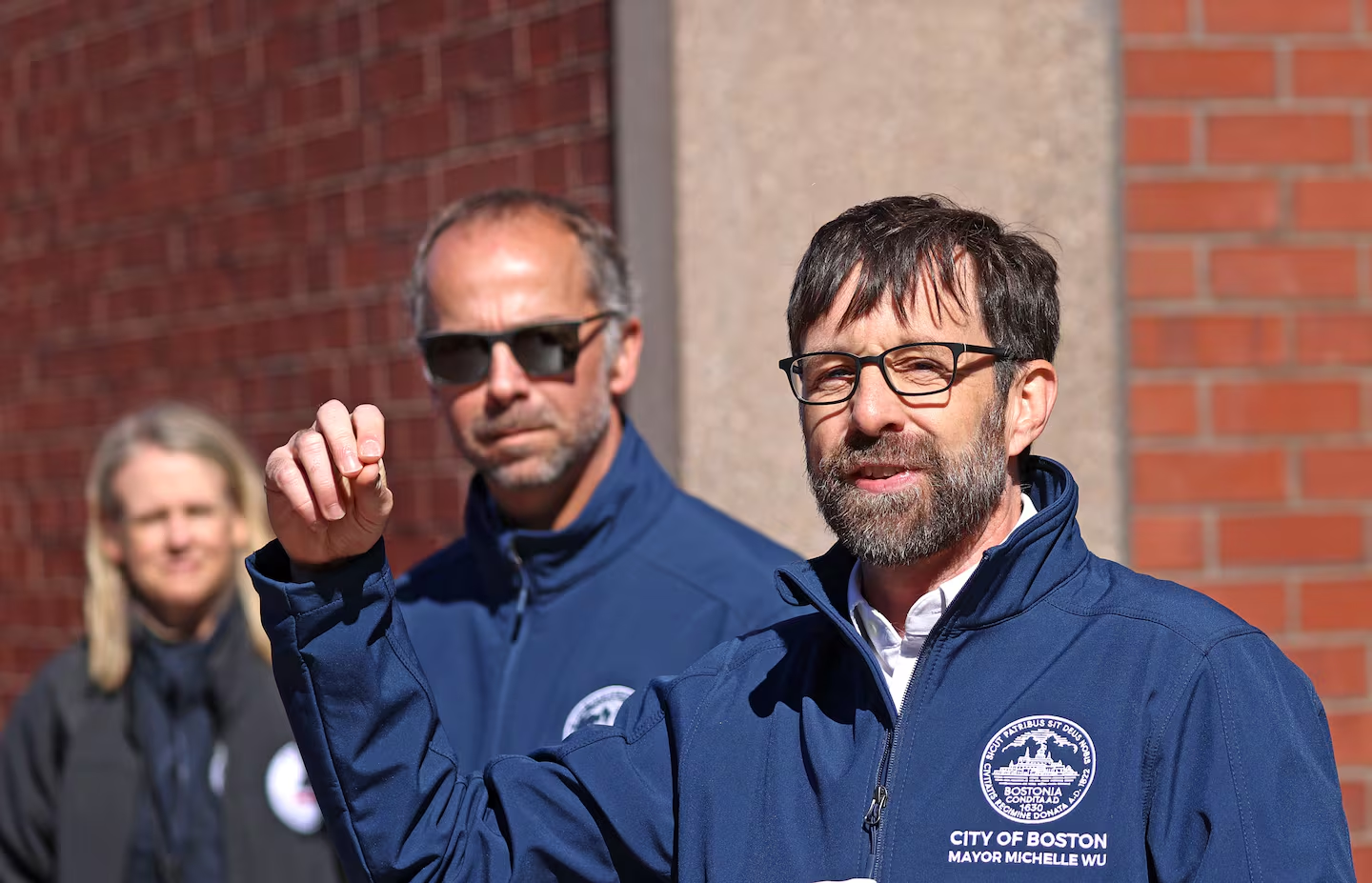
Wu names longtime City Hall veteran Chris Osgood as new interim chief of streets
Boston Mayor Michelle Wu is appointing longtime City Hall veteran Chris Osgood to be the city’s new interim chief of streets, to lead a department that has grappledsince early last year with a broad slowdown of major streets projects, plummeting staff morale, and fierce criticism from transit advocates.
Read more In his 13th season, Patriots OL Morgan Moses relishes passing along his wisdom to younger teammates
The mayor also announced a group of eight advisers, all of whom have extensive experience in City Hall and transit work, to team with Osgood to determine how to adjust and improve the city’s so-called Streets Cabinet’s operations, Wu’s office announced Friday morning.
The personnel changes came with separate announcements that the city and the MBTA will begin to host a series of community meetings to gather feedback on an updated design for the overhaul of Blue Hill Avenue — a new proposal that incorporates feedback and concerns raised by some residents over the past three years.
Wu’s move to publicly announce the next steps for the controversial Blue Hill Avenue redesign and to tap the veteranwells of City Hall to lead and advise her Streets Cabinet represent her latest effort to remedy one of the biggest policy challenges her administration has faced. It is also a response to residents’ and advocates’ demands to take action to improve street safety following the recent death of city planner Louisa Gag in a cycling crash with a truck.
Starting Monday, Osgood will replace Nick Gove, who took over as interim chief of streets after former chief Jascha Franklin-Hodge left the Wu administration last November. Gove will return to his former role as deputy chief of transportation and oversee both the city’s transportation and public works departments, according to Wu’s office.
The administration also announced other staffing changes: Tali Robbins, Wu’s deputy chief of policy, will support Osgood by serving as interim chief of staff for the Streets Cabinet; and Amy Cording, the Boston Transportation Department’s director of engineering, will continue to serve as the cabinet’s interim deputy chief of infrastructure and design.
Osgood has worked for City Hall for nearly 20 years, in roles that include adviser to former mayor Thomas M. Menino and chief of streets under former mayor Martin J. Walsh. He most recently served as Wu’s senior adviser on infrastructure and director of the city’s office of climate resilience, and is considered by many to be a stalwart pillar of Boston’s municipal government.
Osgood confirmed that he is taking the job in an interim capacity and said he does not have an update on the city’s timeline for selecting a permanent chief of streets. The deputy director of the city’s office of climate resilience will fill in for Osgood as he works with the Streets Cabinet, Osgood said.
“The cabinet is in a really strong position because of all of the good work which has happened by the members of the team and by partners across the city of Boston, so I am honored to be able to step back in an interim role and be able to support a team that I love, doing a set of work that I love,” Osgood said Thursday.
That said, “there’s even more to do here in the city of Boston on our streets to make sure that they’re delivering on the mayor’s agenda of streets that are safe and beautiful and family friendly,” he continued.
The committee of advisers that will support Osgood in the temporary role also all have long resumes that include City Hall accolades.
The members include: Brad Gerratt, former commissioner of the Boston Transportation Department; Vineet Gupta, who retired from his role as the director of policy and planning for the Boston Transportation Department earlier this year; Justin Holms, former director of constituent and engagement and chief information officer for the city of Boston; Jarred Johnson, former director of the nonprofit TransitMatters; Joanne Massaro, former commissioner of the Public Works Department; Matt O’Malley, former Boston city councilor; Stacy Thompson, former executive director of the LivableStreets Alliance; and Tom Tinlin, former commissioner of the Boston Transportation Department.
The group will review job descriptions as the cabinet works to fill key leadership vacancies, analyze the cabinet’s personnel and funding needs, and review the cabinet’s structure and how to most effectively deploy its staff and available funding to deliver services and street infrastructure improvements. Osgood said he anticipates that much of the group’s work to develop recommendations will be done by the early fall.
Wu has faced intense criticism from many residents and bike and transit advocates for effectively slowing progress on nearly all streets projects involving design changes for nearly a year and a half.
Early last year, Wu directed her office to conduct a 30-day review of all streets projects after several new bus and bike lanes drew considerable controversy and pushback from some residents, business owners, and her primary mayoral challenger. Wu then began requiring her personal approval for most streets projects to move forward, the Globe previously reported, infuriating advocates and residents who said the stalled work would deliver badly needed safety upgrades to dangerous roads.
Wu has defended the slowdown as an appropriate response to feedback that the city had moved too quickly on certain street infrastructure changes.
But advocates’ anger and pressure to resume that work increased after city transportation planner Gag, who previously worked for Wu, was hit and killed while cycling earlier this month.
In response to residents and advocates’ demands, Wu emotionally pledged to take action to make the city’s streets safer at a vigil at City Hall plaza one week after Gag’s death. She later announced the city will install more concrete barriers on bike lanes and fix sidewalks and curb ramps, among other changes she outlined in a letter last Friday.
Now, the city is also pressing forward on plans to completely redesign Blue Hill Avenue, after activists and elected officials expressed concern in recent months that the city could be at risk of forfeiting the federal funds backing the project if progress didn’t resume.
The project will completely reconstruct three miles of road and sidewalks, adding new streetlights, trees, crosswalks, and other infrastructure, including center-running bus lanes that have drawn controversy and opposition from some community members for years.
The updated design preserves the center-running bus lanes, which the city said are “designed to reduce congestion, improve transit service, and add curbside parking.” The latest iteration of the design also adds more parking spots, a two-way protected bike lane, 200 new trees, 185 new pedestrian ramps, and 20 new signalized crosswalks.
The city and the MBTA will host four town halls and open houses in September where residents can review the new design, ask questions, and provide further input. Engagement teams are already reaching out to small business owners along the corridor to discuss their anticipated needs during construction and when the project is complete, and will work to “develop mitigation tools,” according to the city.
Read more Here are the best players who left Boston and went on to win championships elsewhere


Post Comment