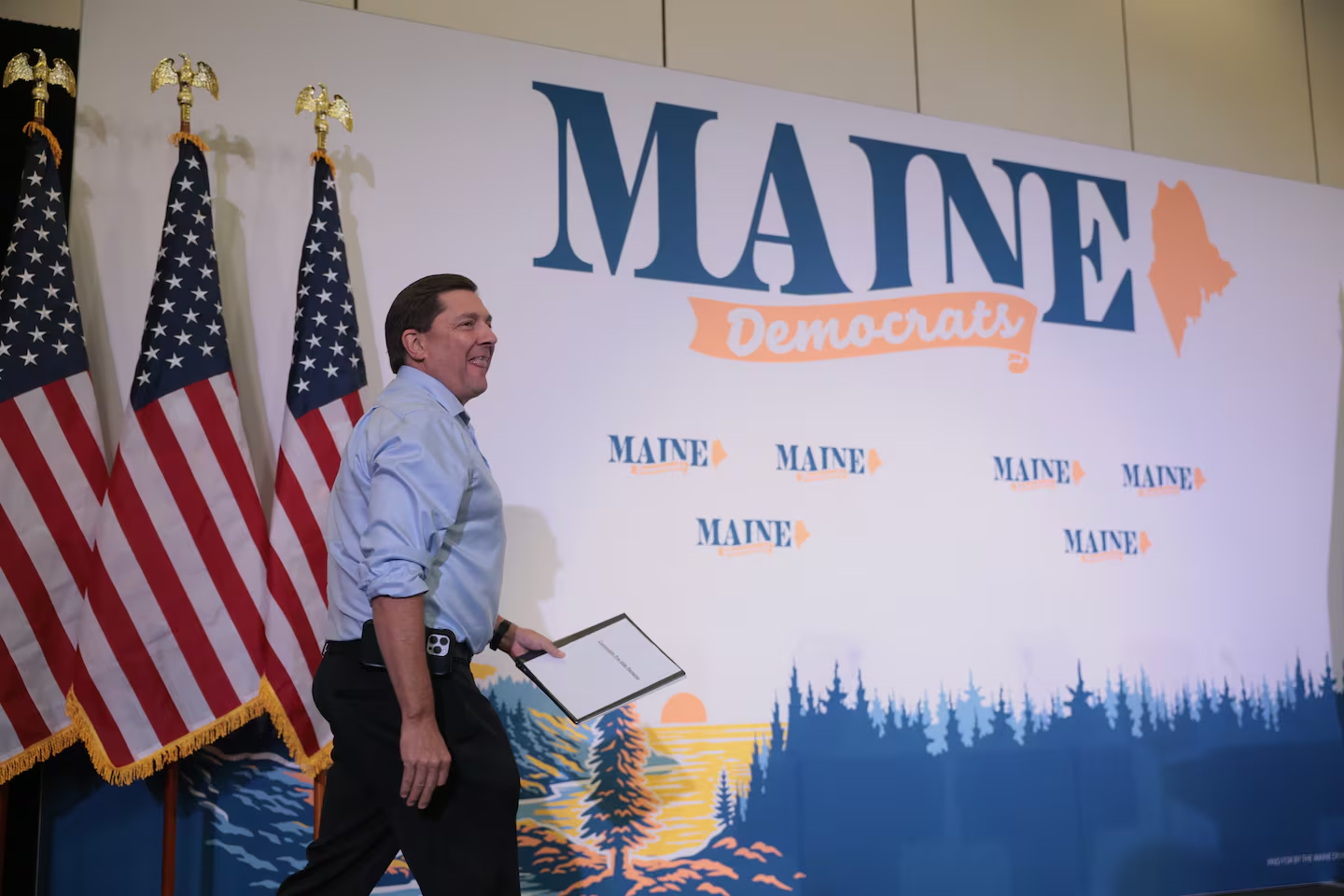
Troy Jackson sweeps Maine Democratic Convention, sets up Senate showdown with Susan Collins
BANGOR, Maine – Eighteen days after the collapse of Senate nominee Graham Platner‘s campaign amid credible accusations that Platner raped an ex-girlfriend, Maine Democrats on Saturday turned the page by nominating former State Senate President Troy Jackson to take on longtime Republican incumbent Susan Collins this fall.
Read more Patriots, second-round pick Gabe Jacas agree to terms on contract
Jackson is a fifth-generation logger and union organizer, who led Bernie Sanders’s presidential campaign in the state and espouses the same ideological outlook as Platner. He backs Medicare For All and has an economic populist message on housing and wages.
“Today we turn the page,” said Jackson in a nomination acceptance speech after coming out to Noah Kahan’s song “Northern Attitude”, which a staffer said was Jackson’s idea. “Today this becomes a general election campaign, and today we begin the work of defeating Susan Collins in November.”
In the days that followed Platner’s exit, more than a dozen Democrats jumped into what became a scramble primary of sorts. But Jackson so dominated the convention delegate process last weekend — capturing 91 percent of the elected delegates — that all of his major challengers dropped out immediately afterward. The fact that he had run unsuccessfully for governor in the June primary meant he had already had a network of supporters in all of the state’s 16 counties.
Thus, what was supposed to be one of the rare political conventions in the modern era that actually mattered instead became another fait accompli.
Jackson received 566 votes from the delegates who voted at the convention. Just one other candidate, Saundra Pelletier, a health care executive, challenged Jackson at the convention, but she received just 5 votes.
“It’s been crazy,” Jackson told reporters about the last few weeks leading to his nomination. “It’s been, you know, really something like I’ve never seen before, but, you know, I have been in politics a long time fighting for these issues.”
Jackson, 58, now enters one of the country’s most competitive and pivotal Senate races this November against Collins, 73.
Maine’s Senate race is key to Democratic hopes of taking control of the Senate for the remaining two years of President Donald Trump’s term.
To pull that off, Democrats must hold three competitive Senate seats in Democratic hands in New Hampshire, Michigan, and Georgia. They must also flip four seats currently held by Republicans. Collins is the only Republican up for re-election this year in a state that Trump lost in 2024.
Polling has consistently shown the race effectively tied, with Collins and Jackson running within the margin of error.
A statement from a Collins spokesman Shawn Roderick said, “Senator Collins looks forward to waging a vigorous and issue-oriented campaign that will distinguish her record of accomplishment against Troy’s angry sound bites and far-left ideology.”
The moment Jackson was announced as the nominee, a Super PAC affiliated with Collins announced a six-figure ad buy labeling Jackson as “worse than Platner.”
In a 10-minute speech ahead of the vote, Jackson cast himself as a working-class outsider despite years in Augusta, describing himself as a fifth-generation logger and union organizer from Allagash, the remote northern Maine town where he grew up.
“I am nothing special,” he told a crowd waving “Retire Susan” signs. “I didn’t get involved in politics because I wanted a title. I got involved because the people that I worked beside were getting screwed, and nobody, nobody in power, seemed to care about them.”
Jackson focused most of his remarks on Collins, whom he accused of standing up for billionaires over Mainers. Collins, meanwhile, has based her pitch for a sixth term on the idea that she is a political moderate with the Senate seniority to bring money back to the state.
The convention marks a pivot point for Maine elections this fall. Matt Dunlap, the Democratic nominee in the state’s open 2nd Congressional District, said in an interview that all the drama surrounding the Senate race has “taken all the attention away” from his race and others.
“It’ll be good to get beyond this so that we can all get to pulling the plow in the same direction,” Dunlap, the former state auditor, said.
There was no mention of Platner during the two-and-a-half-hour convention. That was despite the fact that he is credited with building the largest grassroots campaign in Maine history, one that received 72 percent of the vote in the June primary.
Less than three weeks earlier, Platner had been the Democratic Party’s rising star and one of the country’s most closely watched Senate candidates. By Saturday, it was as though he had vanished from Maine politics.
An hour before the convention began, there was little activity at Platner’s home in Sullivan, 40 miles away. The regular security presence was gone, only two cars were in the driveway, and a single kitchen light was on. In Ellsworth, all signage for his state headquarters had been removed, and the office was filled with cleaning supplies as it was prepared for a new tenant.
Even the general store at the end of Platner’s street had removed the sign advertising its sandwich special, “The Graham,” in honor of the former political phenomenon.
Read more Bruins boast big group of defense prospects, with a bevy of beanstalkers sprouting at camp
The deli clerk said they had run out of roast beef.


Post Comment