Inside the phenomenon of the Portland Hearts of Pine: ‘This will save American soccer’
PORTLAND, Maine — An hour before kickoff, Gabe Hoffman-Johnson is finding it tough to make much progress on a lap around Fitzpatrick Stadium.
Read more Don’t miss a moment of the action: Sign up for Court Sense, our Celtics newsletter
The founder seems to know (and be known by) every person who passes. It’s a lot of greetings and thank-yous and catch-ups as Hoffman-Johnson bats away the notion that he’s the most popular man in the city on matchdays for the Portland Hearts of Pine.
“Maine is the smallest big town — or the biggest small town, maybe — that exists,” he says. “Everybody knows everybody, and I think that’s what’s allowed this to permeate, as well. The sort of grassroots, brick by brick, word of mouth was a massive part of this.”
The soccer club is in its inaugural season in USL League One, a professional league in the third tier of American soccer — two divisions below MLS in the pyramid, though there’s no promotion or relegation — organized by the United Soccer League.
With a crop of players from as nearby as Lewiston and as far away as Japan, the Hearts already are a hit.
In a league that draws about 3,000 per game, regular sellouts in Portland have the team leading the league in attendance. Nearly 6,000 fans pack the stands each week and the 4,000-plus season tickets are long sold out.
It’s all the brainchild of Hoffman-Johnson, a two-time Maine state player of the year at Falmouth High School and later captain at Dartmouth. He could only stomach two years of working in private equity in New York before soccer brought him back home.
When the USL launched League One in 2019, Hoffman-Johnson began leading the push to bringa club to Maine.
Portland was granted a USL franchise in September 2023, with the city-owned, 5,500-seat Fitzpatrick Stadium becoming the club’s first home. Local real estate developers Jonathan and Catherine Culley came on as early investors, as did Lewiston native Tom Caron, a lifelong soccer fan better known to New Englanders as an anchor on NESN.
But the club still needed a name, a badge, an identity. It was never going to be “Maine FC” or “Portland United.” It had to be something that spoke to the soul of the place it represented.
The “Hearts” motif, with its decades of history in the city, might have been the easier part.
In the 1970s, a long-unknown person (or persons) began what has become an annual tradition of decorating the city with red hearts printed on white sheets of paper the night before Valentine’s Day. They were known as the “Valentine Bandit.”
Their identity is no longer a mystery, and these days you still see the Bandit’s impact. Walk up Congress Street and spot red hearts in the storefronts of fabric shops, book stores, and rock clubs — and, now, on soccer jerseys.
“The Valentine Bandit has long been one of my favorite parts of living in Portland,” Hoffman-Johnson says. “It’s a very Maine thing of just like, not seeking credit, spreading joy in the community.”
Still, the process of defining the brand took years. Hoffman-Johnson and Co. solicited opinions all over town, including from the Dirigo Union, the club’s supporters group that formed years before the team had kicked a ball.
The lightbulb moment came through the heartwood of pine trees — the non-living center of the trunk that allows the trees to flourish where they otherwise shouldn’t, such as on Maine’s rocky coastline.
The Portland Hearts of Pine were born. The city’s soccer-loving sections were hooked.
“Mainers see this, and they see pride of place, and they see, like, ‘That’s my club,’ ” says Josh Lane, the club’s marketing and creative guru.
The kits — a blue and green “Woods and Water” jersey, and a heart-speckled white “Bandit” shirt — sell like hotcakes. It helps that instead of a typical corporate sponsor hawking insurance or airline sales, the club partnered with the state’s tourism office to splash one word across the shirts: Maine.
“It just felt like ours,” Hoffman-Johnson says. “It felt right.”
The club’s motto is “lead with your heart,” a play on the state motto “Dirigo,” which is Latin for “I lead.” It’s a phrase that’s just as popular on shirts at the merchandise tent as the jerseys.
“Every little thing resonates with the people of Maine,” Caron says.
Everyone around the Hearts talks about matchday being like a party, and they’re not kidding.
Between the steady stream of music, the score of food trucks, and the chatty atmosphere around “Fitzy,” it feels like a summer music festival, at the center of which a soccer match just happened to break out. You might even see some famous Mainers — actor Patrick Dempsey and Senator Angus King among them — pitchside.
Read more My Miss Mo holds on to win the Black-Eyed Susan over Jumping the Gun
“If you do a lap around Fitzpatrick Stadium right before a match, it’s like you’re going to visit five different neighborhoods,” Caron says. “The families, the kids, the beer garden, the supporters section. That’s Maine, that’s America, that’s the cross section of life.
“Every time we go, people at halftime are chatting with each other like they’re the best of friends . . . It’s a cool little communal living room they’ve made there.”
This August game is a late addition to the schedule. The Hearts are hosting the Halifax Wanderers in the club’s first international friendly, organized to support the Maine-Canada connection as border crossings dwindle. Governor Janet Mills is in attendance to handle the pregame coin toss.
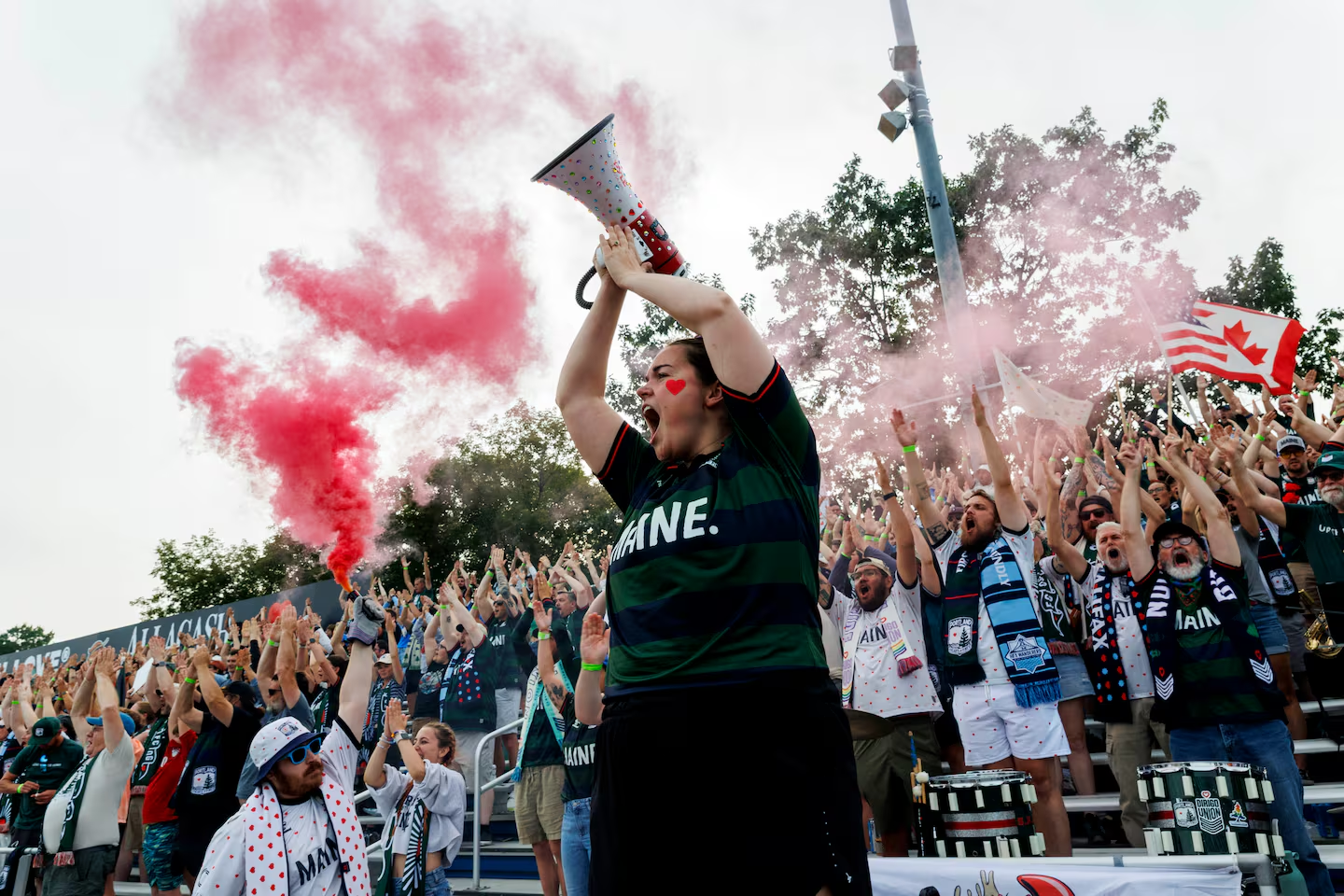
Minutes before kickoff, every scarf in the packed stands is raised to the air as the club’s anthem, “Ballad of the 20th Maine” by The Ghost of Paul Revere, a Portland folk trio, rings through the air.
The atmosphere reaches a fever pitch in the moments before kickoff. It’s the “heartbeat,” which starts as a slow clap, a drumbeat setting the pace, with a chant of “Hearts!” on each joining of palms. The pulse quickens as the pause between claps gets shorter and shorter — and the noise grows louder and louder — until it’s all you can hear and feel in your ears, your feet, and your heart.
“It gets me every time,” Caron says.
It’s easy to not quite notice when the game kicks off. You’re reminded when Portland’s Mickey Reilly latches onto a turnover in the opposing penalty box and fires in the opening goal, setting off cheers, smoky red flares coming from the Zoo, and a rousing rendition of Toni Basil’s “Mickey.”
It’s a “friendly” that turns out to be anything but. Halifax midfielder Jérémy Gagnon-Laparé lunges into a dangerous tackle on Portland’s Khalid Hersi, the first Mainer to sign for the club, in the 26th minute and starts the game’s first fracas.
The continuous singing and chanting from Dirigo Union and the Zoo continues through a back-and-forth match and a 60th-minute goal for the Wanderers. Much of the noise is led by “head capo” Dana Ricker, a bullhorn-toting teacher from Gorham who had never been to a soccer game until her mid-20s. She lives and breathes the Hearts of Pine these days.
Sometimes, she sees her students around the stadium in Hearts gear. Teenage boys, a demographic among whom earnestness and kindness aren’t always deemed cool, proudly wear shirts that read: “Lead with your heart.”
“It’s something very different from other types of sports culture that honestly is so needed right now,” Ricker says. “It’s cool to see these 25- and 23-year-old guys on the field wearing shirts with little hearts on them, and those are the people that these kids are going to look up to.
“It’s not taboo or lame. It’s what they’re supposed to be doing: leading with their heart and leading with kindness and trying to find ways to better other people around them.”
On the pitch, any semblance of friendliness goes out the window in the final minutes, with Halifax earning two red cards. The game looks destined for a 1-1 draw until Portland’s Ollie Wright fires home a sensational volley from 20 yards out in stoppage time.
The noise is deafening. The Dirigo Union is bouncing enough to test the structural integrity of the grandstands. Smoke from the flares fills the air.
At full time, as the singing continues, players make their way over to sign autographs for hundreds of kids lining the fences. It takes Wright close to 45 minutes to make his way down the line.
“Everything you do, you do for the kids,” Hersi says.
The club has followed through on Hoffman-Johnson’s “soccer for good” ethos, whether it’s through supporting local after-school activities, community ticketing programs, or collecting and redistributing secondhand soccer equipment around Greater Portland.
“Our job is to continue to give people reasons to fall in love with this club,” Hoffman-Johnson says. “We have to continue to stay true to who we are over and over and over again.”
It’s working. There are more than 2,000 people on the waitlist and sellouts are routine. A club built from the ground up has plenty of local support behind it, borne of genuine connection, community, and a sense of place.
There may not be a bigger believer in this than Caron, who will comfortably proclaim: “This will save American soccer. And that might be too fine a point on it, but I absolutely believe it.
“What US soccer has tried to do is start massive and work its way down. Bring Pele. Bring Messi. Bring Beckham. It hasn’t worked. What has been growing is the organic, grassroots foundation . . . To me, this is how the United States becomes a soccer country.”
The early indications are there. Similar success has been seen with these lower-league clubs as nearby as Burlington, Vt., where the Vermont Green have made a similar connection in their community (and won a USL League Two championship).
But as much as Hoffman-Johnson does think about the macro implications of the Hearts’ impressive start, that’s a tomorrow problem. For now, the folks behind the success in Portland will keep building things as they have — staying true to Maine, and leading with their hearts.
Read more Elina Svitolina beats Coco Gauff to win Italian Open and Jannik Sinner reaches men’s final




Post Comment