GOP boxed in on Iran war as Trump sidelines Congress
WASHINGTON — President Trump has yet again circumvented the legislative branch as he orders American forces back into combat in the Middle East, weeks after both chambers of Congress rebuked him for waging war with Iran without authorization.
Read more Darline Graham says she will run for a full term in Lindsey Graham’s Senate seat
The collapse of the ceasefire and resumption of hostilities has inflamed a debate on Capitol Hill over war powers just as the administration is seeking tens of billions of dollars to pay for the conflict.
That has presented Republicans with a political worst-case scenario months before midterm elections in which their majorities are at stake: They are being asked to vote to fund an unpopular war over which they have had no meaningful oversight and which they have never voted to approve.
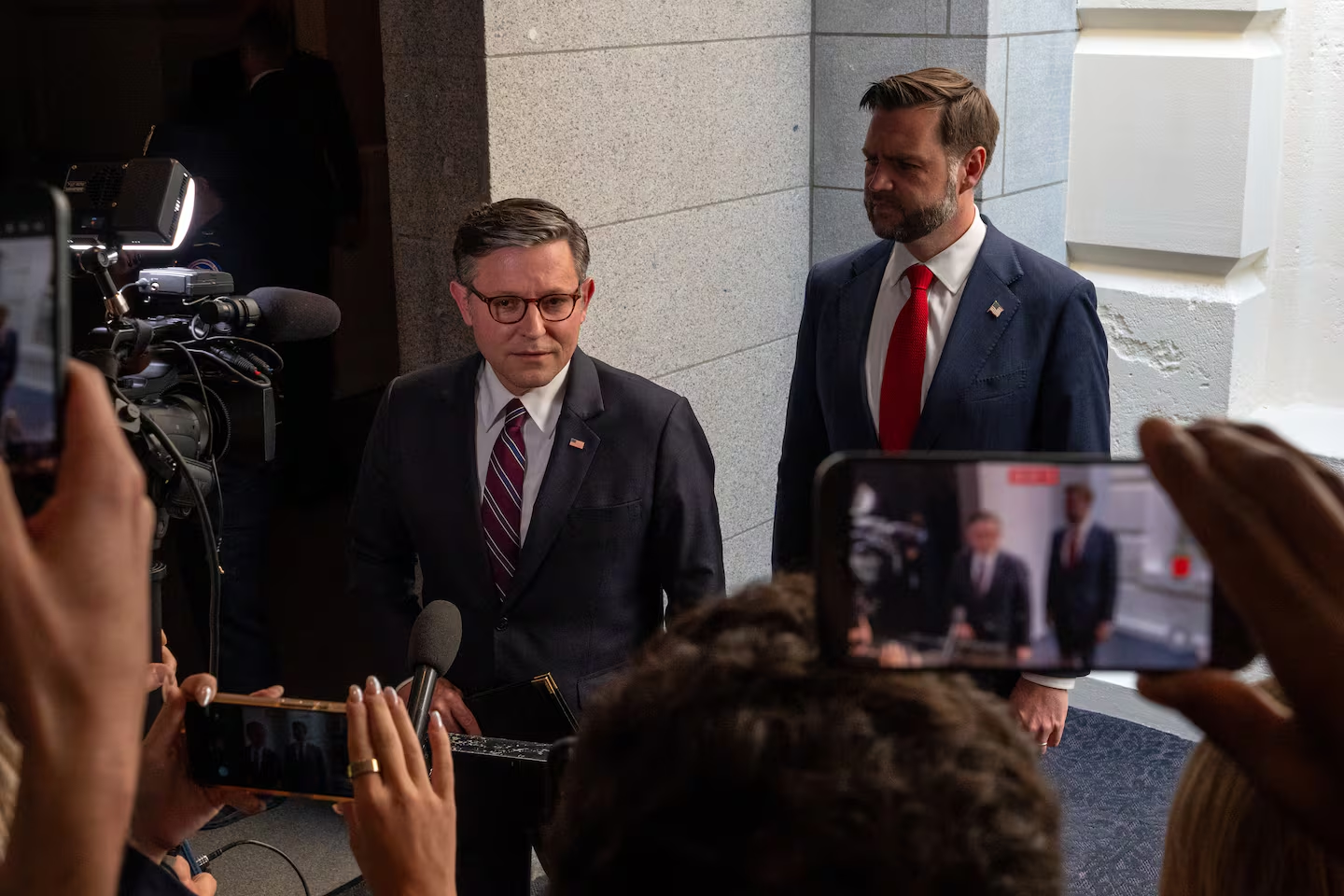
“The greatest fighting force on the planet, the last great superpower, must be fully equipped, and that’s the job of Congress to make sure it’s done,” House Speaker Mike Johnson told CNN’s Manu Raju last week at the Capitol. The administration last month requested $87.6 billion in supplemental funding that would include $67.1 billion in extra military spending this year.
Asked whether it wasn’t also the job of Congress to authorize the war, Johnson replied: “We’re going to supply the needs for America’s national security.”
The position amounts to the latest instance of Republicans ceding power to the executive branch, as they sidestep a debate over the conduct of the war and try to rally support within their ranks for a filibuster-proof, party-line bill to pay for it with no strings attached.
It is all the more remarkable coming weeks after bipartisan majorities in both the House and Senate voted to reassert Congress’ constitutional role over matters of war, a slap on Trump’s wrist four months into a conflict that he had said would last a matter of weeks.
Democrats who worked for months to rally support for such a reproach have followed it up by refusing to allow consideration of the annual defense policy bill or back legislation to fund the military. They have argued that Congress cannot separate its power of the purse from its constitutional authority over war, demanding that the administration share more information about its strategy and plan for the war before they consider voting to bankroll it.
“If the Republicans want our votes, they should provide a credible strategy,” Sen. Chuck Schumer, D-N.Y., the minority leader, said in an interview last week. “How long it lasts, where does it end, what our goals are. Very simple. They haven’t.”
Republicans, by contrast, have largely sidestepped the renewed war powers debate, many of them echoing Trump’s justification for resuming the fight.
“The fact of the matter is, President Trump is the first president dealing with what has been the status quo for decades — which is Iran attacking everybody’s ships, everybody’s navy, everybody’s anything going through the Strait of Hormuz,” Rep. Brian Mast, R-Fla., who chairs the Foreign Relations Committee, said Friday during an interview on Fox News. “After this escalation from them, we are now the United States of America that says this is not going to be the status quo. It’s going to change.”
Lawmakers are expected to get one of their first opportunities to publicly press administration officials on the resumption of fighting Tuesday, when Defense Secretary Pete Hegseth and Gen. Dan Caine, the chair of the Joint Chiefs of Staff, are scheduled to appear before the Senate Appropriations Committee to defend the Pentagon’s request for additional military funding this year.
Read more REI to close its longtime Boston store next month
A handful of Republicans have criticized the administration’s lack of transparency and called for additional information, including those who previously joined Democrats in supporting the war powers measure that called on Trump to end hostilities or seek authorization from Congress.
“If they’re restarting, we should have another briefing,” Sen. Bill Cassidy, R-La., told reporters. He was one of four GOP senators who broke with their party and supported the measure last month.
Sen. John Curtis of Utah, one of the few Republicans who said earlier in the conflict that he would not support military action extending beyond 60 days without congressional authorization, has repeatedly warned his colleagues against repeating mistakes of the past.
“Congress just kept funding the Vietnam War even though there was never a declaration of war,” he said in an interview with Utah news outlet KSL last week, invoking the conflict that ultimately led Congress to enact the War Powers Resolution. “This is not an anti-president move. This is a ‘Congress, do your job’ move,” he added. “We can’t just sit back and put this on the president’s shoulder. We need to get involved.”
But Curtis has consistently joined Republicans in voting against war powers resolutions. And Trump has shown no indication that he plans to work with members of Congress.
He ignored both chambers’ votes directing him to seek authorization for the conflict and last week formally informed Congress that fighting had resumed and that he was again acting under his commander-in-chief authority with no need to consult with lawmakers. In his notification, the president described the renewed campaign as a “limited, measured” response to new Iranian attacks in the Strait of Hormuz but also said American forces remained prepared to take “further action, as necessary and appropriate,” if Iran continued threatening the United States and its allies.
Sunday evening marked the ninth consecutive night that the United States and Iran traded another wave of strikes. U.S. Central Command said in a statement that American forces “were holding Iran accountable at the commander in chief’s direction.”
Three U.S. soldiers were killed over the weekend: two in Jordan when an Iranian ballistic missile struck a military base and another during the disposal of an Iranian drone in northern Iraq.
The number of American military personnel killed since the war began at the end of February is now up to 17.
On Monday afternoon, Trump vowed to avenge the deaths of the soldiers, saying in a social media post that “every time Iran kills an American Soldier they will pay for that killing many times over!”
Read more What I learned on my summer vacation: the Mass. economy edition
This article originally appeared in The New York Times.


Post Comment