Saved by the Scots: Inside the turmoil and triumph of Boston’s big World Cup gamble
Earlier this year, months before the Scots arrived to drink Boston dry and spirit away the city’s collective anxieties over the approaching World Cup, Mike Loynd stared down the world’s biggest sporting event and wondered: Can we actually pull this off?
The obstacles stacked against his tiny organizing team, the Boston Soccer 2026 host committee, were massive. They were “running on fumes,” as he called it, short on cash and facing relentless deadlines. A high-stakes scramble to lock down $20 million in vital assistance from the State House had left Loynd, president of the committee, feeling an “overwhelming” amount of pressure.
Worse, the powerful Kraft family — the event’s financial backstop — and FIFA — global soccer’s notoriously domineering governing body — were locked in a bitter feud with the town of Foxborough over security costs, whose officials threatened to withhold a critical license for the mega event. Boston’s once-in-a-generation opportunity to show itself on a global stage was at the mercy of a town select board.
“I was afraid that this wouldn’t happen,” Loynd said in an interview this week. “It was about six months when it was really a difficult time where we really didn’t have a clear path.”
But come Opening Day on June 11, the tournament and the city roared to life. Thanks to the luck of the draw — quite literally, the tournament draw that placed Scotland for two games in Boston — the magic of the World Cup and its endless capacity to surprise took over.
The arriving Scots didn’t just bring their legendary thirst; they brought a wave of infectious revelry that swept away months of political gridlock and logistical snarls — triggering a collective sigh of relief for Loynd, Governor Maura Healey, Mayor Michelle Wu, and the small band of local leaders who had toiled for years to make the games happen.
Now, for the first time, those key figures are opening up about the pressures they faced behind the scenes, while also taking a moment to celebrate a tournament that ultimately silenced the skeptics and thrilled the fans.
By nearly all accounts, Boston’s big gamble on the World Cup— in spite of the strife and delays — was a triumph.
The seven matches drew nearly 450,000 fans, packing Gillette Stadium to capacity or near capacity. Organizers quickly resolved delays for fans queueing at South Station and the stadium, ultimately transporting 100 percent of fans to the matches on time. Another 160,000 people from 108 countries poured into dozens of festive watch parties across the state.
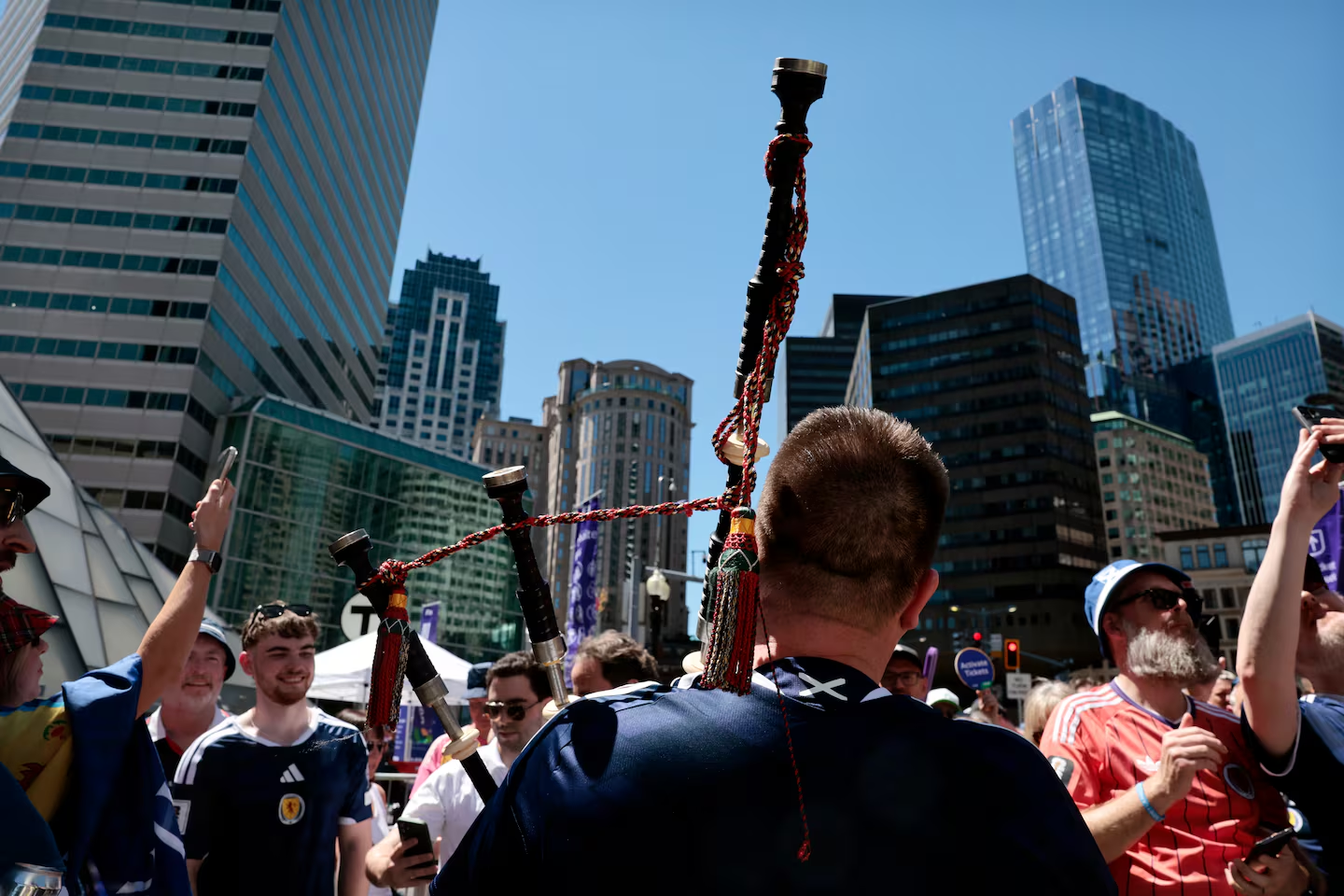
Downtown Boston hummed with frenetic energy: Fans marched through the streets draped in their national colors — blending Moroccan and Norwegian red with Brazilian yellow and Haitian royal blue. The Scots, some 50,000 strong, created a spectacle of their own, with their roaring chants, skirling bagpipes, and statue-topping tomfoolery.
The “beautiful game” didn’t disappoint, and the city embraced it all.
“The World Cup made Boston fall in love with Boston again,” said Brian Bilello, president of the New England Revolution soccer team and director of Boston Soccer 26.
The economic impacts are still being assessed, but early numbers point to a staggering effect: Transactions at bars and restaurants in Boston during the first two weeks of the tournament surged 28 percent, the most of any of the 11 US host cities, according to the payment platform Square. On some match days, consumer spending in Boston increased by as much as 45 percent compared with the same time last year, according to data credit card issuer Visa shared with the Globe.
But one critical question remains unanswered: Did the World Cup pay for itself? The money fronted by taxpayers was significant:$46.6 million from the federal government for security, $20 million from the state, and roughly $35 million from the MBTA. As of now, there isn’t enough information to assess whether the taxes on all those beers, hotel rooms, and other spending by fans will compensate for the local outlays.
Yet, the tournament’s outward success already has city and state leaders looking ahead — openly eyeing a bid to host the 2031 Women’s World Cup. It also led to the creation of a new Greater Boston Sports Commission to help land future mega-events.
“The lesson is that we can do big things, and we can do them really well,” said Governor Maura Healey. “And the other lesson is that Massachusetts should continue to look for opportunities to be a showcase to the world.”
And yet, looking through a deeper lens — and removing the Scottish beer goggles — the early scares leading into the World Cup also delivered a sobering reality check about Boston’s capacity to pull off future mega-events.
The chaotic lead-up exposed turf wars among local, state, and stadium officials, a corporate sector reluctant to open its wallet, and a lack of a broader strategy and funding to attract marquee events. Instead of collaborating, Boston’s leadership at times retreated into fiefdoms. Until days before kickoff, major players did not appear to be on the same page.
Some sports marketing experts and event planners argue that the pre-tournament disarray — exemplified by a last-minute dispute between Wu and state transit officials over crowd control at Boston’s South Station — had an unintended benefit: It lowered the bar for success to the floor level.
“Boston is lucky we got the Scots,” said David D’Alessandro, former chairman and chief executive of John Hancock Financial Services and a former partner in the Red Sox. “But it doesn’t change the fact that our politicians didn’t get along and most of corporate Boston laid down … The next time, whoever comes, we will face the same problems.”
Did it have to be this difficult? Could the fan experience have been better?
It wasn’t only Boston. From the start, organizers here and other host cities ran into the same formidable roadblock: FIFA, the Zurich-based organization that owns and operates the tournament and is projected to rake in a record $11 billion from the games.
For the 2026 tournament, FIFA president Gianni Infantino restructured the tournament, effectively splitting it in two: FIFA retained absolute control over the event and most of its revenues, while host cities and stadium authorities were on the hook for the costs — including hundreds of millions of dollars in upgrades to stadiums, transportation, security, and public fan festivals.
“FIFA was focused on the three things that really mattered to them — money, money, and more money,” said Pat Moscaritolo, former head of the Greater Boston Convention & Visitors Bureau who helped bring the 1994 World Cup here. “It was their way or the highway, and the result was lowered expectations and a reduced fan experience.”
Additionally, the pool of potential corporate funders was small because FIFA prohibited host committees from sponsorships with companies that compete with existing FIFA sponsors. Time and again, Boston’s host committee proposed local sponsors that were rejected by FIFA, according to Loynd.
“The categories of brands that we could go after were very thin,” Loynd said.
While a $5 million grant from Meet Boston provided vital startup funding, the depth of the committee’s financial difficulties came to light in March. Amid its heated dispute with Foxborough town officials, the committee revealed it had less than $2 million in the bank for an event projected to cost more than $100 million to pull off.
Jon Persch, the Boston committee’s former chief commercial officer, said FIFA sought to help but had also established its own revenue goals that made it difficult for local organizers. “FIFA is going to FIFA — they never shied away from the amount of revenue that they wanted to generate to be able to do that, and I think that that had a trickle-down effect,” he said.
In Boston, fund-raising constraints had one highly visible casualty: the scaled-back fan festival at City Hall Plaza.
Originally planned as a 39-day celebration, the lack of money forced organizers to reduce the festival by nearly 60 percent to just 16 days. What’s more, Boston capped attendance at just 5,000 people at any time. By comparison, other host cities went all out: Miami’s waterfront festival hosted up to 30,000 fans, while Philadelphia drew a staggering 55,000 to a hilltop park to watch Haiti face Brazil on June 19.
While Boston hosted nearly a dozen smaller community watch parties to fill the gaps and staged its own watch parties on the plaza after FanFest left, the situation left a bitter taste for some locals. The event, designed for regular fans who were priced out of the stadium games, was the one that got cut short.
Looking back this week, Wu said she initially pushed for a longer fan festival that would have extended several more days to capture the excitement of the high-stakes quarterfinal matches. However, due to strict budget constraints, organizers had already committed to the shortened schedule. By the time the demand was clear, it was logistically impossible to renegotiate terms with vendors, Wu said.
As a result, construction crews began dismantling the giant stage at City Hall Plaza on June 27 —not quite halfway through the tournament andthree weeks before festivals in Houston and Philadelphia were scheduled to wrap up.
To Wu, the festival’s early shutdown was a missed opportunity.
“We already had a gigantic stage that could have stayed up a little bit longer had the financial resources been certain from the beginning,” Wu said. “The decision around the length of that was based on the host committee’s resources that they had in hand, and their decision that there were not enough funds to go longer.”
But the scaled-back fan festival was merely the tip of the iceberg.
International visitors to Boston grumbled about having to shell out $80 round-trip for trains to Foxborough — quadruple the normal rate — while many other cities charged regular transit fares. The dispute Wu had with the T over South Station was resolved only 12 days before the first match. Meanwhile, the effort to recruit and train 3,000 volunteers was hampered by delays, communication breakdowns, and glitches.
To top it off, many community watch parties planned across the state were caught in FIFA-created bureaucratic limbo around the issuing of broadcast licenses until the last minute.
Boston also faced a major disadvantage compared to other host cities: It lacked an established, state-funded sports commission with a proven track record of landing marquee events.
In contrast, Atlanta, Los Angeles, and Philadelphia have robust commissions designed to raise private capital, secure corporate sponsorships, and negotiate complex logistics with public officials. Philadelphia’s commission was so effective that local organizers had already secured more than $40 million in funding commitments by 2021 — well before it was selected by FIFA as a host.
Other host cities also enjoyed far more state support. Missouri, for instance, poured $74 million into Kansas City’s World Cup, or more than three times what Boston organizers received.
Last November, Meet Boston announced the formation of the Greater Boston Sports Commission, and a proposed provision in next year’s state budget would direct a portion of sports-wagering taxes to fund it.
Meet Boston chief executive Martha Sheridan said the commission would help the state secure funding for upcoming events and overcome obstacles such as those by FIFA.
Unlike other cities, she said, “We never had that luxury, but we managed to do all right in the end.”
According to Wu, the lack of a state-funded commission accounted for “90 percent” of the anxiety over whether Boston could actually afford to pull off the massive tournament.
“What other places did have going for them was again the sense of being able to start earlier, with certainty coming earlier with funding,” Wu said. “Having a [sports] commission that we’re now looking to stand up that would, over time, institutionalize the ability to have funds … that would be a game-changer for future events.”
Now, with the World Cup ending on Sunday, the city’s gaze turns to the next big stage.
The bagpipes have gone home, and the orange cones have come down from Boston’s patriotic statues.
Next comes the real test: Can Boston throw a giant party like this on its own, or does it need thousands of Scots to show the way?
Globe correspondent Yogev Toby contributed to this report.


Post Comment