‘Simple but incredibly meaningful’: Mass. Senate wants to allow for more duplexes in bid to ease housing crunch
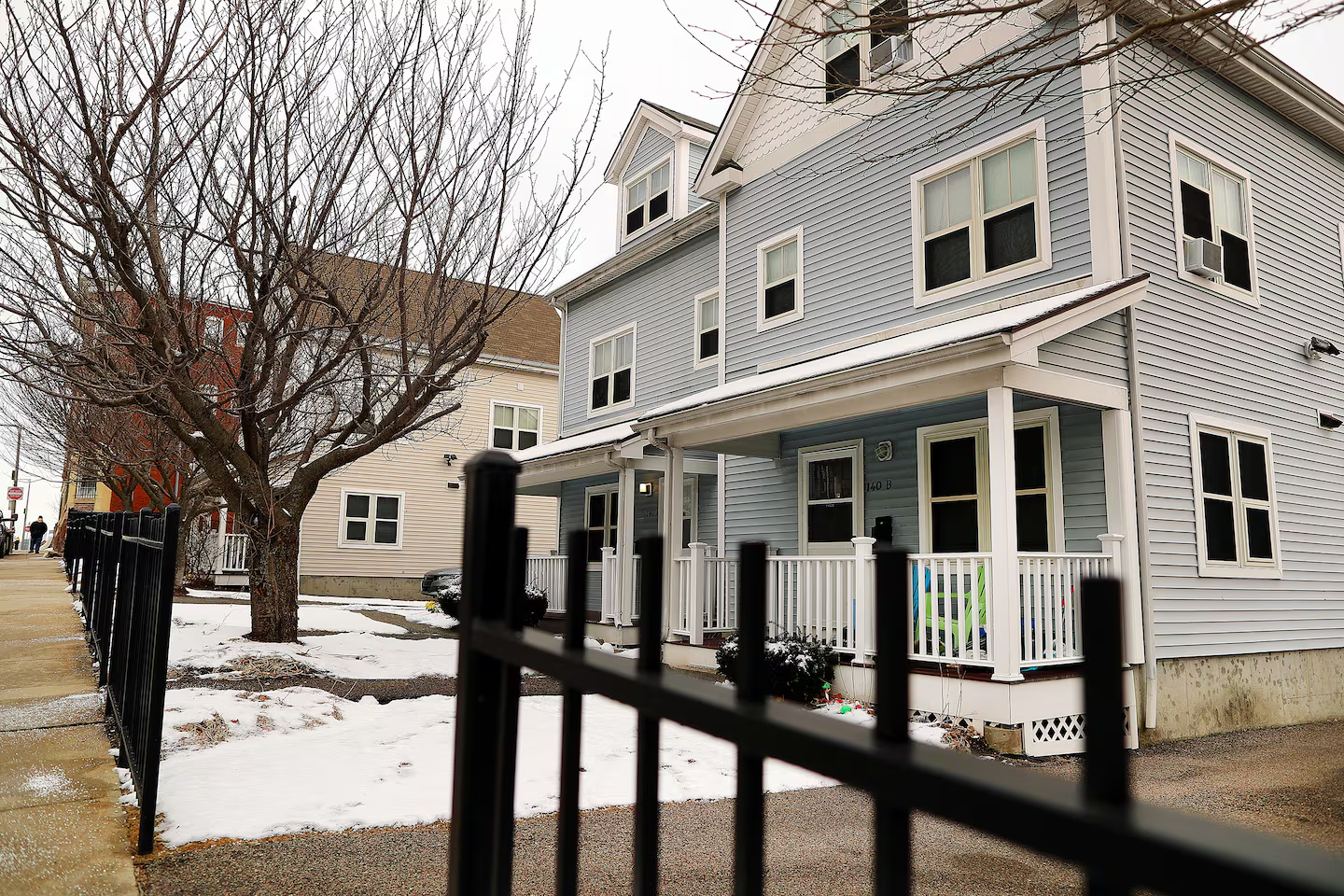
Housing looms as the state’s most pressing affordability issue. The Legislature’s latest solution? Allowing for lots more duplexes.
Read more White House teleprompter operator bet on Trump speeches, Kalshi says
Democratic Senate leaders said Thursday they would take up a measure next week that would allow two-family homes, or duplexes, to be built “by-right,” meaning they could be built on any residentially zoned lot in the state.
Legislators tucked the proposal into a wide-ranging economic development bill that would authorize more than $300 million in borrowing and create a variety of new policies. Those include puttingguardrails onlarge artificial intelligence companies, allowing local officials — not state lawmakers — to set caps on liquor licenses, and regulating where and how e-bikes, mopeds, and scooters can be used.
Senate officials said the duplex language could “vastly” expand the number of housing units in a state that needs hundreds of thousands of new homes in the coming years to meet demand.
“This is a simple but incredibly meaningful reform,” said state Senator Julian Cyr, a Provincetown Democrat who worked on this legislation. “Duplexes are part of what we often call missing middle housing — and we’ve been missing it for quite a while.”
Cyr and housing advocates have pitched duplexes as a way to expand units while still preserving the “character” of neighborhoods. The legislation, he said, would allow those who own residential property and who seek to build a duplex that meets local requirements to avoid “navigating unnecessary barriers or seeking special permission” to build.
The MassachusettsHouse, too, passed housing measures in its version of the economic development bill earlier this month, including one that would make it easier for religious institutions to develop housing on their properties.
The Legislature did not take up standalone housing legislation this session after passing a $5.2 billion package two years ago, instead opting to attach various housing proposals to other bills.
Jesse Kanson-Benanav, executive director at the affordable housing group Abundant Housing Massachusetts, said he was “really excited” to see the duplex provision, calling it “one additional tool” to ease the state’s affordable housing crisis.
“Folks who create the backbone of all our communities are the folks that are struggling to afford to live in Massachusetts,” Kanson-Benanav said. “We need to change the laws that will allow us to build the variety of types and shapes and levels of affordability of homes that Massachusetts residents need.”
The proposal, however, also drew skepticism from the Massachusetts Municipal Association, a group representing the interests of the state’s cities and towns. Adam Chapdelaine, the group’s executive director, said the law would “represent a significant erosion of municipal authority over local planning and zoning.”
Read more Trump administration caps how long international students can stay in the US
“The MMA and municipal officials share the goal of creating more housing, but durable solutions are only achieved through partnership with communities, not by overriding local decision-making,” he said.
Economic development packages have historically served as a catch-all for policies lawmakers want to get across the finish line, particularly as the Legislature approaches a self-imposed deadline on July 31. Under new rules lawmakers adopted last year, most bills must pass each chamber and enter negotiations in a so-called conference committee by that date to stay alive for lawmakersto pass before they close out their two-year legislative session.
The Senate’s initial economic development bill would authorize about $230 million less in borrowing than the House’s version. Senators will likely increase that bottom line and add more policy riders during their debate next week.
“We stand in the face of a federal government that has never been more hostile to the people of this state,” Senate President Karen Spilka said at a newsconference announcing the legislation. “Massachusetts has a responsibility to do what we can to keep our economy thriving.”
Many of the policies the Senate included mirror measures the House folded into its version, including a proposal to regulate e-bikes.
The Senate’s version would bar those under 14 from using so-called micromobility devices that go up to 20 miles per hour, andbar those under 16 from using onescapable of traveling 21-30 miles per hour. And shared-use paths would have a default speed limit of 20 miles per hour, according to the proposal.
The Senate’s bill differed from the House’s in other key ways, including proposing AI regulations that would require companies to publish a safety framework and create accountability mechanisms, enforced by the attorney general’s office. State Senator Barry Finegold of Andover, who chairs the economic development committee, called the proposed measures “common-sense guardrails.”
The Senatealso wants to put $100 million toward research at public colleges and universities that have faced federal funding cuts. The Senate’s proposed funding, which excluded private institutions, was less than the $200 million the House proposed for colleges and universities and would bea fraction of the original $400 million that Governor Maura Healey had proposed last year for her so-called DRIVE Initiative.
The bill the Senate released also seeks to give control over issuing liquor licenses to cities and towns, a sea change in how the sought-after permits are handled.
The Senate had passed a similar measure in its state budget proposal last year, but it didn’t survive negotiations with the House, whose leaders have long opposed relinquishing a legislative authority they have framed as a necessary check on local government officials.


Post Comment