Fatal shooting by ICE puts Susan Collins’s role as a Trump administration middleman under scrutiny
In January, just days into the Trump administration’s controversial deportation crackdown in Maine, Republican Senator Susan Collins announced the “enhanced operation” was over and implied heavily it had come at her urging.
Read more Prosecutions, Epstein, and the $1.8b fund: What to watch at Todd Blanche’s confirmation hearing
The move was characteristic of Collins’s approach in the Trump era to demonstrate her distinct value by positioning herself as an effective backchannel to a Republican administration for a state led by Democrats.
But the killing of 26-year old Johan Sebastián Durán Guerrero by Immigration and Customs Enforcement agents on the streets of Biddeford, Maine, on Monday underscored what local officials and advocates have known for months: Far from retreating, the agency continued a high level of operations in the state, just more quietly and with different tactics.
The pace and volume of arrests did drop significantly after the conclusion of ICE’s heightened operation in January, which resulted in more than 200 arrests over four days, as the Globe previously reported. There were 40 detentions in the six weeks that followed, according to the Portland Press Herald. (The administration has not yet released its most recent quarterly immigration enforcement data.)
In her statement in January, Collins did not claim ICE would depart entirely from Maine, saying only there were “currently no ongoing or planned large-scale ICE operations here” and the agency “will continue their normal operations that have been ongoing here for many years.”
Many local leaders, however, soon became acutely aware ICE continued to operate in ways that did not seem normal. David Morse, the Democratic mayor of Westbrook, where ICE agents were spotted in January, said many residents are still afraid to go about their normal routines.
“What the difference mainly seems to be is that however they were operating in January was kind of designed to be noticed, and the activity since then has continued,” said Morse. “I assume that their operational tactics had shifted to, ‘we don’t want to draw attention or too much attention.’”
By May, Maine immigrant rights advocates were reporting signs of heightened ICE activity, such as a sharp uptick in calls to a help hotline, as the Globe reported that month. According to the office of Representative Chellie Pingree, the Democrat representing Maine’s First District, its representatives are fielding at least one call weekly from residents directly affected by ICE activity.
“I would concur that the numbers have been reduced from the surge that happened in January, but there’s just no question: They have been continuing these detentions, stops, pickups,” Pingree told the Globe.
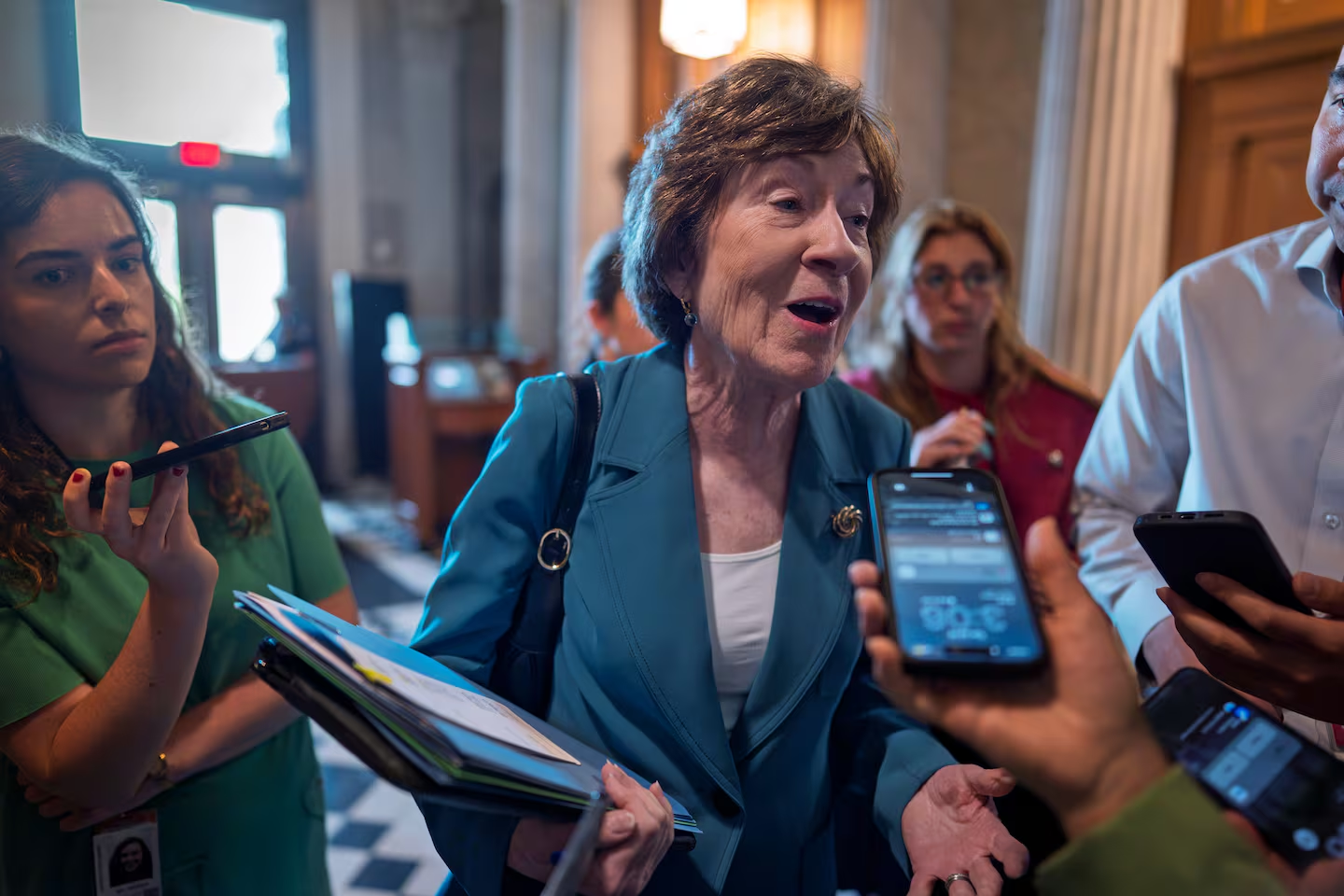
When asked by the Globe in the US Capitol on Tuesday about claims that ICE did not wind down operations in Maine after January, Collins responded, “they clearly did.”
“What appears to have happened is that there now has been … somewhat of an increase of ICE activities” before the deployment of more body cameras for which she had secured funding.
The shooting in Maine this week has again brought her role as intermediary into the spotlight.
Calling Guerrero’s death a “tragedy,” Collins noted her frequent engagement with the administration since Monday. She told reporters she had spoken three times with Department of Homeland Security Secretary Markwayne Mullin, telling him “it would be wise” for ICE to temporarily cease conducting non-urgent traffic stops. The agency reportedly instituted that order on Tuesday. (An ICE spokesperson would not comment on the call or on overall agency tactics.)
The stakes of Collins’s actions are only magnified by the pressures of an election year in which she is running for a sixth term. Her powerful role in Washington also figures significantly into the immigration issue.
As chair of the Senate Appropriations Committee, Collins has considerable influence over funding for ICE and other agencies. Earlier this year, after ICE officers killed two civilians in Minnesota, Democrats pushed for new restrictions on the agency’s operations in exchange for any continued funding.
The resultingstandoff with Republicans led to a months-long shutdown of DHS, which ended when the GOP pushed through a $70 billion package to fund the agency for three years with no new conditions. Collins joined all other Republicans in voting for the legislation.
Read more After fatal Maine shooting, Healey renews calls to rein in ICE
The senator touted her efforts to secure $20 million in the bill for body cameras for federal immigration officers, along with $2 million in de-escalation training. Speaking on Tuesday, Collins blamed Democrats for delaying that funding, suggesting it was a reason why the agents involved in the Maine shooting did not have body cameras. Federal law does not require immigration enforcement to use them;Democrats pushed for them to be mandated as a condition of ICE funding.
Administration officials had pledged to deploy body cameras throughout ICE forces in response to the violence in Minnesota. Collins’s Maine colleague, independent Senator Angus King, questioned why the body cameras were not used in Maine yet, given the agency’s massive budget.
Collins’s role as Appropriations chair, and her eventual support of Trump’s overall immigration requests, has drawn criticism from Democrats vying to face her in November.
With Graham Platner’s withdrawal last week as Democrats’ nominee to take on Collins, the group of Democratic hopefuls competing for the party’s nomination at a July 25 convention all quickly seized on Guerrero’s killing to galvanize their candidacies and to attack Collins.
Three leading contenders — Troy Jackson, Shenna Bellows, and Nirav Shah — appeared in Biddeford on Monday and Tuesday for events and to join demonstrations. All the leading Democratic candidates support abolishing ICE.
Shah, who held a press event outside Collins’s office in the city, said the Republican senator claimed credit for brokering the de-escalation in January but that “it was nothing of the sort… it was just a shift of tactics to go from the visible to the invisible.”
“Here we are just a couple of months later, and a Mainer has been murdered,” Shah told the Globe. “Susan Collins predicates a lot of her case for her reelection on her ability to get things done in Washington. She can pick up the phone and call anyone. If that’s the case, why did the supposed de-escalation result in re-escalation?”
In a statement to the Globe, Collins campaign spokesperson Blake Kernen said “it’s unfortunate that Democrats who are desperate to be appointed to run for the Senate are using a tragedy to further their political aspirations.”
“It’s important we improve ICE’s performance, and that is why Senator Collins negotiated new protections in the DHS funding process [that] became law in April,” said Kernen, referencing the body cameras and a “17 percent increase” in funding for the office of a DHS internal investigator.
“Abolishing ICE would make America less safe,” added Kernen, referencing the Democratic candidates’ positions. “Anyone calling for abolishing ICE is calling for the agency to cease critical efforts to combat human trafficking, child exploitation, forced labor, and international drug smuggling.”
As demonstrations continued around Maine into Tuesday, local officials expected more attention on Collins’s role and significant potential impacts on the Senate race.
Cory Fellows, chair of the town council of Scarborough, which is home to ICE’s lone facility in Maine, agreed that the agency’s presence in the town, and activity around the state, has continued to be a major issue since January. (Fellows’s position is nonpartisan but he is a Democrat.)
“Even after things were wound down and Susan Collins took some credit for that, rightly or not, there was this sort of background baseline level of activity,” Fellows said.
“There would’ve been a lot of eyes on this regardless, but given that we are into what most people expect to be a pretty contentious election cycle, that has really heightened the level of vigilance and energy around it.”
Read more House passes bill to ‘ditch the switch’ and make daylight saving time permanent


Post Comment