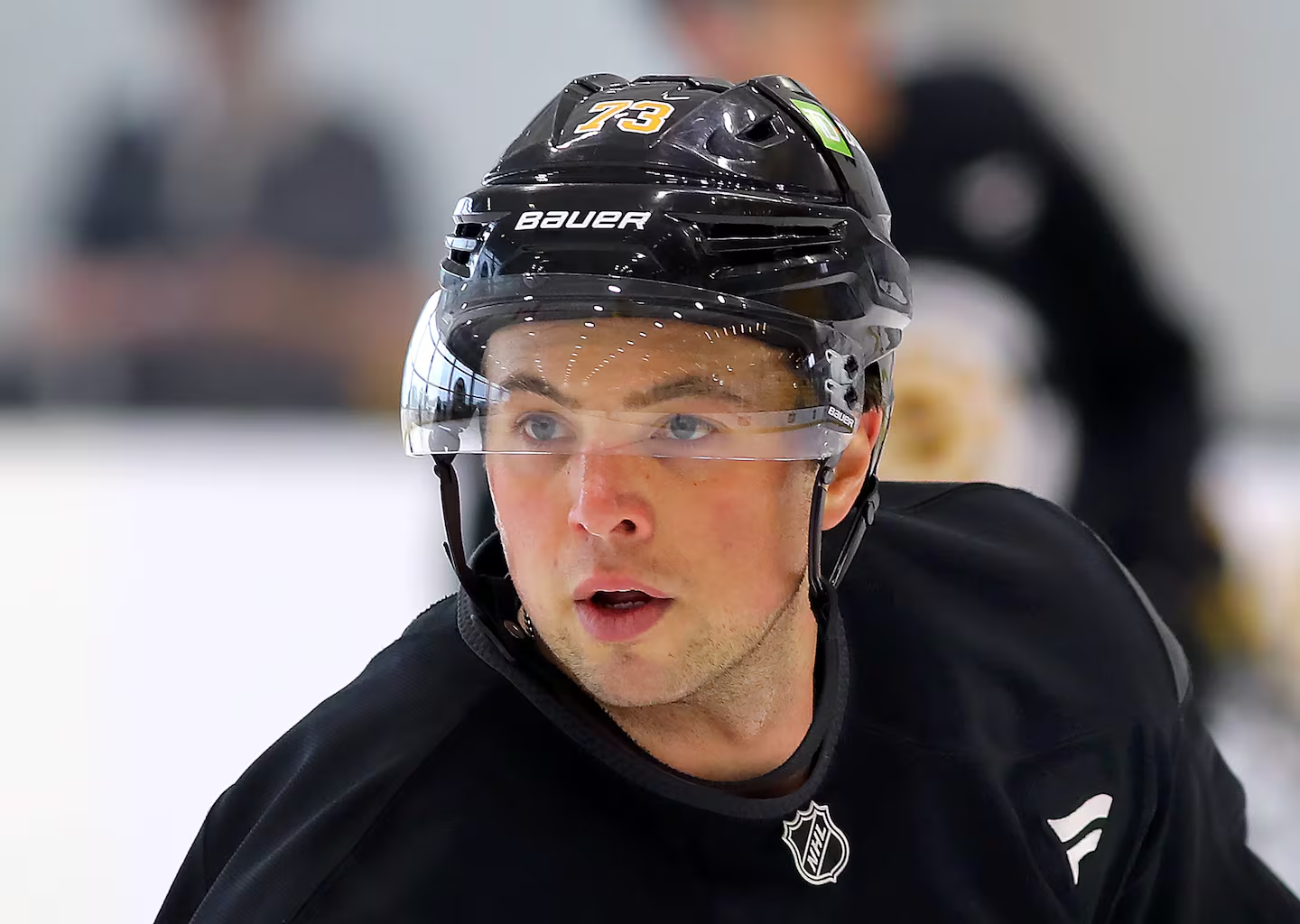
Auditions for a top-pairing defenseman to ride alongside Charlie McAvoy can extend into regular season now
The Bruins earlier last week received official notice that they’ll start 2026-27, the NHL’s return to an 84-game regular season, with one foot stuck deep in the bucket while Charlie McAvoy serves a six-game suspension for his Casey-at-the-Bat hack on the Sabres’ Zach Benson.
It could have been worse for McAvoy. The league’s department of player safety, its disciplinary rulings a hybrid game of roulette and 1-2-3 shoot!, would have surprised no one if it tagged the Bruins defenseman with, say, 8-10 games. McAvoy, rightly furious after being slew-footed into the rear wall by Benson, cracked his baseball-style swing across the irritant forward’s right arm in Buffalo just before the Bruins’ season ended with an Eastern Conference first-round playoff series loss in six games.
It also could have been a lot worse for Benson, who was lucky to walk away unscathed, lip readers suggesting he muttered, ’Tis but a scratch.” (see: Black Knight, “Monty Python and the Holy Grail.”)
Player safety didn’t express it in the ruling, and never would, but Benson’s nasty slew foot (whistled as a two-minute trip) had to have factored in its decision to cap McAvoy’s penance at six games. Referees Gord Dwyer and Pierre Lambert missed the danger factor, blatantly obvious in the replay. The league couldn’t excuse McAvoy’s action, but holding the line at six games speaks to player safety recognizing Benson set the fire (pyromania is an enviable art, particularly in the NHL postseason).
Meanwhile, the Bruins front office now has all summer, plus a half dozen games, to figure out who best to be McAvoy’s regular lefthand man upon his return. Just as the club won’t add substantially to its postseason expectation until finding a bona fide No. 1 center, it desperately needs to come up with a dynamic, prolific No. 1 defense pairing.
The gifted McAvoy represents half of the answer. Jonathan Aspirot is not the other half.
Aspirot deserves tons of credit. Now age 26, he came out of AHL obscurity (six-plus seasons with Belleville, Calgary, and Providence) and proved to be a reliable, stout partner for McAvoy. Admirable. For what was expected of him, and for the position’s demands, Aspirot by far would have been the best pick, ahead of forward Fraser Minten, for NESN’s Seventh Player Award.
Now, all that credit and feel good aside, Aspirot is not a first-pairing D-man in the fastest, most competitive hockey league in the world. More to the point, he’s not the guy, and just can’t be the guy, to help McAvoy get his motor running at top RPM.
The Bruins have been waiting way too long for McAvoy to head out on that highway.
Imagine if we’d said here in October that a career minor pro, one who was never drafted, would be the top choice to help McAvoy reach new heights in his ninth NHL season. How fast do you think reader hate would have reached “mailbox full” level for your faithful puck chronicler? Keep those kind words coming, gentle readers. Currently, the prime left-shot candidates to pair with the right-shot McAvoy remain Hampus Lindholm, Nikita Zadorov, and Mason Lohrei. A case can be made for any of the three, though the best case, by coach Marco Sturm’s eye, ended up being Aspirot.
By the end of the playoffs, Lohrei, age 25 and with 191 NHL games under his belt, was sitting in the press box, with Sturm now the third Bruins coach to find too much risk and too little reward in the young, eager blue liner’s game.
As the end-of-season presser wrapped up at the Garden, a question to Don Sweeney about Lohrei’s suitability as McAvoy’s partner had the general manager lauding the former Ohio State standout’s skills and improvement over his three NHL seasons.
“He’s able to execute some of the skill plays that I wasn’t,” noted Sweeney, who enjoyed a long playing career (1,115 games) including lengthy stints as franchise defenseman Ray Bourque’s running mate. “You applaud that. Now, can [he] play with the same conviction that you want from every one of our players? That’s the balancing act. Mason’s got a lot of upside.”
Look, transplant Aspirot’s competent, simple, safe defensive game into Lohrei’s body and, whoa, the table is set and the dinner bell be ringing. Until the good team doctors at MGH figure out that bit of medical mojo, Lohrei remains the guy who watched from the ninth floor as his pals on the ice fought to take the Sabres to a Game 7. If he’s not traded in the next few weeks, Lohrei’s back in September, still in need of convincing Sturm his game comes with more reward than risk.
The skilled Lindholm has paired previously with McAvoy and, in theory, remains the best fit for the role. Sturm chose otherwise, in part as a means to spread the skill wealth across the three pairings.
Lindholm started the playoffs with Lohrei on his right and finished with a shaky Henri Jokiharju in that spot. All in all, hardly the best use of Lindholm’s talents either. McAvoy worked in a compromised pairing. Ditto for Lindholm. Any wonder the Sabres’ backliners outscored their Black and Gold counterparts, 6-0, across the six games?
As for Zadorov, his main value in his two years here has been as a shutdown strongman. He improved in that role this season, despite again taking too many penalties. He has more offensive skill than many realize, and it could be fun to see him ride full time with McAvoy. You never know, right? He sure can shoot and he is amazingly nimble at 6 feet 7 inches, 255 pounds. Still, no way would Sturm make New Z a No. 1 pairing fixture.
July 1 free agency has 40-plus defensemen currently on path to hit the open market. The biggest name there is John Carlson, the former Capitals great dealt to the Ducks at the March deadline. But Carlson, like McAvoy, is a right shot. He is also 36 years old and pricey. Carlson chipped in with 0-6–6 in the Ducks’ dozen playoff games.
If there’s an ideal fit to find for McAvoy, it’s a guy who could ride with him for five years or more, someone to help him routinely reach 25 goals and 75-80 points a season. He has the talent to be that guy and he’s about to enter a 10th season without a partner to provide him a 10-finger boost to get there.
Frederic Brunet, Providence’s top scoring defenseman (12-24–36) this season, is a left shot. Far too premature to think of Brunet as the “McAvoy and …” answer. Brunet is likely to see abundant looks during training camp and the abbreviated pre-season. A long shot, but after seeing Aspirot’s ascension anything is possible and all options are on the table.
CHANGING COLORS
Maple Leafs have coaching options
The anticipated turfing of Craig Berube as Maple Leafs coach brought to five the number of 2025-26 bench bosses to get the gate. For his two years on the job, Berube led Toronto to a mere four more wins than losses at 84-62-18, despite his debut season of 52-26-4.
Next up to coach the Maple Leafs, who remain in search of their first Stanley Cup since 1966-67? Bruce Cassidy’s name, speculated as a candidate weeks before Berube was ditched, will remain atop the pile. Toronto has to go with a name and Cassidy has the requisite Q factor and track record, including his name on the Cup in 2023 with the Golden Knights.
Patrick Roy, like Cassidy fired by the Islanders late in the season, may still have too much of a Canadiens identity for new Maple Leafs GM John Chayka to consider him seriously for the job. But, remember, Pat Burns slipped seamlessly behind the Toronto bench immediately after his four-year tenure in Montreal ended. Burns also directed the Maple Leafs to back-to-back trips to the Eastern Conference finals in 1992-93 and ‘93-94.
Toronto is in no position to worry about Roy’s lingering Les Glorieux vibe if it truly thinks he is the best fit.
NHL insider Frank Seravalli reported the Golden Knights didn’t grant the Oilers permission to talk with Cassidy, who still has a year’s pay left on his Vegas deal (at a reported $4.5 million). The Oilers didn’t deny the report, perhaps because they still had Kris Knoblauch under contract as their coach. Now that’s awkward. Less than 48 hours later, Edmonton booted Knoblauch.
If true that the Oilers were denied access to Cassidy, it may seem petty on the Golden Knights’ part, but they still own the contract and its salary obligation. Vegas had the right to call the shots, though historically clubs grant quick release.
Upon Cassidy’s dismissal, the read here was the Kings would reach out in an attempt to hire him to replace interim D.J. Smith (who replaced Jim Hiller on March 1). I also suspected then that the VGK might prohibit the Kings from contacting Cassidy and posted that suggestion to social media.
If the Kings want to hire Bruce Cassidy, would the VGK stand in the way?
— Kevin Paul Dupont (@GlobeKPD) April 6, 2026
Some then did not understand it, but until or unless contracts are viewed or written otherwise, the club holding the contract maintains the right to make the call. Few GMs, if any, would give Cassidy unfettered access to take a job with a divisional rival.
The bet here: Vegas quickly works a deal (read: financial relief) with the club that ultimately signs Cassidy. The only logic behind not letting Cassidy go would be if Vegas entertained the idea of putting him back on the job. Crazy, right? Right?
Meanwhile, look for at least a couple of more firings between now and the June draft. Also, Smith (Los Angeles) and John Tortorella (Vegas) remain interim space savers at this hour.
ETC.
McKenna opts for combine over Worlds
Gotta love Sidney Crosby’s boundless passion for being on the ice. The Penguins’ surefire Hall of Fame center, age 38 and with three Stanley Cups and 1,420 regular-season games, answered Canada’s call for the IIHF World Championships that began Friday in Switzerland.
Meanwhile, fellow Canadian Gavin McKenna, expected to wear his nation’s red Maple Leaf at the Worlds, ultimately chose to stay in North America and instead train for the upcoming NHL Draft combine (June 1-6 in Buffalo).
McKenna (5-11/170 pounds) remains the presumptive No. 1 pick in the draft (Round 1, June 26), destined to be the cornerstone of the Maple Leafs’ rebuild. That’s a heavy lift, by the way, as Connor Bedard and the Blackhawks have come to realize.
“It’s better for [McKenna’s] development to stay back,” agent Matt Williams of CAA Hockey told NHL.com.
It also eliminates the risk of injury for the 18-year-old winger. He faced older players in his year of NCAA play at Penn State, but it’s a big leap from college to a world tourney stocked with NHLers.
Money matters
The Blue Jackets and ex-Bruin Charlie Coyle offered a preview to the spiked paydays we can expect to see when unrestricted free agency starts on July 1. Rather than test the market, the 34-year-old Coyle, perhaps the game’s best No. 3 pivot, signed on for six more years in Columbus at a $6 million average annual value.
It’s outstanding dough for the steady Coyle, who spent this season in Columbus after his short tour with the Avalanche upon being dealt out of Boston in March ‘25.
Though never a prolific producer, Coyle was rewarded, in part, for endurance and dependability. He suited up for all 82 games this year and has not been sidelined since 2020-21, his third season with the Bruins. He played in 83 games last season because of the trade, including 64 with the Bruins and 19 for Colorado.
What impact might Coyle’s cash has on the Bruins’ two UFAs, winger Viktor Arvidsson and former Blue Jackets defenseman Andrew Peeke? Both are eligible to re-sign before July 1 and Sweeney said on autopsy day that he’s talked to their agents about remaining on Causeway Street.
Whatever figure the sides had in mind, Coyle’s AAV surely changed the math, particularly for Arvidsson, who is a year younger than Coyle.
“Arvy” has termed out of a deal that carried a $4 million AAV while Coyle’s previous deal, signed in Boston, was for $5.25 million per season. Based on Coyle’s bonanza, Arvidsson can expect the market to yield perhaps some $30 million over six years, a payout akin to what the Panthers a year ago handed former Bruins captain Brad Marchand (six years/$31.5 million). Marchand was 37 when he signed that Sunrise-to-sunset extension.
Coyle’s new deal kind of reframes the numbers, doesn’t it?
As for Peeke, 28, his expired AAV is $2.75 million. He is now a proven third-pairing guy with a right shot, which often brings a premium, and he has the skill to play higher in the order. With a potential for another 31 teams bidding, perhaps he comes in at five years/$20 million?
For the most part, the UFA market is underwhelming. The keenest interest, if all decide to continue their careers, could be around aged Russians Sergei Bobrovsky, Alex Ovechkin and Evgeni Malkin, all with their names on the Stanley Cup and each with career average earnings of some $140 million (per puckpedia.com). The bet here: all return with their current clubs, on one- or two-year deals around $5 million AAV.
Loose pucks
The NHL last played an 84-game slate for two seasons, 1992-93 and ’93-94, then trimmed back to 82 with the collective bargaining agreement that settled Lockout No. 1 in ’94-95. The Bruins, then with Adam Oates, Ray Bourque, and Cam Neely at the top of the order, finished those seasons with 109 and 97 points, respectively … With their sweeps over the Senators and Flyers, the Hurricanes enter the Eastern Conference finals as the lone franchise ever to stand a perfect 8-0 after two rounds in this era (dating to the 1987 playoffs) that requires 16 wins to capture the Stanley Cup. The best record en route to the 16 Ws belongs to the 1987-88 Oilers, who needed only 18 games (16-2) to capture their fourth Cup of the ’80s. The finishing touch came against the Bruins, with Game 4 a re-do staged at Northlands Coliseum after a power transformer exploded outside Boston Garden and sent everyone home with the score tied, 3-3. The Oilers thumped the Bruins, 6-3, two nights later, which also turned out to be a 27-year-old Wayne Gretzky’s final home game in Edmonton … But for the bounce of the ping-pong balls last May, the Bruins on Wednesday would have celebrated their own Matthew Schaefer as the NHL’s Rookie of the Year (Calder Trophy) winner. The Bruins held the No. 5 spot in that draft lottery, and could have slipped into the No. 1 hole, only to see the Islanders filch it with a leap from No. 10 to select Schaefer. The 18-year-old Schaefer had a stellar freshman season (23 goals, 36 assists) and became the first unanimous Calder pick since Teemu Selanne, the Finnish Flash, who potted an astounding 76 goals and collected 132 points in 1992-93 in Winnipeg for the original Jets.



Post Comment