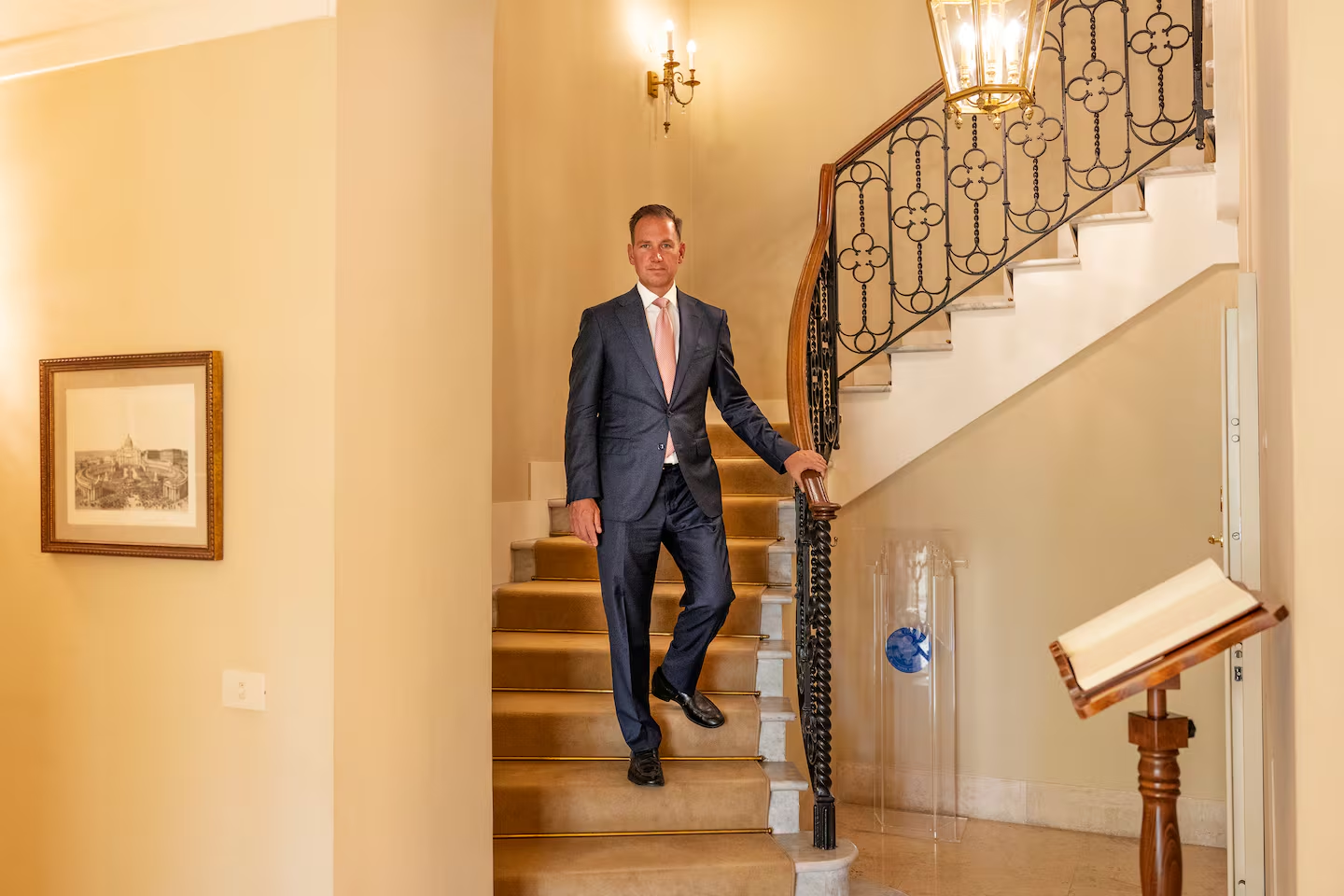
Trump’s loyal defender at the Vatican
ROME — To the world, it has seemed clear for months that President Trump has been fighting with Pope Leo XIV about the U.S.-Israeli war in Iran, which the pope has said is not a just war.
But to the president’s man at the Vatican, that narrative is simply “false” and “entirely unfair.”
In fact, the U.S. ambassador to the Holy See, Brian Burch, would go so far as to say that the pope — the first born in the United States — has not even declared the war unjust.
“The Vatican has not said, nor will they say, declare definitively whether or not this is a just or unjust war,” he said during a 90-minute interview from his office in Rome in late June.
Yet on a flight to Spain several weeks earlier, the pope spoke plainly.
“I believe this has already been made very clear: In Iran, the criteria for a just war are not present,” Leo said.
To Burch, declaring the Iran war unjust is not a judgment the pope can make because he has access to only “a set of limited facts.”
An ambassador’s job is always part ceremony, part policy. Inevitably, there are differences between countries that the diplomat must help navigate.
But Burch is in an unusual spot. Leo is no typical head of state who deals simply in temporal politics. He is the world’s most prominent religious leader, attending to the moral lives of 1.4 billion Catholics, including Burch.
A longtime conservative Catholic activist, Burch also navigates the relationship between the two most prominent American men in the world — a popular pope and a bellicose president who have sharply diverging visions of global leadership.
Burch has made clear his fealty to Trump, even as the president publicly derided the pope on social media and Vice President JD Vance questioned the theology of the leader of the Catholic Church.
“I have never once thought for a second that somehow I couldn’t properly represent the president,” Burch said, adding that he believes the president and the pope share goals that “are very much aligned.”
An American pope is a unique opportunity for the United States, but he said that fundamentally, “the policies and leadership of President Trump are enabling a moment for the Catholic Church to both grow and thrive.”
At times, Burch believes the Vatican has failed to understand Trump’s agenda. After the Defense Department invited Cardinal Christophe Pierre, the Vatican’s ambassador to the United States at the time, to a rare meeting at the Pentagon in January, reports spread that U.S. officials had threatened the Vatican for its position on the war in Iran. The meeting was “grossly mischaracterized,” Burch said.
Burch presumed a leak had likely come from the Vatican’s side — “the story was largely an attack on the United States,” he said — so he called Pierre to ask for an apology and to help identify “who was lying about this meeting,” he said. He then posted a statement saying that Pierre “emphatically denied” the reports, and the Vatican also confirmed that details of the meeting had been exaggerated. Pierre did not respond to a request for comment.
Trump nominated Burch, who had been the president and co-founder of Catholic Vote, a political advocacy group, after he helped him win key states like Pennsylvania in the 2024 election. Burch’s confirmation as ambassador was a symbol of the rising strength of the conservative Catholic movement in America. He and his wife have nine children, and like Leo, he lived in the Chicago area.
Burch’s views on the president have evolved over time. Catholic Vote did not support Trump in 2016, citing concerns over his moral judgment, but it had reversed course by 2020. In Burch’s book “A New Catholic Moment: Donald Trump and the Politics of the Common Good,” he wrote, “Donald Trump is Catholics’ best choice — perhaps our only choice.”
Over two interviews in the past two weeks, Burch sometimes deployed his own Trump-like rhetorical flourishes.
“This is such a mischaracterization that somehow the president seeks war,” he said. “The last thing the president wants to do is go to war.”
But at a time when the pope is one of the few world leaders who can openly criticize the president without fear of economic or military reprisals, Burch also suggested that the president wanted the pope’s moral approval.
“When the Holy Father speaks, people pay attention,” he said.
Burch said that even if the pope declared the war unjust, he didn’t mean it.
“You’re right, he did say that,” Burch later said, referring to the pope’s statement about the Iran war.
He continued: “But keep in mind the ‘just war’ tradition for the Holy See does rely ultimately upon the prudential wisdom of the legitimately elected sovereign” of a country that wages war.
Burch argued that when the pope spoke out against the war, he was not doing so as the leader of the Catholic Church, the vicar of Christ, but only as the sovereign political leader of the Vatican city-state.
“When the pope acts as the sovereign leader of the Holy See, he is coequal with world leaders,” he said.
Unlike many other world leaders, Trump has not yet visited the Vatican. And, as far as Burch was aware, the president has yet to speak directly with the pope, via phone or text or otherwise. The only known letter Trump has sent to Leo was the official presidential introduction that Burch presented to the pope when confirming his credentials, he said. Vance and Secretary of State Marco Rubio have both met with Leo at the Vatican.
Burch argued that the pope typically doesn’t directly engage leaders in “the traditional way that say Trump calls Putin,” referring to Russian President Vladimir Putin.
“I don’t know, how many conversations has the pope had with Giorgia Meloni directly?” he said, referring to the Italian prime minister. The pope and Meloni have met and spoken on the phone more than once, and the pope has hosted 82 world leaders, including President Emmanuel Macron of France, Prime Minister Donald Tusk of Poland and President Javier Milei of Argentina. He has also spoken by phone with other leaders, including the prime ministers of Canada and Israel, Mark Carney and Benjamin Netanyahu, and President Volodymyr Zelenskyy of Ukraine.
So far, Leo is handling the country of his birth on his own terms. On Saturday, the 250th anniversary of the Declaration of Independence, Leo visited Lampedusa, the tiny Mediterranean island that has become a gateway to Europe for asylum seekers, to show support for migrants after declining an invitation from the White House to join the festivities in Washington. He also sent a letter directly to the American people, congratulating them and reminding them that “defending human life also includes welcoming, protecting and assisting immigrants.”
In what appeared to be a conciliatory gesture from the pope and a diplomatic coup for Burch, Leo joined Burch and his family for a rare private dinner at the ambassador’s residence in Rome on the night the pope returned from Lampedusa. The Vatican did not offer a readout of the dinner, but Burch described it as a “reminder of the closeness of our two nations.”
Read more Lawrence mayor appeals for end to bus strike that has shut down regional transit system
He added: “We had an encouraging dialogue on President Trump’s bold leadership.”
This article originally appeared in The New York Times.


Post Comment