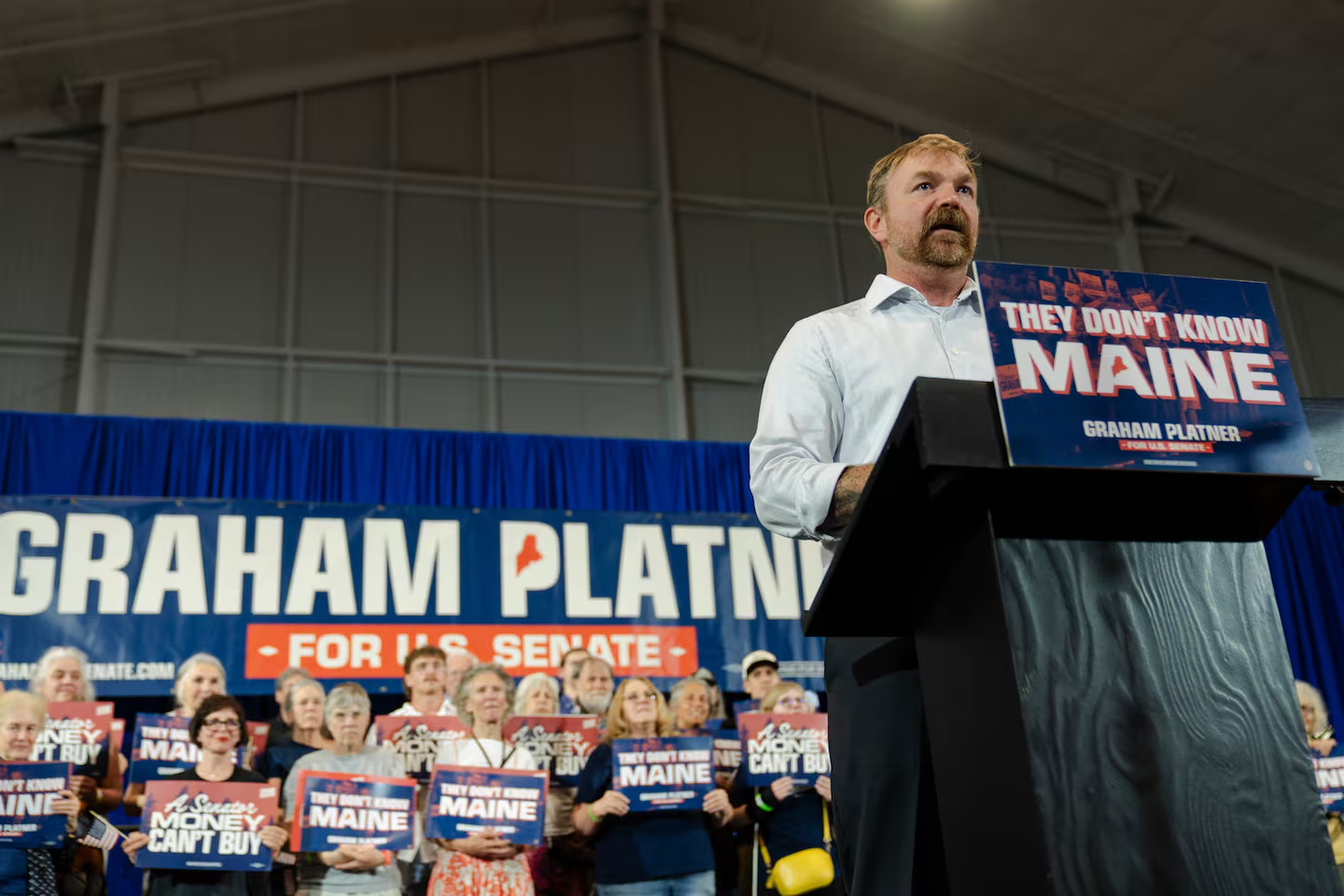
After his support collapses, Graham Platner ends scandal-plagued Senate campaign
SULLIVAN, MAINE — Graham Platner, the Democratic nominee for US Senate in Maine, ended his candidacy on Wednesday — throwing a contest with national implications into chaos and punctuating one of the most meteoric rises and dramatic falls of any candidate in recent memory.
Read more Trump says he’ll ask Supreme Court to rehear citizenship case, an unlikely event
The seismic announcement came in the wake of a report from Politico on Monday, in which Jenny Racicot, a woman from Maine who used to date Platner, alleged he raped her in 2021. Damaging allegations have defined Platner’s campaign from the beginning, including reports on his past threatening and troubling behavior toward dating partners, but he could not survive the gravity and clarity of Racicot’s account.
In a 11-minute video posted online on Wednesday night, Platner said he was “suspending campaign operations” and defiantly cast actors in the political “establishment” as antagonists seeking to destroy his insurgent movement. He insisted the sexual assault allegations against him are false.
“We’re not doing it because of the allegations,” Platner said. “We’re doing it because of the structures that are being taken away from us by those in power.”
He also argued the process to replace him as the Democratic nominee “needs to assure what comes next is reflective of the Mainers who turned out in June 9 and showed they are desperate for a different kind of politics.”
Planter had been holed up inside his simple blue two-story house in Sullivan all day, according to members of his campaign security team stationed outside.About an hour after his video was released, Platner’s campaign manager, Ben Chin, and consultant Morris Katz left the home through the kitchen without making comment and drove off.
On Monday, within hours of the Politico story, Platner’s support completely collapsed among Democrats from Maine to Washington. Senate minority leader Chuck Schumer and powerful party campaign organizations called on him to drop out and refused further investment in Maine while he remains the nominee. The Maine Democratic Party and key Democratic candidates in Maine also called on him to end his campaign, as did important endorsers, like Massachusetts Senator Elizabeth Warren.
Despite the pressure, Platner had for two long days refused to drop out, to the heightening dismay of many Democrats.
Adding to the anger were reports Platner and his team were trying to influence the selection of a replacement candidate. The rift spilled into public Tuesday night when the executive director of the Maine Democratic Party, Devon Murphy-Anderson, posted a statement accusing Platner’s team of “repeatedly reach[ing] out to us in an attempt to put their thumb on the scale of what this process looks like.” She added that the party “repeatedly reiterated” Platner’s team would have no role.
Platner’s team responded by denying they tried to determine the process; on Wednesday, campaign officials accused the state party of bringing in Washington Democratic operatives to craft a replacement process.
Now, Maine Democrats enter truly uncharted territory, just four months from an election in which they’d hoped they could finally defeat longtime GOP Senator Susan Collins and with it, control of the Senate.
A process — one yet to be determined — now begins for Democrats to select a replacement. Even before Platner withdrew, a half-dozen candidates were making moves to enter the race.
Platner won his party’s nomination with an overwhelming share of the vote in the June 9 primary election. But because he withdrew from the race before a ballot deadline of July 13, the state party can put forward a replacement by July 27. However, there is little precedent for this in recent memory, and certainly never in such a high-profile situation.
The process, as stipulated by state law, does not specifically provide for a new special primary election, and by default, gives party insiders considerable power to select a replacement nominee. But Maine Democrats seem inclined to conduct a more open process to decide the extraordinary question.
Well before Platner officially dropped out, behind-the-scenes posturing had begun among those who could potentially replace him. Attention quickly turned to several well-liked, qualified Democrats who ran for governor and lost in the primary election — primarily former Senate leader Troy Jackson, Secretary of State Shenna Bellows, and former Maine COVID response director Nirav Shah. All three took steps toward launching campaigns by Wednesday. Dan Kleban, cofounder of Maine Beer Co., who was a candidate for Senate before dropping out, also declared his intent to run.
Governor Janet Mills, who was the pick of national Democrats in the race before she struggled to compete with Platner and withdrew, remains a possibility. She suspended her campaign but never endorsed Platner. She has not responded to questions about the latest Platner stories.
No matter what Maine Democrats decide, many are shell-shocked and deeply disappointed over the dramatic collapse of an insurgent candidate who had excited and mobilized many voters in a way few had seen in recent memory.
Read more Trump’s plan for a triumphal arch in the nation’s capital is getting another review
A year ago, Platner was a virtual unknown outside his Downeast community. The 41-year-old combat veteran was running a small oyster company in his hometown of Sullivan, where he also served as harbormaster. Consultants who had worked for Vermont Independent Senator Bernie Sanders wanted a left-wing populist to enter the Senate race as a counterweight to the expected run from Mills, and found Platner. In August, his launch video had gone viral and his bid was publicized in national newspapers.
As his campaign picked up momentum, reporting began to surface about Platner’s extensive history of offensive comments on Reddit, and the existence of of a skull-and-crossbones tattoo resembling a well known Nazi symbol on his chest.
And Platner’s self-described image as a working-class outsider began to crumble under scrutiny: Despite him claiming he was “never close” to money and power, news outlets — largely on the right — found he briefly attended the elite Hotchkiss boarding school, and bought his home largely thanks to a loan from his father, a lawyer.
Yet, Democratic voters continued to flock to Platner on the strength of his outsider appeal and stridently populist, anti-corporate message. His numerous town hall events around the state attracted massive crowds.
Influential Democratic pundits and commentators defended him, and he picked up endorsements from prominent figures including Warren, while Mills failed to attract much energy and support after she finally entered the race; she suspended her campaign in April.
Platner’s team may have thought they weathered the worst until, a week before the June primary, the Wall Street Journal reported he had sent explicit texts with women who weren’t his wife as recently as 2025.
When he visited Washington to meet with Democratic senators on June 2 — a visit meant to help him build relationships ahead of the general election contest — Platner was instead dogged by questions about the Journal’s reporting and chatter of more revelations to come.
Yet, when senators asked Platner if more troubling stories would come out about his past, he told them no. Days later, The New York Times reported several of his ex-girlfriends alleged disturbing and threatening behavior on his part.
Publicly, Platner fiercely denied those allegations, and, buoyed by public defenses from his wife, brushed off the negative stories as smears from disgruntled ex-staffers and a Republican ex-girlfriend. He won 72 percent of the vote in the primary. In a defiant speech in Blue Hill, Maine, that night, Platner thundered that outsiders “don’t know Maine” and pivoted to sharp attacks on Collins.
Still, Platner entered the general election battle in relatively weak position, especially for a Democrat running in a Democratic-leaning state in a year that is expected to favor Democrats. Early polls showed Platner running neck-and-neck with Collins, despite voters clearly souring on President Trump and the Republican brand in general.
The Politico story landed at a critical juncture on Monday. Racicot also appeared on CNN to detail her troubling allegations that Platner forced her to have sex with him without her consent.
In a direct-to-camera statement released after the Politico story came out, Platner denied any nonconsensual activity, but did not commit to staying in the race, saying only he was “taking the time to reflect on the best path forward for the state that I love, the people that I love, the movement I belong to, and the goal of defeating Susan Collins.”
But the figures who had defended Platner amid past revelations abandoned him within hours, from Warren, to Representative Ro Khanna of California, to influential liberal pundits who had staunchly backed him after the first round of damaging stories.
The final, and perhaps most damaging, blow came on Tuesday afternoon, when Sanders called on Platner to step aside. The Vermont senator was his earliest and most important endorser and appeared with him in Maine several times. In a statement, Sanders said he had spoken with Platner “about the best path forward for Maine.”
“In light of these very serious allegations,” Sanders said, “I have recommended that he step aside.”


Post Comment