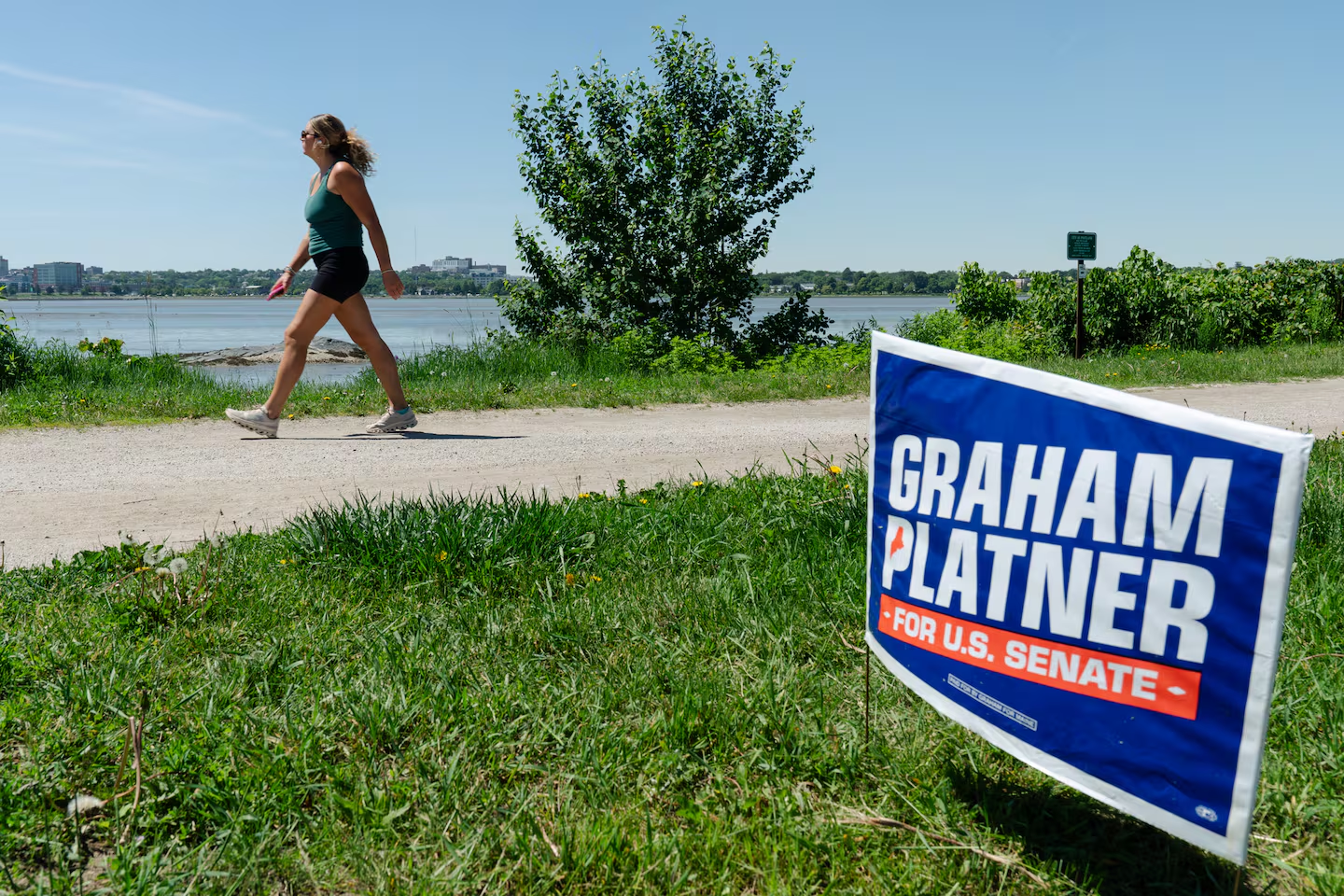
Graham Platner, Bob Dylan and the concept of leverage
On Monday night, the Maine Democratic Party’s executive director accused Graham Platner’s team of trying to “put their thumb on the scale” to influence how the party might go about replacing him as the Democratic Senate nominee should he drop out.
“We’ve repeatedly reiterated to Graham Platner’s team that they have no role in determining our next Democratic nominee for the U.S. Senate, nor in determining what this process looks like,” Executive Director Devon Murphy-Anderson said.
Murphy-Anderson repeated a sentiment shared by many watching the current situation in Maine’s Senate race, which is twofold: First, after accusations of rape, Platner should drop out immediately. Second, someone accused of rape should have no role in determining who replaces him on the ticket.
It’s an understandable sentiment from Democrats who are disappointed, heartbroken and enraged that they find themselves in this mess instead of running at full speed to defeat Republican Senator Susan Collins.
But urging Platner to drop out and simply go away is a wish. It is not reality.
In reality, no matter how much people may dislike it, Platner and his team have leverage and quite a lot of it. Yes, he is finished in politics, but that actually gives him more leverage, not less.
Leverage doesn’t come from popularity. It comes from controlling something everyone else needs. Right now, Platner controls the one thing Democrats cannot do on their own: vacate the Democratic nomination. Until he does, the party cannot move to its preferred outcome. That gives him bargaining power even if virtually everyone in Democratic politics wants him gone. In fact, because he no longer has a political future to protect, he has fewer incentives to simply do what party leaders want.
As Bob Dylan wrote, “When you got nothing, you got nothing to lose.”
The next step is entirely Platner’s call. He is the Democratic nominee for Senate in Maine. He can either drop out or not.
Sure, if he stays in the race, there is likely no path to victory against Collins. His campaign will likely run out of money within months if he tries to go it alone, and his support among Democrats has cratered.
Nor are Democrats necessarily stuck with him. They can organize around a write-in candidate before an August deadline with relatively little penalty. After all, Maine’s ranked-choice voting system eliminates the risk of splitting the anti-Collins vote the way it might in other states.
That said, the easiest and best path for Democrats is still without Platner, which is why he currently holds the cards.
If Platner and his team are asking questions about how the replacement process would work, it is because, legitimately, no one seems to know. State law requires the Democratic Party to name a replacement within two weeks, but beyond that, there is little clarity.
Will it be a closed meeting of roughly 100 state party members? A statewide convention of delegates? Decentralized county caucuses? Will prospective candidates have to formally file, or will it be a free-for-all in which any eligible Democrat’s name can be nominated?
National Democratic donors might reasonably ask another question: Who is vetting these potential candidates given everything that has happened?
There is also structural mistrust between Team Platner and a state Democratic Party run in the mold of his one-time rival, Governor Janet Mills.
The questions, the back-and-forth and even the public sparring are at least honest reflections of the current reality. Platner does have leverage. The party can apply political pressure. What we are watching is a public negotiation over the terms of Platner’s exit.
Democrats should be comfortable with the handwringing if that is the extent of the damage. Whether Platner withdraws on Wednesday or onMonday, July 13, one minute before the filing deadline, is unlikely to change the outcome of the general election. What matters is that he leaves before the deadline expires.
It’s a deeply uncomfortable reality for Democrats, but it is still reality.
It is, in many ways, Platner’s last call in public life. He is simply acting like someone who knows it.
Read more WHDH-TV photographers sue station, alleging the outlet failed to compensate them for work travel



Post Comment