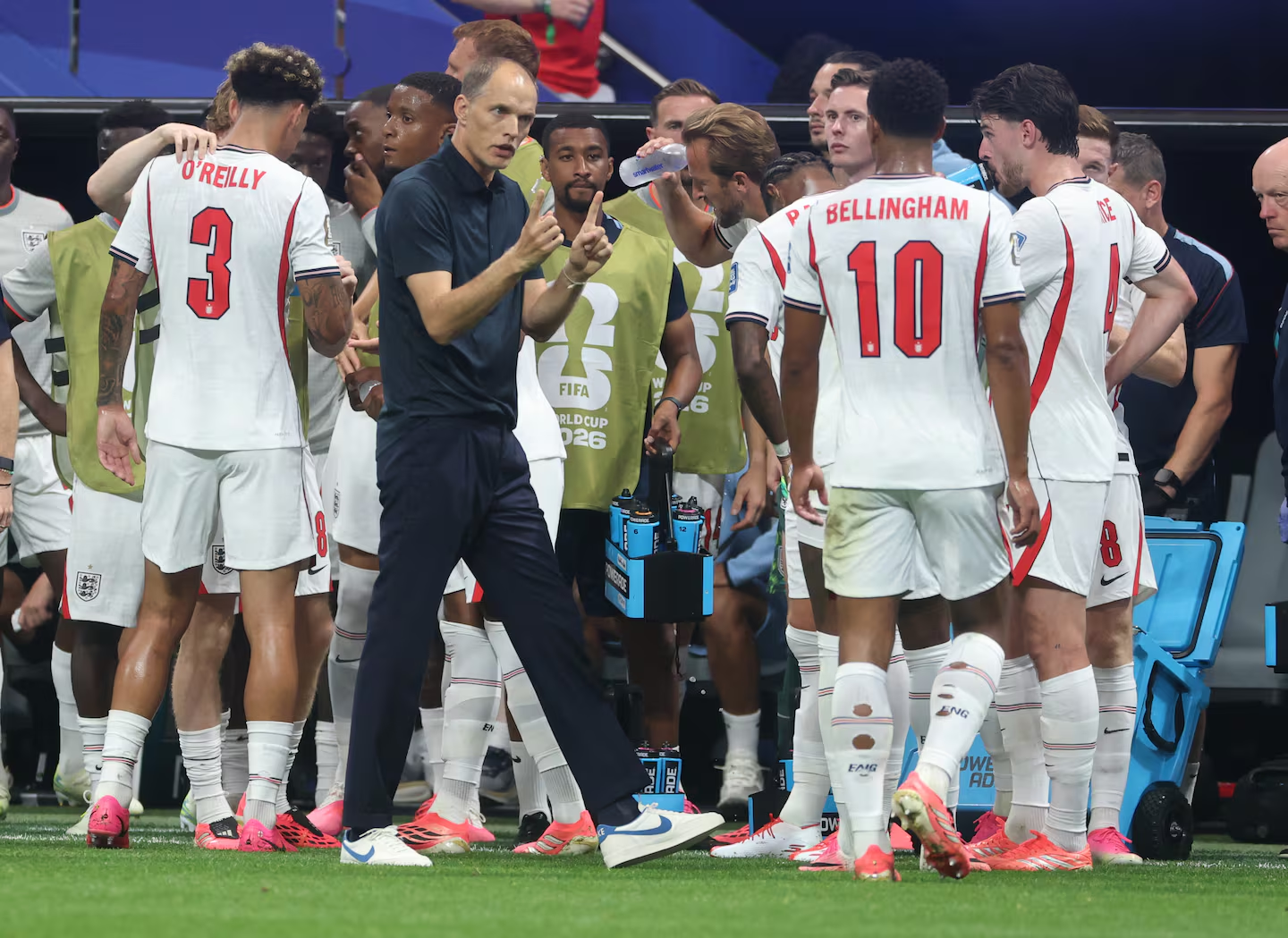
Is there anything World Cup fans despise more than the hydration breaks? (Players can’t stand them, either.)
For much of this World Cup, the boos have come like clockwork.
You could set your watch to it, with a minute or two of margin for error: 22 or 23 minutes into each half, the referees have blown their whistles and signaled for a hydration break, and the fans have booed time and time again.
Read more Analyzing Belgium, the US men’s team’s round of 16 opponent in the World Cup
The hydration breaks introduced for this World Cup have been widely unpopular, with fans quickly sniffing out FIFA’s thinly veiled excuse of “player safety” in hot conditions as a pretense for sneaking in extra commercials.
Those commercials are unusually valuable real estate. Soccer fans are used to two halves of 45 minutes each, sans interruption, and aren’t likely to click away for those three minutes.
The fact that the breaks were introduced wholesale, and not on a case-by-case basis, made them even more unpopular. June brought fairly mild weather through much of the country, but those hydration breaks for “player safety” remained, including in Atlanta, Houston, and Dallas, where the games are being played within the confines of climate-controlled, indoor arenas.
“For players safety, when it’s too hot, yes, absolutely have a hydration break,” said former England striker Alan Shearer. “But, an example, England’s game [against Croatia] was air conditioned. [70] degrees. Perfect temperature with a roof over. So, there is absolutely no need for players’ welfare to have a hydration break.
“We all know what they’re for. We all know why they’ve brought them in. And the vast majority of time, unfortunately, it’s not for player welfare. It’s for adverts.”
Perhaps the most farcical outdoor example came in Foxborough on June 23, when England and Ghana played to a 0-0 draw. On a 65-degree day with overcast skies and intermittent rain, a hydration break didn’t seem particularly necessary.
Things got even sillier when the game was interrupted by an injury stoppage 20 minutes in, leading to a three-minute break in which the players came to the sideline, took on some fluids, and had a chance to recover.
Play restarted for about two minutes, then the referee blew for a hydration break — despite the fact that one, in essence, had just occurred. The boos, particularly from the England fans, were some of the loudest of the tournament.
“Let’s be honest, that whole passage of play was a farce, wasn’t it?” said FOX sideline reporter Geoff Shreeves.
Responses from players have been mixed. Dutch center back Virgil van Dijk advocated for breaks on a case-by-case basis after the Netherlands’ game against Japan was interrupted for a hydration break during an indoor match in Dallas.
“I think for the neutral watchers on TV, it’s also not great,” van Dijk said. “If it’s really hot, obviously it would be good to put them in. But I think you have to look at it in every game, separately, in my opinion.”
France’s Kylian Mbappé mostly deflected, suggesting players weren’t in the best position to make a judgment.
Coaches have often been more positive, as the breaks give them two extra chances to address their teams.
“These hydration breaks for three minutes, you can get the players close to you and this gives you an opportunity to adjust a couple of things,” said French coach Didier Deschamps. “With the high temperatures, it’s important to be able to give this extra opportunity, two opportunities to the head coach. It’s a good thing — this is a fact, but it leads us to split the game and if you’re in a strong position, following this break you have to start playing again.”
Perhaps the staunchest critic among the coaches was Uruguay’s Marcelo Bielsa.
“With the new rules there are lots of goals — so be it,” he said. “According to the general consensus, playing four periods instead of two alters the culturally constructed conception of how to interpret football.
“In my view, it adds nothing and takes away a lot. When [the match] was divided into four periods, no thought was given to the effect it might have on what makes football such a captivating sport, but instead to other repercussions which I’m neither discussing nor analyzing.”
While responses among players and coaches are mixed, the reaction of fans has been overwhelmingly negative, as evidenced by the frequent booing of the breaks.
In Foxborough, those in charge of in-game entertainment have seemingly caught on and adjusted. During the last two games — France vs. Norway and Germany vs. Paraguay — music has kicked in much earlier. As soon as the referee blows and signals for a hydration break, Bon Jovi’s “Living on a Prayer” or some version of “Hey! Baby” have made the booing much more difficult to hear.
In a statement to the Globe, FIFA said it has continued to operate as usual.
“During scheduled pauses in play, including hydration breaks, the stadium continues to operate as it would at other stoppages, with announcements, music, and other fan engagement activities managed in accordance with the venue’s standard event presentation plan,” the statement said.
As a heat wave rolled through the United States, the hydration breaks made more sense. When France beat Paraguay in Philadelphia on Saturday, the temperature hovered around 100 degrees, with a few other matches this week played in the high 80s and low 90s.
Whether fans will embrace them any more — or if they’ll slowly just become an accepted part of the World Cup experience — remains to be seen.
Read more US seeks ‘revenge’ for thrilling World Cup loss to Belgium 12 years ago



Post Comment