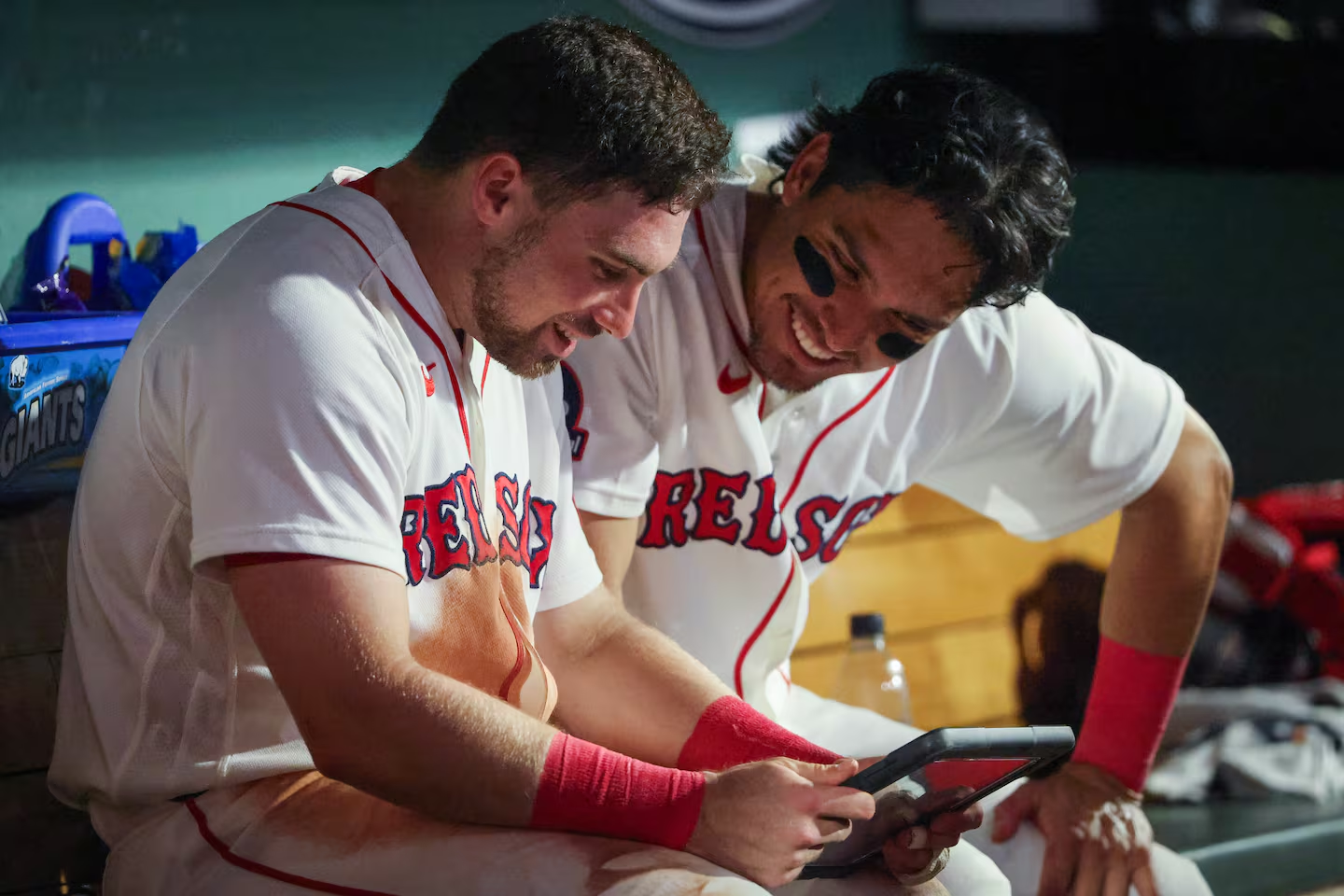
How Caleb Durbin recovered from the ghastly start to his Red Sox career: ‘You gotta do what you gotta do’
Caleb Durbin doesn’t shy from the idea that he’s a hitting obsessive, but he did identify limits to the trait.
“I’m not sleeping with my bat or anything like that,” said Durbin.
Still, he spends plenty of time in the company of his lumber, even away from the park. He brings an extra bat on the road to keep with him — mostly in his hotel room, but he’ll also occasionally find a venue for a morning hitting session — in case he wants to search for or lock in a feeling. He also packs a tee in his suitcase and will smash foam balls into a curtain in his room if the mood strikes him.
“You gotta do what you gotta do,” shrugged Durbin.
The 26-year-old Red Sox third baseman finds both comfort and confidence in the time he commits to the craft. Even when he endured the worst stretch of his life the first two months of this season, he remained convinced he’d climb a ladder out of his hole based on his willingness to work until he found one.
“I never really got flustered throughout the start of the season, because I’ve always figured it out,” said Durbin. “I was going to figure it out because of how much I love hitting and how much I care about it. I understand that sometimes you just lose feels, and at the end of the day, you fall back on the work you’re putting in.”
Durbin’s commitment to hitting stems from curiosity and an atypical baseball education. As a kid, his primary hitting coach was his father, Regis, who never played baseball.
“He would just watch videos and we’d go to the cage every day, and he’d teach me,” said Durbin.
They identified an approach and swing that was good enough to make Durbin an all-conference player in high school, which resulted in an opportunity to play Division 3 at Washington University in St. Louis. He showed enough in college (.386/.477/.684 with 10 homers and 39 steals in 93 career games, including a junior year where he struck out just twice in 190 plate appearances) to have the Braves tab him as a 14th-round pick in the 2021 draft. But he quickly discovered that his tools weren’t translating to pro ball.
“The swing that worked at the Division 3 level, I took that to rookie ball, and I couldn’t really get the ball in the air,” said Durbin. “I struggled.”
And so, he searched. At a college friend’s recommendation, Durbin went in the offseason of 2021-22 to Driveline in Seattle (where he was introduced to current Red Sox hitting coach John Soteropulos as well as current Sox minor league coordinator JP Fasone). His father also found videos of St. Louis-based hitting instructor Richard Schenck — “Teacherman,” a polarizing figure in the baseball world known for his work with Aaron Judge and frequent social media feuds.
Durbin starting working with Schenck that same offseason.
“I rolled with [Schenck] for three, four years, and still believe in [his methods],” Durbin said.
Already gifted with excellent bat-to-ball skills, Durbin learned how to drive the ball in the air and positioned himself to emerge as an unlikely prospect who was targeted in a succession of trades. He was dealt from Atlanta to the Yankees after 2022, to the Brewers after 2024, and — after he finished third in NL Rookie of the Year balloting in 2025 — to the Red Sox this spring.
But the brutal start to this season (.163/.241/.238 with a sky-high 58 percent ground-ball rate, putting his job as an everyday player in jeopardy) led to another search for answers and adjustments. In addition to the incredible volume of work (100 to 200 swings a day) he did at the park, Durbin also started working with Lorenzo Garmendia of Gradum GSwing.
The focus was to create better direction.
The adjustment served as an unlock. In 31 games through Friday’s game against the Angels, he’s cemented himself back at third base, hitting .321/.356/.615 with seven homers. His season numbers (.230/.289/.398) remain below average, but are quickly trending up.
With his typical open stance, Durbin was spinning off the ball, losing power and hitting grounders. He closed his stance in an effort to create and hold a cleaner line in his stride that allowed him to keep his weight behind the ball while staying inside of it.
The adjustment served as an unlock. In 30 games entering the start of the weekend series against the Angels, he’s cemented himself back at third base, hitting .321/.351/.594 with six homers. Durbin’s season numbers (.229/.286/.387) remain below average, but are trending up.
“The ball was just going straight in the ground when I hit it [early in the year], and it’s not doing that as much anymore. It’s a pretty pronounced difference,” said Durbin, whose ground-ball rate has fallen to 41 percent. “I don’t know why it took me so long, but once it clicked, it clicked, and now it’s like, ‘OK, I have a better idea now than I’ve ever had.’ It’s definitely the best I’ve felt, and I think even [including] the minor leagues it’s the best I’ve hit numbers-wise.”
The hairpin turn from the worst slump of his life to the best peak of his life serves as a microcosm of the maddening, addictive art of hitting. There will come a time when Durbin again finds himself in a hole.
Read more Trump pardons former Abramoff partner, 9 people convicted of violating vehicle emissions controls
He will have a bat close at hand to start working his way back out.



Post Comment