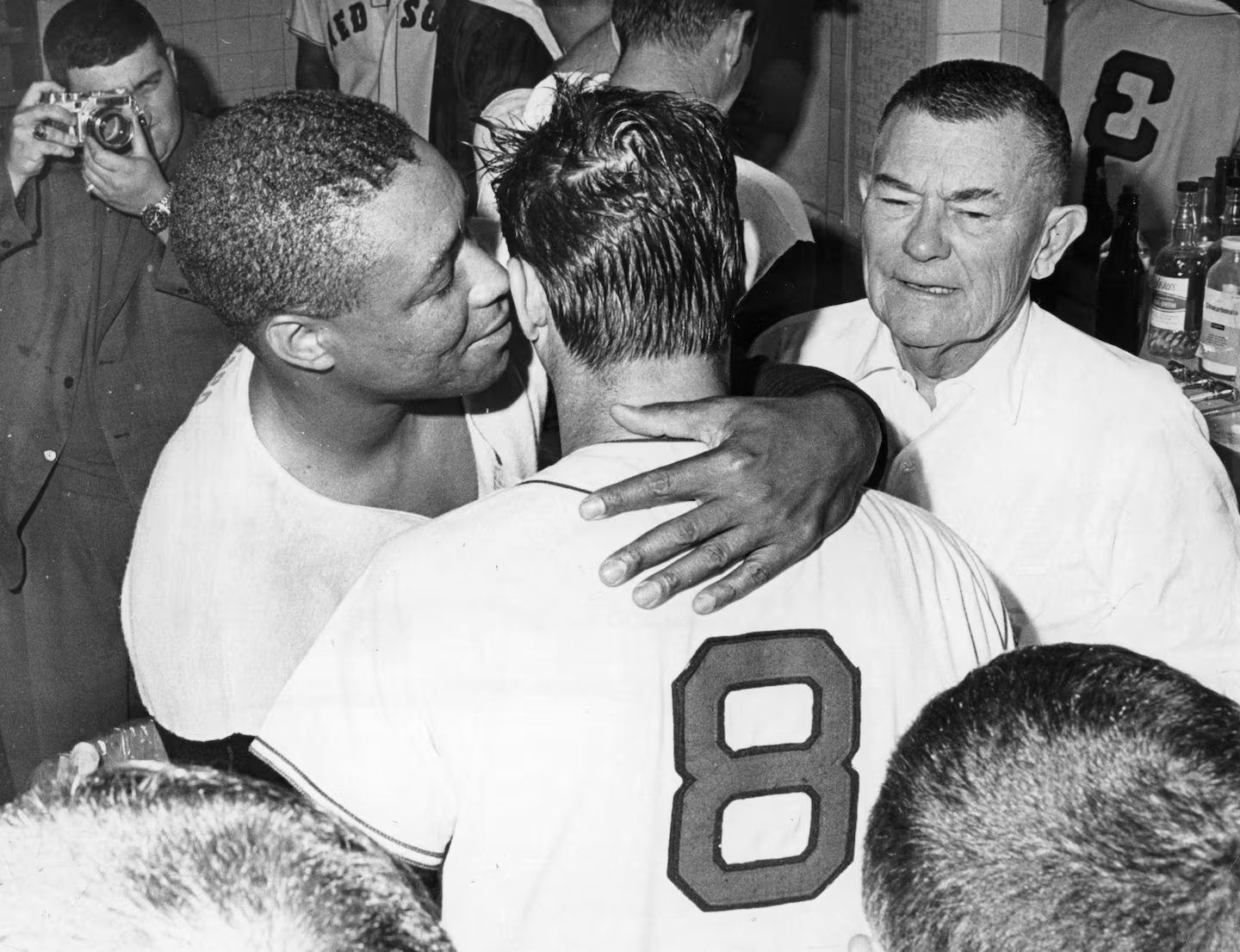
Nearing the 50th anniversary of his passing, remembering former Red Sox owner Tom Yawkey
The Red Sox will be in Chicago on Thursday for a matinee against the White Sox, game No. 91 in what thus far has been a highly forgettable, painful season.
Read more Lionel Messi, Argentina survive World Cup knockout match with Cape Verde in extra time thriller
Tom Yawkey died 50 years ago on Thursday, the day the team he owned across five decades will play at someplace known, at least at this hour, as Rate Field on the South Side of Chicago.
The Red Sox, an especially motley crew during the early 1960s, frequently endured seasons as bad as 2026 during the 44 seasons Yawkey owned both the club and that lyric little bandbox, now 114 years old, in which it continues to play.
Long forgotten is that by the mid-60s, Yawkey had grown tired and frustrated — not with his beloved team, but with his outdated, dilapidated Fenway Park. Upon taking ownership of the team in 1933 for a price of $1.25 million, he immediately forked out an added $1.5 million to refurbish Fenway, creating the basic size and structural outline that exists today.
Three decades later, Yawkey wanted out of the Back Bay, mainly because of his park’s limited seating capacity and its all-but-nonexistent parking lots. New ballparks, like Shea Stadium in Flushing, N.Y., and Busch Memorial Stadium in St. Louis, were sprouting around the country. He was smitten with the new-age cement bowls, the expansive parking lots … and, of course, the promised revenue boost.
In June ’67, in the thick of his franchise’s rollicking “Impossible Dream” rebirth, the usually-mild-mannered Yawkey firmly stated to the Globe’s Will McDonough that his team’s days in the Fens were numbered.
The Braves, who played a short hike up Commonwealth Avenue, hot-footed it out of town in 1953, and Yawkey felt it just might be time to do the same with his American League franchise.
“No one paid attention,” said Yawkey, reminding McDonough of what had been protracted hints about the Braves leaving, “and then suddenly they were gone.”
Yawkey still preferred the Sox remain Boston’s team, though ideally housed in a new park in the suburbs. He was initially enamored by a proposal dubbed Weston Junction, adjacent to the intersection of the Mass. Pike and Route 128 — today known as I-95. Another hot rumor had the Sox headed to open Suffolk Downs acreage in East Boston.
Fenway, 55 years old at the time, was full of cracks, its wooden grandstand seats reeking of decades of spilled beer. It wasn’t viewed then by fans as some priceless family heirloom, handed down by Abner Doubleday and the diamond gods.
The wild, storybook success of the ’67 season flipped the franchise’s business dynamics, ultimately ridding Yawkey of his burbs-or-bust mind-set. The Sox won the AL pennant, delivering the mighty Bob Gibson and the Cardinals to Fenway for the World Series — the first here since 1946.
Attendance more than doubled year over year, to 1.727 million. Boston baseball was reborn.
That old ballpark that Yawkey wanted to vacate? Nothing a little paint and some tens of millions of dollars these last 60 years didn’t make right.
Read more Ben Rice hits two-run homer as Yankees stop seven-game losing streak
Anyone born this side of 1966 has little memory of the usually mild-mannered and unassuming Yawkey. A man of significant financial means before wealth was measured in the hundreds of billions and artificial intelligence equity positions, he frequently could be spotted doting around Fenway on game day, forever smiling, even amid the worst of seasons.
He chatted with players during batting practice, and sometimes played pepper near the backstop. Yawkey, 73 when he died of leukemia, was about as stylish as a 1912 catcher’s mitt and equally presumptuous. He kept his hair trimmed putting-green short. His typical ballpark attire was a Red Sox cap, blue windbreaker, and baggy pants.
Bernie Carbo, among the Game 6 heroes of the 1975 World Series — the last of three under Yawkey’s watch — figured at first glance the frumpily attired Sox owner was a clubhouse worker. Fortunately, Carbo had a sharper eye for that Rawly Eastwick pitch in Game 6.
In earlier years, Yawkey and wife Jean sometimes would head out to Fenway’s emerald lawn, the perfect spot for lunch in the sun. Ownership came with privileges. They sat each game in their modest sky box toward the third base side of home plate.
Late in the afternoon of July 9, 1976, a solemn GM Dick O’Connell shuffled into the press dining room at Fenway and delivered word of Yawkey’s passing. It was a Friday, a couple of hours prior to Rick Wise’s first pitch that night against the Twins.
Internet and social media yet to be created, very few fans were aware of Yawkey’s death as they entered the ballpark. The flag in center field was lowered to half-staff prior to the gates opening. Fenway PA announcer Sherm Feller delivered the news to the crowd. During a long moment of silence, a black-and-white picture of Yawkey appeared on what was then the new giant electronic message board in the bleachers.
A report by United Press International noted “the shocked silence blanketing” the Sox clubhouse as stunned players stared into their lockers before the game. Yawkey’s health issues were widely known for some time, but his death was abrupt.
Largely beloved by fans, players, and team personnel of the day, Yawkey was not perfect. Over the half-century since his passing, his role in the Sox being the last MLB team to add players of color to their roster has been judged harshly. Accusations around his record on race as it related to the roster existed while he was alive, though rarely was he called to respond. In his death, others have felt empowered to frame his life, judge his thoughts and deeds.
Yawkey’s name is hard to find around the team or ballpark. Tom and Jean’s initials still appear in Morse Code on the face of the iconic left field scoreboard, both visible and hidden at the same time. We are a city sometimes so subtle.
Elsewhere in town, the Yawkey name and legacy live on through the robust charitable giving of the Yawkey Foundation. A large portion of the ongoing financial gifts comes from money received from the sale of the franchise 25 years ago for $700 million. CNBC this year valued the franchise at $5 billion, fourth highest in MLB.
Decades later, business is still going strong in Tom Yawkey’s spruced up and beloved ballpark, the one again with a bedraggled Sox team and still precious-few parking spots.
Yawkey was loathe to draw attention to himself, so in a sense maybe it’s fitting that his name increasingly fades with time. Fitting maybe, but hardly fair.
Read more Jhon Arias goal helps Colombia beat Ghana, advance to World Cup round of 16


Post Comment