‘Total opposite of unity’: Trump’s 250th approach diverges from Ford’s in the bicentennial
WASHINGTON — Fifty years ago, as the nation’s 200th birthday approached, President Gerald Ford’s chief speechwriter had an overarching goal for the upcoming high-profile bicentennial addresses.
Read more Boston Legacy FC, NWSL hoping to ride the wave of the World Cup
“While they of necessity deal with political and economic principles and institutions,” Robert Hartmann wrote in a , “there should be no campaign code words or partisan insinuations whatsoever.”
President Trump apparently didn’t get the memo.
While Ford used a milestone anniversary to try to unify a fractured nation, Trump hasn’t tried to replicate that spirit of ‘76.
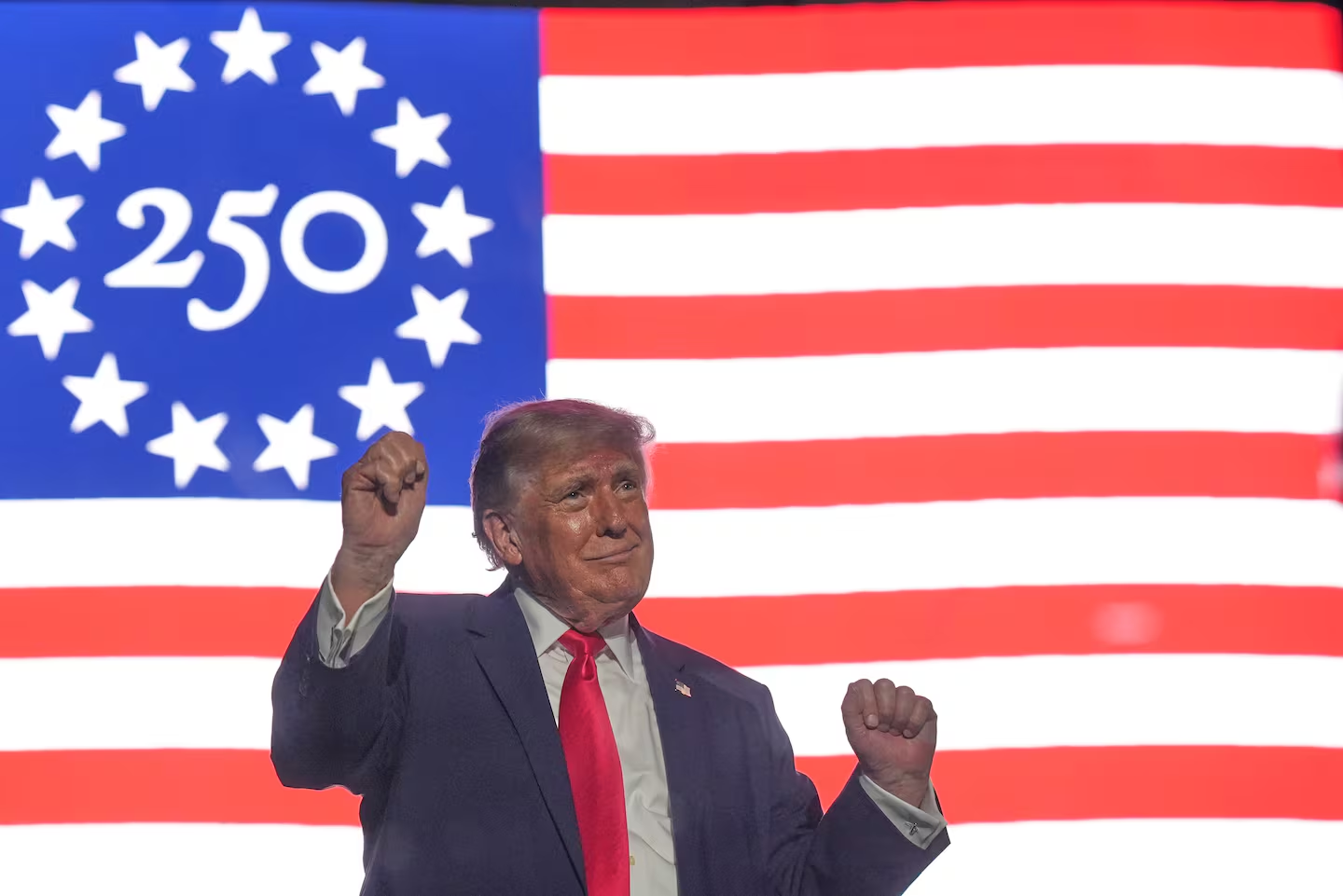
He’s delivered highly political, campaign-style speeches tied to America’s 250th birthday, a theme expected to continue at Mount Rushmore on Friday and in his Independence Day address in Washington, D.C., on Saturday night. He’s billed the July Fourth extravaganza in the nation’s capital, scheduled to include the largest fireworks display ever, as “A Rally to end all Rallies!”
At the official semiquincentennial kickoff in Iowa a year ago, Trump ripped into his Democratic rivals, declaring, “I hate them. I cannot stand them because I really believe they hate our country, you want to know the truth.”
Then in opening the Great American State Fair on the National Mall on June 24, Trump mixed some US history with a long list of his accomplishments and disdain for former President Joe Biden. “Where were we two years ago?” he told the crowd in what he billed as a rally. “We weren’t respected. We were a joke.”
Trump ended both speeches with the typical rally buildup to his campaign slogan, “We will make America great again.”
“It’s the total opposite of unity,” said Douglas Brinkley, a presidential historian at Rice University. “It’s fierce guerrilla fighting, partisan warfare over the soul of America and what our history means.”
The White House and Trump’s allies said he isn’t making America’s 250th birthday partisan, even though he created his own entity, Freedom 250, to put on events such as the state fair and UFC fight separately from the congressionally created bipartisan America250 organization.
“President Trump is ensuring that America gets the spectacular birthday it deserves,” said White House spokesperson Davis Ingle. “The celebration of America’s 250th anniversary is going to display great patriotism in our Nation’s Capital and throughout the country, and the President is proud to participate in our historic semiquincentennial celebrations.”
But Trump’s strategy is a sharp contrast to Ford’s, even though both presided over a historic anniversary at a time of deep partisan divisions in highly tumultuous times. Ford actually had more reason to be political in 1976: it was a presidential election year and he was fighting to be the Republican nominee.
Instead, right from the bicentennial kickoff in Boston in 1975, Ford preached patriotism, unity, and hope — all with nary a hint of partisanship.
“We have suffered great internal turmoil and torment in recent years,” he said in a nationally televised address from the Old North Church on the 200th anniversary of Paul Revere’s midnight ride. “Nevertheless, in all of the explosive changes of this and past generations, the American people have demonstrated a rich reserve of reason and of hope.”
“It is a time to place the hand of healing on the heart of America — not division and not blame,” he declared.
Ford had taken office in 1974 under the most controversial circumstances, ascending from vice president after Richard Nixon was forced to resign because of the Watergate scandal. Americans also were still grappling with the trauma and unrest caused by the recently ended Vietnam War.
So the new president viewed the bicentennial as an opportunity to help the nation move on, Brinkley said.
“Ford tried to be Mr. Unity and thought it would be grotesque if he somehow turned America’s 200th birthday into something like a Ford rally,” Brinkley said, noting Ford titled his presidential memoir “A Time to Heal.” “History accords him high marks for the dignity and grace and intelligence of the way he handled the bicentennial with maximum humility.”
Read more Erdogan’s warm ties with Trump offer Turkey an edge ahead of NATO summit
“Maximum humility” is not a phrase associated with Trump. But it highlights the contrasting styles between the most bombastic president ever and one of the most boring.
Known as the accidental president, Ford is the only commander in chief never to have been elected as either president or vice president.
“I am a Ford, not a Lincoln,” Ford quipped upon taking the vice presidential oath in 1973 to replace the scandal-plagued Spiro Agnew in a double entendre nodding to the auto industry in his home state of Michigan. “My addresses will never be as eloquent as Mr. Lincoln’s. But I will do my very best to equal his brevity and his plain speaking.”
In Hartmann’s White House memo, the speechwriter emphasized the need for Ford to connect with average Americans and deliver a message that “looks forward more than backward in Bicentennial self-congratulations.”
“Any whiff of pomposity or pretentious elegance must be avoided,” Hartmann wrote. “The President will be speaking for, as well as to, all the people of America. He will have to speak in their language, not that of poets or philosophers.”
On July 4, 1976, Ford delivered three speeches, including one in front of Independence Hall in Philadelphia before a crowd of 1 million people. He praised the Founding Fathers and “the foot soldiers who followed General Washington into battle after battle, retreat after retreat.”
“But it is important to remember that final success in that struggle for independence, as in the many struggles that have followed, was due to the strength and support of ordinary men and women who were motivated by three powerful impulses: personal freedom, self-government, and national unity,” Ford said.
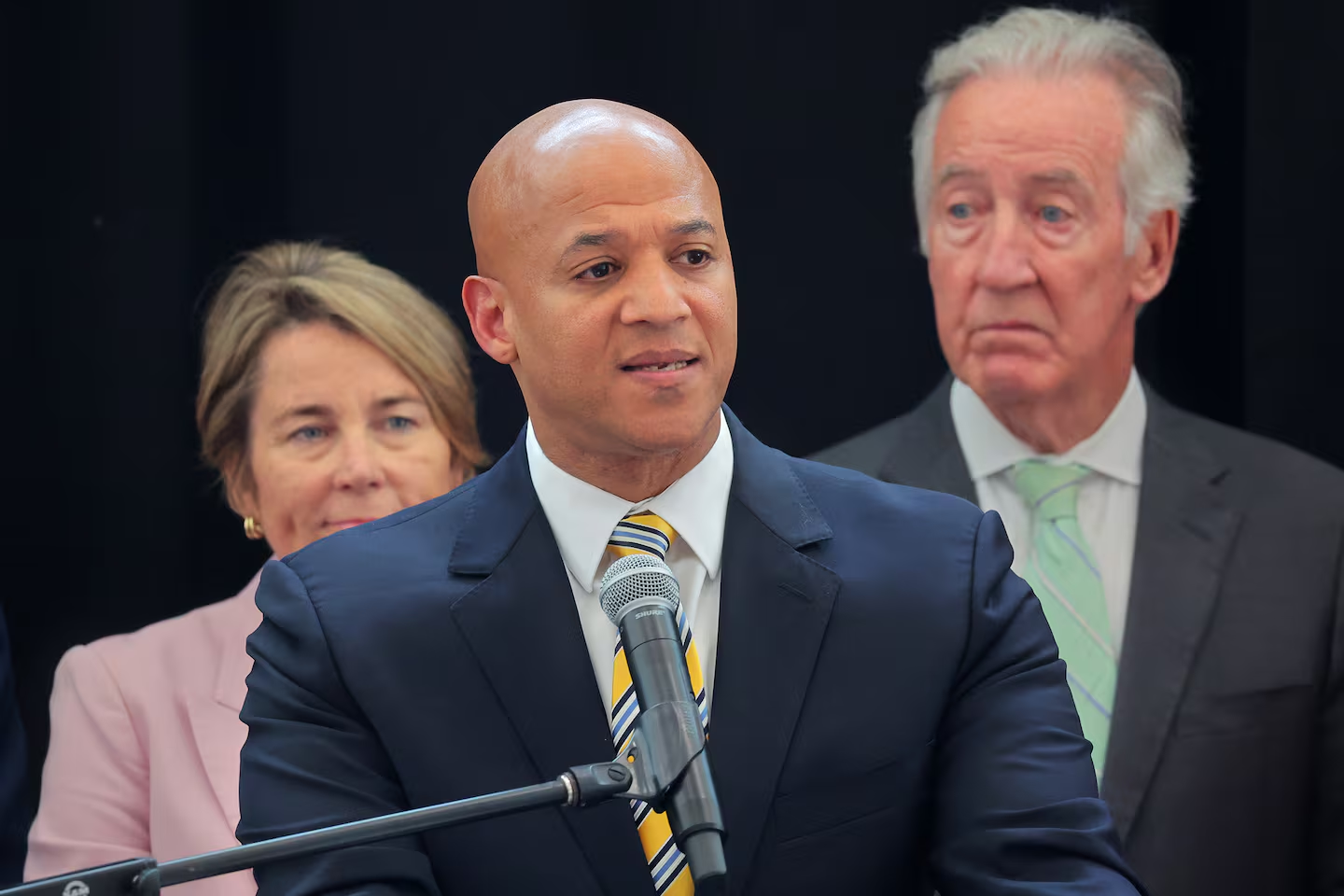
Representative Richard Neal, 77, a Springfield Democrat who was a young politician in 1976, noted Ford had been a long-serving member of the House of Representatives and took an institutionalist approach to the bicentennial.
“It was traditional,”Neal recalled. “It was unifying.”
But while Ford wasn’t overtly political in his bicentennial speeches, he did use the commemoration to his advantage as he dealt with a strong Republican primary challenge from Ronald Reagan ahead of the party’s nominating convention later that summer, said Tevi Troy, who has written five books on the presidency.
“He talked about unity, he talked about the founding principles, he honored the birthday celebration, but he was also a canny political player,” said Troy, a senior fellow at the Ronald Reagan Institute, the Washington, D.C., arm of the former president’s library. “Whenever he went someplace, there were Air Force One seats, or arrival ceremonies, or tickets to the event. . . . He and his political team were doling out those favors, those goodies, to get delegates on his side for a very tight race against Reagan.”
Ford also held office at a time when there weren’t such deep partisan divisions over patriotism, Troy said.
A Gallup Poll released Wednesday found just one-third of US adults said they are “extremely proud” to be an American, the lowest level since the organization began asking the question in 2001. The partisan split was wide, with 70 percent of Republicans extremely proud and just 14 percent of Democrats.
“Some of the messages that [Ford] was saying about honoring the founding . . . might be seen in a more partisan way today,” Troy said.
Trump’s 250th speeches have included references to American greatness, which dovetails with his MAGA slogan. But the partisanship has been overt, Brinkley said.
“Trump has put a lot of his brand into this particular coincidence of 250 occurring on his watch . . . and he is a grand event impresario,” Brinkley said. “It’s a P.T. Barnum approach to leadership.”
It’s also a missed opportunity, he said.
“All that’s going to be remembered about America250,” Brinkley predicted, “is that instead of uniting the country, Trump continued to divide it.”


Post Comment