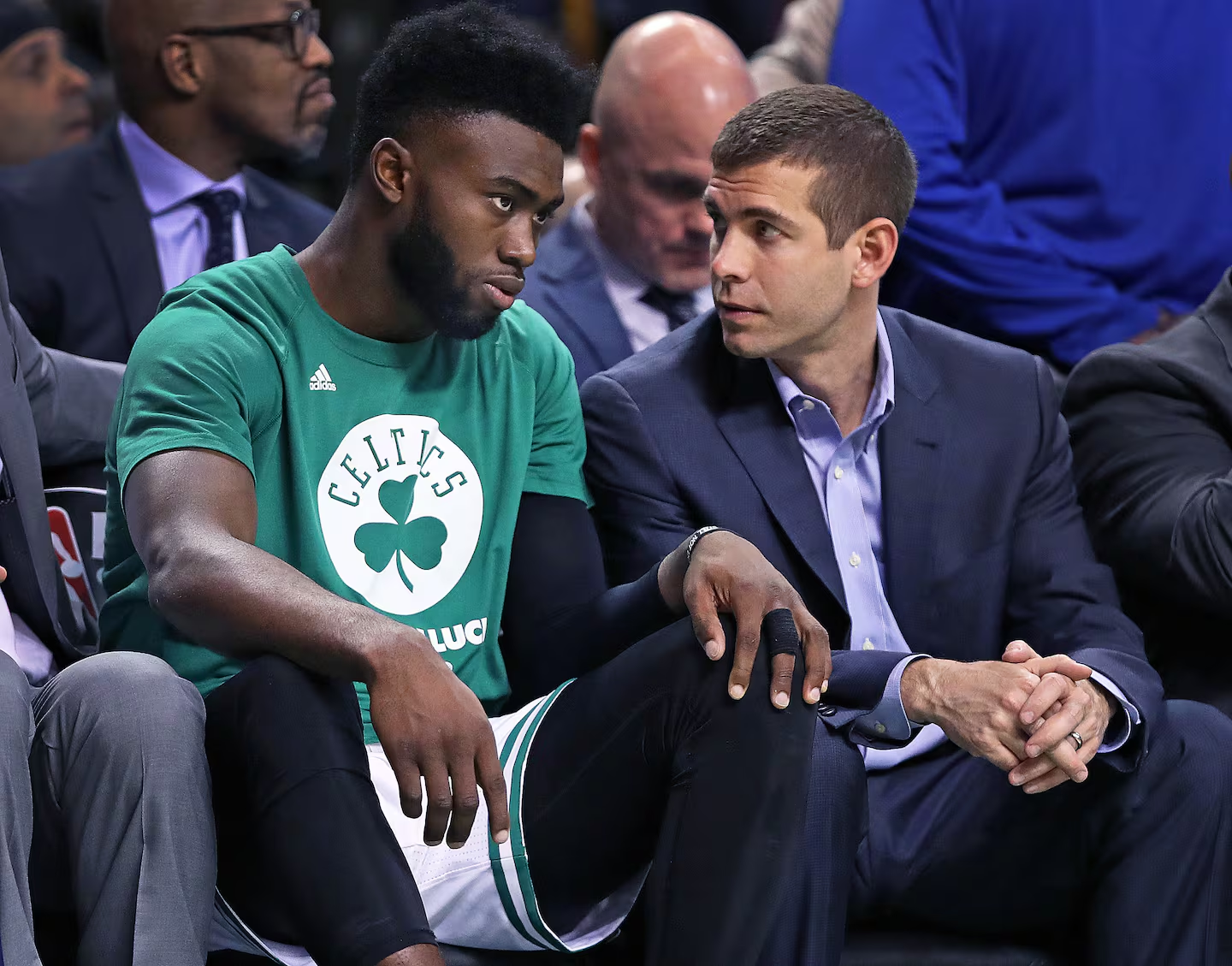
The biggest question of them all: What was Brad Stevens thinking when he traded Jaylen Brown?
What the heck is Brad Stevens thinking?
That’s a question that can be asked at this hour in a couple of different ways.
For the vast, vast, vast majority of Celtics fans, it’s one asked in anger, and perhaps dotted with expletives following Wednesday’s stunning trade of franchise cornerstone Jaylen Brown to the Sixers for the low, low price of 36-year-old oft-injured Paul George and two first-round picks.
Read more Democrats accuse Trump-linked fundraisers of fraud over diverted donations for America’s anniversary
As a general principle, I dislike using the word hate in the context of sports, but it’s the right choice here: Celtics fans hate this trade, pretty close to unanimously it seems.
And I get it. From a fan standpoint, they should.
Brown isn’t yet 30 years old, made second-team All-NBA and finished sixth in Most Valuable Player voting this year, won Finals MVP just two summers ago, was a blast to watch when he was locked in on both ends of the court (ask Luka Doncic about that), and most admirably, authentically cared about the people of this city and what it meant to be a Celtic. He was a constant through a decade of consistently high achievement and one banner-raising. Someday, his number 7 will join that 2024 banner in the rafters.
Trading him for Giannis Antetokounmpo — an objectively superior basketball player who would have singlehandedly fixed some of the Celtics’ flaws — made sense, even if it would have carried its own risks. That failed deal doesn’t look so bad now, huh?
Trading him for this, which generously looks like 75 cents on the dollar and failing to get the best player back, a fundamental rule in any big NBA trade? At the least, it’s bewildering. For most, it’s infuriating.
In an attempt to make sense of it, we must circle back to that original question:
What is Stevens thinking?
We’re obligated to try to understand the “why” here, the motivation on saying “yes” to a deal that is a giant “no way” to the fanbase, because of who made it.
Since becoming president of basketball operations five years ago, Stevens’s roster-building decisions have been close to impeccable, or Auerbachian in Celtics parlance.
His first deal was a swap of Kemba Walker for Al Horford. He brought in Derrick White, now a quintessential Celtic, when few in this market knew much about him. He blindsided fans by trading popular Marcus Smart for Kristaps Porzingis and two first-round picks, a deal no one lamented post-championship parade. He read the Bucks’ interest in Damian Lillard properly and was ready to pounce when they sent out Jrue Holiday to Portland to acquire him.
Stevens — who also knows Brown and Jayson Tatum as well as anyone, having coached them in their NBA youth — has banked as much faith, credibility, and goodwill as any modern sports executive in this market save for perhaps Theo Epstein.
And yet my social-media feeds and email inbox has been populated with “Fire Brad” declarations from upset Celtics fans. I get that it’s a take born from sadness, anger, and frustration at watching a favorite player go for what appears to be a piddling return. But it’s patently absurd.
We shouldn’t be asking whether Stevens — the reigning NBA executive of the year who has proven a superb evaluator of talent over and over again — has suddenly lost his mojo, if not his mind.
Read more Former Olympian indicted on felony charge in what Trump called Reflecting Pool vandalism
We should be asking why he determined that such a stunning, staggering decision was the right one.
He needs to explain himself. The fanbase deserves that. But if/until he does, the best we can do is try to apply common sense to something that doesn’t seem at all sensible on the surface.
I believe common sense and some basic powers of deduction tell us that the Celtics had no interest in giving Brown a two-year extension, which he is eligible for now, that would pay him approximately $70 million per season at ages 33-34.
Taking all sentiment out of it, that’s understandable. The new collective bargaining agreement — which, ironically, Brown was involved in shaping as a vice president of the players association — makes it nearly impossible to build a true championship contending team with two players on max contracts, Tatum being the other.
Then there’s the analytics dilemma. Brown had a sensational statistical season on the surface, averaging 28.7 points, 6.9 rebounds, and 5.1 assists per game. But it does not take a statistical deep dive to recognize that he’s inefficient, and he doesn’t elevate teammates with his playmaking.
Tom Haberstroh at Yahoo! Sports wrote up an illuminating, sober, and thorough breakdown on Wednesday of how various analytic models measure Brown. One ranked him as high as the 11th-best player in the league. Another had him way down at No. 51.
I’d love to know what the Celtics’ internal data places him, but it’s pretty obvious that it wouldn’t suggest paying him one of the highest salaries in the league into his 30s.
This also must be considered: If this was the best offer the Celtics could get for him — and goodness, I’m not sure I want to know the worst — are we misreading how Brown is viewed around the league? No one would top this offer? And yet the Celtics were willing to take it, from a divisional rival no less? That tells me that no one, including the Celtics, think Brown is as valuable as you do.
After laying all of that out, I feel like I should reiterate that I don’t like this deal at all. My initial reaction, especially regarding the return, was the same as yours. I’m sad that the Jays are no more, and that young Celtics fans in particular are heartbroken to see a favorite go.
But I keep coming back to the person that made the deal, and made it with full knowledge of how it would be perceived.
You know the slogan, reiterated each time Stevens pulled off a savvy move over the past five years: In Brad we trust.
Read more Court blocks firings of intelligence officers who worked on diversity
It’s not in past tense to me.



Post Comment