The Supreme Court just gave the GOP a new midterm edge
Just days before the 2022 midterm elections, as Democratic candidates were drastically outspending JD Vance and other Republicans running for the Senate, the future vice president and the Senate GOP campaign arm filed a lawsuit to try to change the rules of the game.
Read more Harvard professor with polarizing alien theories is picked to lead new White House UFO council
They knew it was too late to affect that year’s elections. The lawsuit was part of a longer-term gambit to tilt the financial playing field in future elections in the Republican Party’s favor. The goal was to unshackle political parties from existing limits on what they could spend in coordination with the candidates they were supporting.
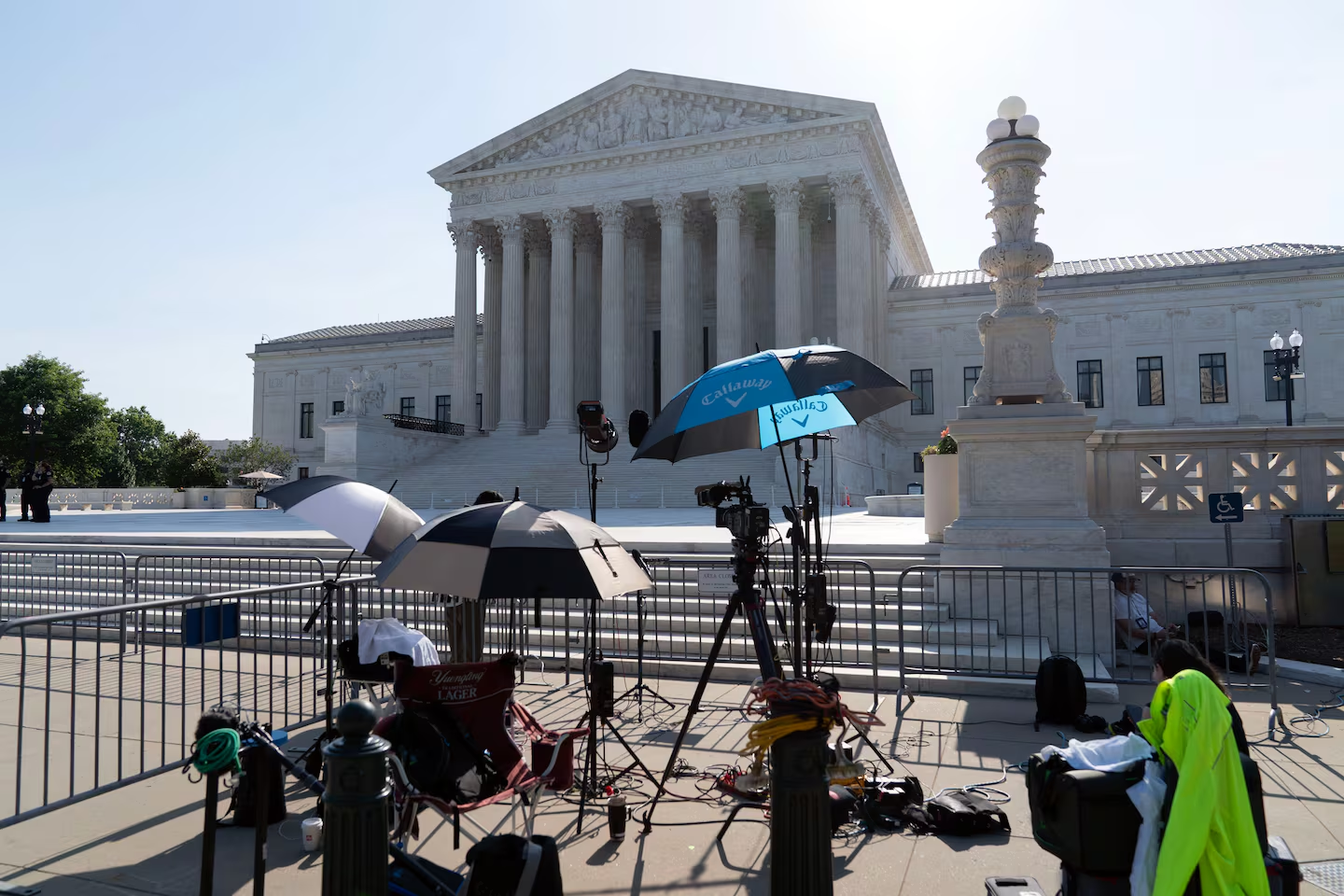
The plan paid off Tuesday, when the Supreme Court rolled back decades-old restrictions on political party spending, further expanding the power of big money in American politics.
It couldn’t have come at a better time for Republicans: Their party committees are flush with cash, and they can start spending that money immediately on midterm battlegrounds that will determine control of Congress.
For years, Republican candidates had faced a persistent disadvantage. Their Democratic counterparts had raised far more money, primarily from small-dollar donors online. And candidates qualify for cheaper advertising rates than political parties do. Republicans wanted to close that gap by letting parties — which can be funded by six-figure checks from wealthy donors — spend as much as they wanted in coordination with candidates. In the process, the parties would also qualify for those lower ad rates.
The lawsuit was the brainchild of Ryan Dollar, then the general counsel of the National Republican Senatorial Committee. The Supreme Court had been loosening campaign spending restrictions for years, and Dollar spied an opportunity to loosen them some more.
“We had our eyes on SCOTUS from Day 1,” Dollar said in an interview.
, the Supreme Court ruled limits on coordinated spending violated the constitution’s First Amendment.
“For nearly 200 years after the ratification of the First Amendment, parties could spend freely to support their candidates during campaigns and could do so in coordination with the candidates,” Justice Brett Kavanaugh wrote in the majority opinion. He cast the decision as returning to that era.
Justice Elena Kagan, one of the court’s liberal justices, wrote a dissent lamenting that while candidate donation limits are $7,000, donations to parties can be “as much as half a million dollars.”
“The Court ushers back in the same opportunities for quid pro quo corruption that the contribution limits were meant to check,” she wrote.
The ruling in National Republican Senatorial Committee v. Federal Election Commission is widely expected to usher in the biggest shift in how campaigns are funded since the aftermath of the Citizens United decision in 2010, which lifted limits on corporate expenditures and laid the groundwork for the current era of big-spending super political action committees.
The decision is the latest in a series of Supreme Court rulings in recent years that have struck down limits on political spending using the argument that spending money amounts to protected speech. The ruling also suggested the court’s willingness to further dilute such limits in the future.
In the short term, the case is likely to benefit Republicans. The Republican National Committee entered June with $125.5 million in the bank, while the Democratic National Committee carried more debts than cash on hand.
“It will be a massive advantage for our party,” said Mike Ambrosini, a top party strategist and chief of staff of the Republican National Committee.
Read more Supreme Court upholds birthright citizenship, rejecting Trump’s proposed limits
Tim Persico, who served as the executive director of the Democratic Congressional Campaign Committee in the 2022 cycle, said the midterm elections just became instantly more challenging for Democrats. “It just makes it harder,” he said.
“Democrats have figured out how to leverage our grassroots support so we can compete with billionaires and corporations,” Persico said. “This is another example of this Supreme Court undermining the voices of the many for the voices of the millionaires, billionaires and corporations.”
In the long term, Democrats could adjust their fundraising and spending strategies to try to push the playing field back in their favor. Few advantages become permanent in the ever-changing world of money in politics.
But this much is clear: The new landscape will result in a greater concentration of power within both national parties, which may now buy unlimited ads on behalf of the candidates they are supporting, all while coordinating directly with them.
Inside the RNC, Ambrosini said, the planning for the ruling began early last year. His internal mandate was to conserve as much cash as possible so the party could be ready to spend heavily on ads in tandem with congressional candidates if a favorable ruling landed and granted the parties those lower TV rates.
The effect will magnify the importance of the GOP’s huge cash advantage.
“It’s one of the main reasons that anyone that is a Republican should not write our obituary in June,” Ambrosini said.
The specifics of why the ruling matters are as technical as they are important.
Political committees have previously faced strict limits on coordinated spending between parties and candidates. The result has been a logistical headache. Parties have had to erect internal firewalls in order to run ads for House and Senate candidates. Those making the party’s ads could not talk to the campaigns they were trying to help.
That amplified the value of the small donations pouring into Democratic campaign accounts. Not only was that money controlled by the candidate’s own team, but it also stretched further because of a federal law entitling candidates of both parties to the cheapest available ad rates.
The upshot: Republicans relying on outside money have been paying much more than Democrats for similar ad time.
“In some of these races that get really intense and competitive, it can be 10 and 20 times as much,” said Jason Thielman, who served as executive director of the Senate Republican campaign arm in the 2024 elections.
In 2022, a 30-second TV ad during a football game in Nevada cost one Republican group $150,000; the Democratic candidate paid $21,000.
Tuesday’s ruling threw out that disparity.
“This is about as significant as a game changer and leveler we could see,” Thielman said.
Read more Defending champion Jannik Sinner survives massive five-set scare in Wimbledon opening round
This article originally appeared in The New York Times.


Post Comment