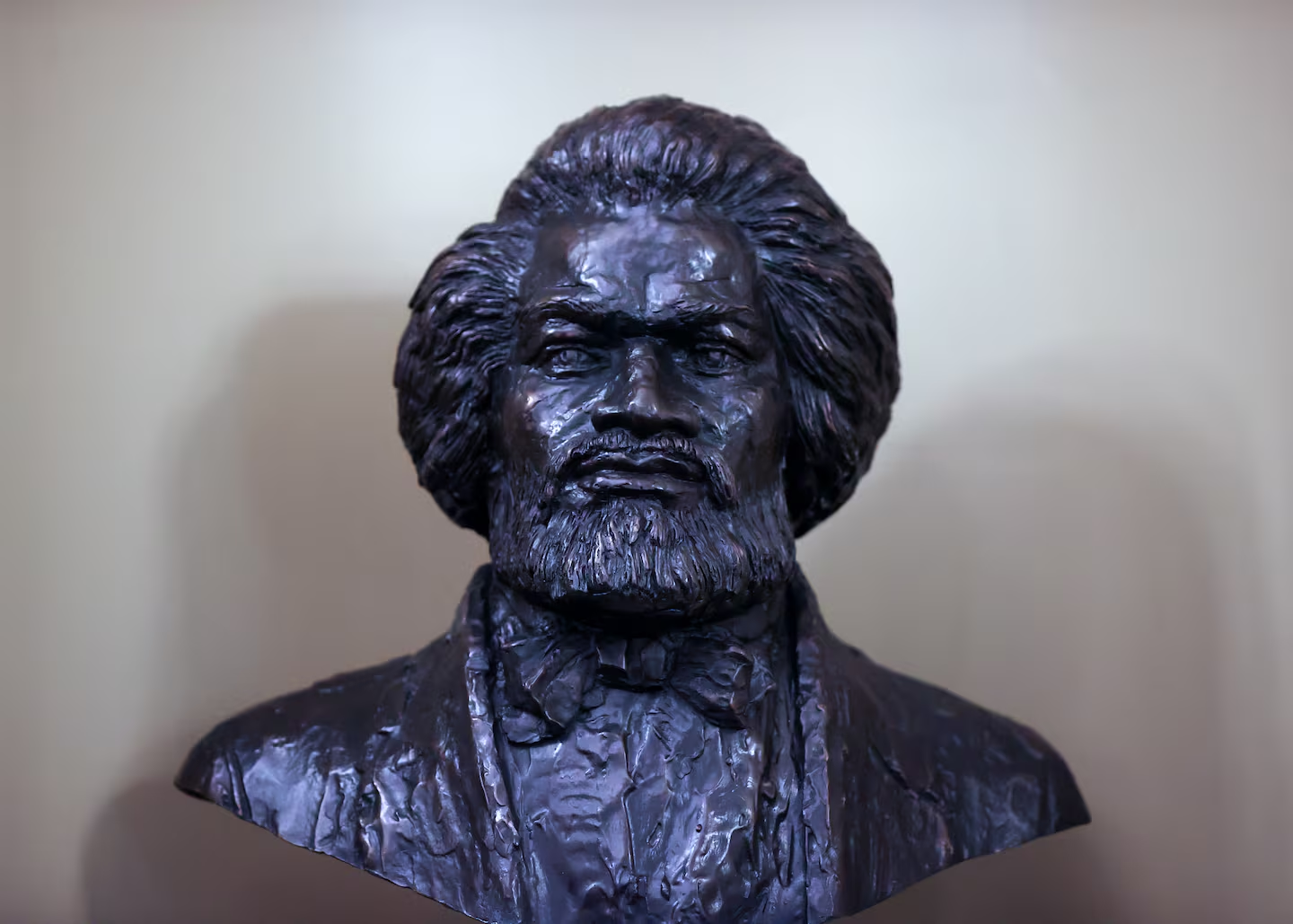
With ‘What to the Slave Is the Fourth of July?’ Frederick Douglass challenged American hypocrisy
In our weekly series, One Special Thing, the Globe arts staff highlights something timeless — movies, books, TV shows, albums, paintings, plays, symphonies, dishes — that we return to in good times and bad. Something we’re just dying to tell you about. The only parameter is passion.
Frederick Douglass was already on his way to becoming the greatest orator of the 19th century when he took the podium in Rochester, N.Y., on July 5, 1852. The occasion was the 76th anniversary of US independence. Douglass was only 14 years past his own independence; he’d escaped from slavery in 1838, and had become a favorite speaker on the abolitionist circuit. He was establishing himself outside the influence of Boston-based abolitionist William Lloyd Garrison, and publishing his own abolitionist newspaper, The North Star.
The speech he gave that day at Corinthian Hall, at a meeting organized by the Rochester Ladies’ Anti-Slavery Society, stands as one of his major achievements, as essential in its own way as his two major autobiographies, “Narrative of the Life of Frederick Douglass, an American Slave” (1845) and the more comprehensive “My Bondage and My Freedom” (1855). “What to the Slave Is the Fourth of July?” takes a blistering approach to a theme that always feels ripe this time of year: the wide chasm between American ideals and American reality. But in 1852 that chasm seemed as unbridgeable as ever.
In 1850, the US Congress passed the Fugitive Slave Act, which required the return of enslaved people to their enslavers, even if they were caught in free states. The law all but extended slavery into the Northern states, and amid these Fourth of July celebrations, it compelled Douglass to ask a burning question: Independence for whom, exactly? Certainly not African Americans.
Douglass began his speech with a favorite tactic: disarming his audience with self-deprecation. “The little experience I have had in addressing public meetings, in country school houses, avails me nothing on the present occasion.” Maybe, maybe not. But what follows is not the work of a man uncertain how to proceed. “What to the Slave” is a masterclass in strategic rhetoric and oratory, guided and forged by fire.
Read more A ‘Frankie and Johnny in the Clair de Lune’ that Terrence McNally would admire
For a museum gallery placard in the exhibition, “One Life: Frederick Douglass,” at the National Portrait Gallery, Harvard English professor and Douglass scholar John Stauffer wrote that the speech employs a “double reversal.” Douglass begins by comforting his mostly white audience and singing the praises of “your independence.” A wonderful thing, that Declaration. Then, for the next hour or so, he executes reversal No. 1. “What have I, or those I represent, to do with your national independence?” he asks. He tears into the church’s complicity in slavery, the still-thriving internal slave trade (or the trade of enslaved people within the US).
Then, still picking up speed … he downshifts into reversal No. 2, in which he expresses optimism for what Lincoln would call “the better angels of our nature.” “The arm of the Lord is not shortened,” he thunders, paraphrasing the Book of Isaiah, “and the doom of slavery is certain. I, therefore, leave off where I began, with hope” (italics his). “What to the Slave Is the Fourth of July?” is a searing jeremiad, a song of lament seeking to restore the ideals of the nation’s founders.
But it’s hard to convey the speech’s power without quoting it at length. And so: “What, to the American slave, is your 4th of July? I answer; a day that reveals to him, more than all other days in the year, the gross injustice and cruelty to which he is the constant victim. To him, your celebration is a sham; your boasted liberty, an unholy license; your national greatness, swelling vanity; your sounds of rejoicing are empty and heartless; your denunciations of tyrants, brass fronted impudence; your shouts of liberty and equality, hollow mockery; your prayers and hymns, your sermons and thanksgivings, with all your religious parade, and solemnity, are, to him, mere bombast, fraud, deception, impiety, and hypocrisy — a thin veil to cover up crimes which would disgrace a nation of savages.”
At which point, one likes to imagine, he dropped the mic, leaving the Rochester Ladies’ Anti-Slavery Society in a state of stunned silence.
Read more How much have airfares risen with high jet fuel costs?





Post Comment