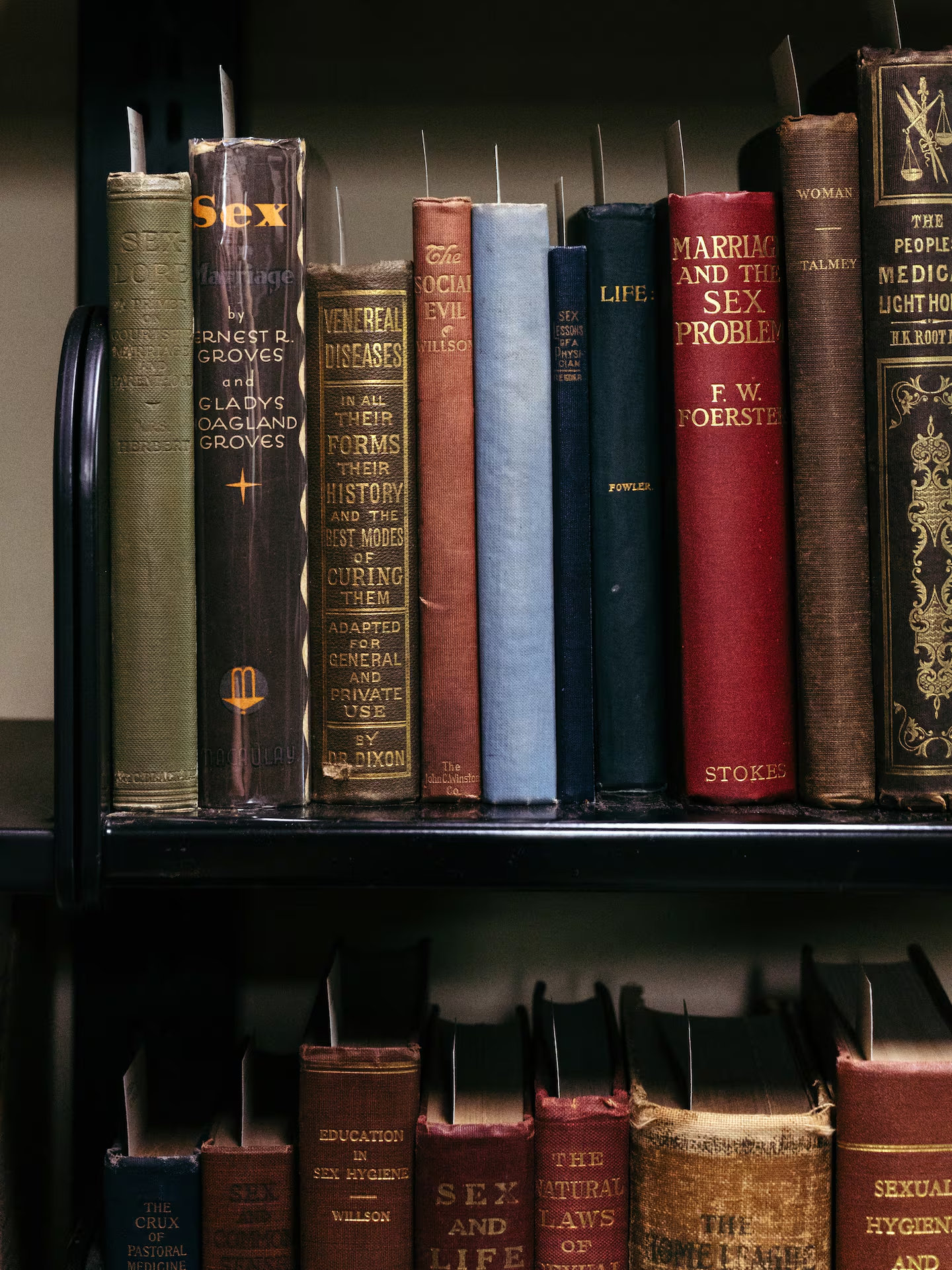
Rare books on sex have spiced things up at a library Franklin founded
PHILADELPHIA — There is much history to celebrate on America’s 250th birthday at the Library Company of Philadelphia, the oldest public rare book collection in the United States, founded by Benjamin Franklin in 1731.
Read more For the US’s 250th birthday, a German Declaration of Independence goes on show
Forty-five years older than the country itself, the landmark nonprofit once extended borrowing privileges to delegates of the First and Second Continental Congress and the Constitutional Convention. It served as the research arm of a nascent American government before there was an official Library of Congress.
Now, as ever, it displays Franklin’s electrostatic machine and William Penn’s desk. But there’s also something a bit racier on the menu as the library celebrates the recent gift of 1,500 rare volumes illuminating centuries of attitudes on sex and the reproductive anatomy.
The sexuality collection is the latest donation by Charles E. Rosenberg, 89, an emeritus professor of the history of science at Harvard University, who has already bequeathed the library some 15,000 books on the social aspects of medicine, topics covered in six books he himself wrote. He described his latest gift as largely “how-to-run-your-sex-life books.”
“There’s definitely some graphic materials but they’re not intended as pornographic,” said Rachel D’Agostino, the library’s curator of printed books.
The collection includes dozens of variations of what was once a cornerstone primer on sexuality, “Aristotle’s Masterpiece.” It was not really by Aristotle, and it was hardly a masterpiece, but the widely pirated, often questionably informed manual was in virtually continuous print for more than two centuries since its first anonymous publication in London in 1684.
Mary Fissell, a professor in the history of medicine at Johns Hopkins University, who is writing a book about the book, said the unknown author had posed as the Greek philosopher who gained a reputation (largely undeserved and not at all serious) in 17th-century England as a Dr. Ruth of antiquity. But the popularity of the underground bestseller waned when anti-vice crusader Anthony Comstock suppressed sex books in this country in the 1870s. “That killed it,” she said.
As it approaches its 300th birthday, the Library Company is marking its own milestone — a pending merger with Temple University to shore up its shaky finances and expand its academic and public footprint. The deal, approved by shareholders of both would-be partners last December, awaits approval by the Pennsylvania attorney general and the state judicial unit that oversees charities, known as Orphans’ Court.
Like many nonprofits, the library, with an annual budget of roughly $3 million, has struggled financially in recent years and its staff, which numbered 28 two years ago, has shrunk to 16.
Joining forces would expand scholarly vistas for the university’s nearly 35,000 students and faculty while securing the library’s public future, John Fry, Temple’s president, said in an interview. “It’s the best shot for it to continue another 300 years.”
Jessica Choppin Roney, the Library Company’s incoming director and an associate professor of history at Temple, said Franklin’s commitment to populism would have left him “really excited about Temple.”
As a Quaker colony with no established church or strong central government, she said, Pennsylvania was particularly open to volunteer projects like the library.
What Franklin might have thought about the sex books is not known, although he did reprint and publish a 1734 book by a Virginia doctor named John Tennent called “Every Man His Own Doctor: Or the Poor Planter’s Physician,” which offered a method of home abortion.
Read more Ukrainian strike sets fire to oil refinery in southern Russia
The latest Rosenberg gift includes sets of another rare book first published in London in the early 1700s, “Onania, or The Heinous Sin of Self-Pollution,” with warnings against masturbation.
The donation also includes many books on topics that today might be classified as LGBTQ+ life — one, on “Greek Ethics” bearing the plaintive scrawled inscription: “To Bob, if we had only lived then. Sincerely Phil.”
In all, the Library Company, once based in Independence Hall and since 1965 in a Center City building at 1314 Locust St., holds an estimated 500,000 books and an equal number of historic papers, illustrations and artifacts. Visitors do not roam the stacks but request items from librarians.
“Franklin spent more time and care on the Library Company than any other civic project,” wrote University of Delaware historian J.A. Leo Lemay in his multivolume biography unfinished at his death in 2008. Franklin founded it as an outgrowth of his Junto mutual improvement discussion club of 1727 and served as its director, librarian and book agent.
The idea, he wrote in his autobiography, was that by “clubbing our Books to a common library, we should, while we lik’d to keep them together, have each of us the Advantage of using the Books of all the other Members, which would be nearly as beneficial as if each owned the whole.”
With few booksellers outside Boston, Franklin, then 25, had subscribers pay a modest fee of shillings to join and pledge additional sums to buy books from England. They usually met in taverns, with the fine for missing a meeting set at “one Pint of Wine.” Franklin, as inscriptions show, donated some of his own volumes, including an English translation of a French text “Logic or the Art of Thinking” from 1717, and the group voted to purchase texts such as “Gulliver’s Travels” and “the Koran,” according to the Lemay book.
In 1740, the library housed its roughly 375 titles in the State House of Pennsylvania (now Independence Hall), and in 1773 it moved nearby into the newly built craft guild house Carpenters’ Hall.
The following year, the First Continental Congress became its downstairs neighbor, convening to weigh a response to King George III’s “Intolerable Acts.” The library welcomed delegates with a resolution, now preserved on the shelves in a bound volume of original handwritten minutes:
“Upon Motion, Ordered: That the Librarian furnish the Gentlemen who are to meet in Congress in this City with the use of such Books as they have occasion for during their sitting, taking a Receipt for them.”
That hospitality was extended for subsequent assemblies before and after the Revolution. “The U.S. is a baby compared to us,” said D’Agostino, who also teaches at the University of Virginia’s Rare Book School.
In his unfinished autobiography, written from 1771 to 1790 when he died at 84, Benjamin Franklin expressed special pride in his Library Company, which he called “the Mother of all the N American Subscription Libraries now so numerous.”
“These Libraries,” he added, “have improv’d the general Conversation of the Americans, made the common Tradesmen & Farmers as intelligent as most Gentlemen from other Countries, and perhaps have contributed in some degree to the Stand so generally made throughout the colonies in Defense of their Privileges.”
Read more The best local book events this week
This article originally appeared in The New York Times.





Post Comment