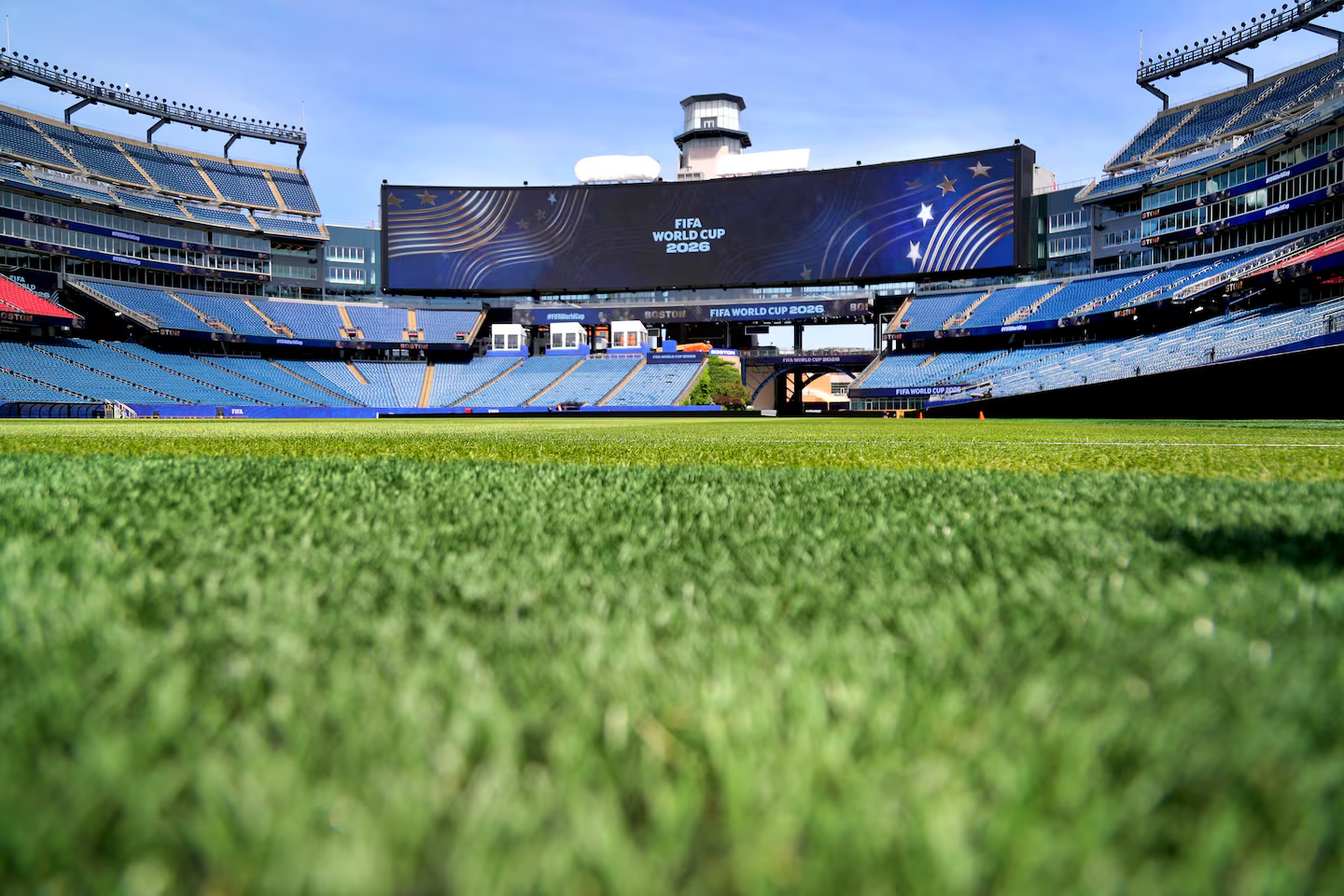
NFL owners installed natural grass for the World Cup. Why won’t they keep it for their own teams?
With the knockout stage still to come, the World Cup already has brought incredible competition and joy to the 11 host stadiums in the United States.
Read more World Cup forecast: Timing pushes back thunderstorm threat for Friday’s Foxborough match
The sport’s biggest superstars, headlined by Erling Haaland, Kylian Mbappe, and Lionel Messi, have delivered. Team USA has wowed with its dominant performances, clinching Group D. International fan bases, and their unbridled passion, have quickly endeared themselves to Americans across the country.
But the World Cup also has spotlighted an important question: Why will NFL owners install natural grass playing surfaces for soccer players, but not for their own teams?
Only 15 of 30 stadiums feature natural grass during football season. Of the 11 World Cup hosts, seven, including Gillette Stadium, usually feature synthetic turf — and had to make significant arrangements in order to meet FIFA’s tournament-quality standards. The six others were Mercedes-Benz Stadium (Atlanta), AT&T Stadium (Dallas), NRG Stadium (Houston), SoFi Stadium (Los Angeles), MetLife Stadium (New Jersey), and Lumen Field (Seattle).
Ahead of the first World Cup match on June 11, the NFL Players Association issued a statement criticizing owners for selective accommodations.
“The temporary installation of natural grass fields for the World Cup is a choice by certain NFL team owners to do for soccer players what they refuse to do for NFL players,” wrote the NFLPA. “It’s no longer a question of capability; the technology exists, the expertise exists, and the resources exist to install the high-level grass fields that our players overwhelmingly prefer.
“We have seen the meaningful investments made to meet the standard for international athletes and global events. NFL players — who regularly compete on these fields, help fund these stadiums, and whose work makes the league what it is today — deserve the same commitment to quality grass fields.”
According to a recent survey conducted by the NFLPA, 92 percent of its players prefer playing on natural grass as opposed to synthetic turf. The latest edition of the NFLPA player report cards revealed that home grass fields received a median grade of B+, while turf fields received a median of D.
The most popular explanations are that turf is harsher on the body, particularly the joints, and that grass is easier to move on.
“I’ve always been a big proponent of playing on grass,” said Patriots safety Kevin Byard, who is entering his 11th season. “It’s just a longer recovery process [after playing on turf]. My joints, mainly my ankles not my knees, take a little longer to recover. On a Tuesday or a Wednesday when you’re practicing, you still feel the soreness.”
Added Patriots special teams captain Brenden Schooler, “I love playing on grass. It doesn’t hurt as bad when you fall. When it’s freezing out, I don’t think it cuts you up as bad as turf does. You don’t have to worry about turf burn. I just think, you know, from doing my own research and looking at data and stuff, on turf you have the unfortunate thing where you get caught up and guys get rolled up on and your knee or your ankle gets stuck. Grass has got a little bit more give.”
The turf vs. grass debate is not new. But the World Cup, and the beautiful grass fields installed for all 78 of the matches in the United States, has revived the discussion.
In the leadup to the tournament, NFL players fielded questions about their preferences. Several echoed Byard and Schooler, voicing their desire to play exclusively on natural grass. Some, including Cowboys wide receiver CeeDee Lamb and Bears quarterback Caleb Williams, also shared their support via social media.
“This grass looks great on SoFi’s field,” 49ers tight end George Kittle wrote on X. “Wonder if we could get that all season.”
Giants coach John Harbaugh elected to stay out of the conversation. Players have panned MetLife Stadium’s notorious field, which received an F- in the player report cards.
“[NFL commissioner Roger Goodell] is going to call me up and he’s going to get mad at me because I’m probably not going to say what he wants me to say,” Harbaugh said with a laugh.
Goodell, though, is not the one who would make the call.
“This grass and turf stuff has nothing to do with Goodell,” former Patriots captain Devin McCourty explained recently on Pro Football Talk’s podcast. “The owners don’t want to pay for the upkeep of the grass field. They want to be able to, in the offseason, have all of these different events at their stadium because of the turf surface, whether it’s concerts. It’s very cost effective to have the artificial turf. You can place so many different things over it. You can do a rodeo over it, you can do a monster truck show over it, you can do all these things.”
McCourty said he and former Patriots coach Bill Belichick would talk “all time time” about how everyone, coaches included, would prefer to hold games on grass.
“Every team practices usually on grass fields,” McCourty said. “They have these grass fields they have to take care of because they know you don’t want to practice on that turf day in and day out because of the impact it has on your body.
“I remember in 2012 or 2013, Brazil and Portugal played a friendly at Gillette Stadium. It’s the most disrespectful thing as a player when you see them pouring all this dirt and putting this grass surface on top of your field because the field’s not adequate enough for these soccer players to get on the field. But you know you’re about to go back and play on this field time and time again, and watch guys get hurt on it.”
The 15 sites with real or hybrid grass playing surfaces are State Farm Stadium (Arizona), M&T Bank Stadium (Baltimore), Soldier Field (Chicago), Huntington Bank Field (Cleveland), Empower Field at Mile High (Denver), Lambeau Field (Green Bay), EverBank Stadium (Jacksonville), GEHA Field at Arrowhead Stadium (Kansas City), Allegiant Stadium (Las Vegas), Hard Rock Stadium (Miami), Lincoln Financial Field (Philadelphia), Acrisure Stadium (Pittsburgh), Levi’s Stadium (San Francisco), Raymond James Stadium (Tampa Bay), and Northwest Stadium (Washington).
So, what’s it going to take for all 30 NFL stadiums to install natural, high-quality grass?
The league has maintained that there is no statistical difference in injury rate on grass and turf. The league also has pointed to the climate as a limiting factor, saying the changing weather over the duration of the season provides a maintenance challenge.
“We’re operating a league that plays across multiple seasons,” said Nick Pappas, the NFL’s field director for the past three years. “It starts at the end of summer and operates deep into the winter. The location of our venues is spread out across one of the biggest continents — North America is massive — and at any given time the weather is going to be different not only in Seattle, Houston, Pittsburgh, and Miami, but also from what it was when the season started.”
Read more Red Sox victory follows travel delays that led to early-morning arrival in Boston
The Patriots, for example, played on a natural grass field when Gillette Stadium opened in 2002. By the end of November 2006, the team made what would become a permanent switch to turf as a result of the poor conditions during the middle of the season.
The key is not just installing natural grass, but maintaining a high-quality surface that can consistently meet the weekly demands of football over the course of at least five months.
“All of our NFL fields can perform at an excellent level for global world-class soccer,” Pappas said. “It’s not always the same case when you take a soccer pitch and put NFL players on it. The difference in style of play, difference in size of athletes. Sometimes a soccer field can perform well for soccer players, but when you put larger, faster athletes than the standard athletes, they may not have what they need when they go out there. Our athletes are so much bigger, faster, and stronger than they were a decade ago.”
The turf vs. grass discussion will probably intensify when the collective bargaining agreement expires at the end of the 2030 season.
If the NFLPA decides to push for all 30 stadiums to feature natural grass, then players will likely have to cede a different issue, such as an 18-game schedule, in negotiations. Both topics will likely continue to gain steam in the coming years, especially as the NFL continues to load its schedule with games on nearly every day of the week.
“The owners know, ‘All right if they want grass, and we’re going to give them grass, how do we ultimately get something that we know we could have never gotten?’ ” McCourty said. “Even though it is proven, the statistics show it, the World Cup is there, like everyone knows it’s better.”
In the meantime, the NFL announced last December that every stadium will have to meet “new enhanced standards” for playing surfaces by the start of the 2028 season. The standards were developed by two tools, one that replicates the movements of NFL players and another that determines the field’s firmness.
“Largely speaking, our NFL surfaces are some of the best playing surfaces that you can turn your TV on and see,” Pappas said.
DENIED ENTRY
No supplemental draft means no Sorsby
The NFL announced it would not be holding a supplemental draft this year, meaning quarterback Brendan Sorsby will not be going pro in 2026.
The decision was an attempt to take a stand against Sorsby’s gambling violations, which included thousands of bets totaling approximately $90,000 — all made during his time as an NCAA student-athlete. Sorsby made at least 40 bets on Indiana in 2022, when he was the Hoosiers’ backup QB.
In his letter informing Sorsby and his representation of the league’s decision, Larry Ferazani, general counsel for the NFL, called out a lack of accountability.
“The sole reasons identified in your Petition for seeking entry into the Supplemental Draft are that you have been ‘declared ineligible’ by the NCAA, have ‘exhausted all of [your] avenues to continue in the NCAA,’ and ‘want to now play in the NFL,’ ” Ferazani wrote to Sorsby. “The Petition provides no information regarding the basis for, or timing of, the NCAA’s decision. Public sources, however, indicate that in May 2026 the NCAA issued a determination declaring you permanently ineligible from participation in college athletics, based on a sustained pattern of improper gambling activity during your collegiate career at three different universities.”
Sorsby had applied for the supplemental draft after the NCAA stripped him of his eligibility. For a brief moment, it looked as though Sorsby would still have a chance to return to college after a Texas judge, Ken Curry, granted him a temporary injunction against the NCAA. But Sorsby ultimately will not suit up for Texas Tech, where he transferred after playing the past two seasons at Cincinnati, following significant backlash against Curry’s decision, including Big 12 opponents threatening to cancel games in all sports.
With no remaining avenues to play in college, Sorsby turned to the NFL — only to be denied. The CBA does not require the league to hold the supplemental draft, let alone grant every applicant eligibility.
“The League does not have the complete record of the NCAA’s investigation, and you did not provide any such materials with your Petition,” Ferazani wrote. “Available information nonetheless indicates that, over the course of your collegiate career, you knowingly engaged in repeated and significant violations of NCAA rules designed to preserve the integrity of athletic competition. Reported conduct includes placing wagers on your own team and teammates and, to avoid detection, establishing or funding accounts in the names of intermediaries who placed bets on your behalf. There are also reports that you may have violated state criminal law. Your Petition does not address these matters.”
The strongly worded letter does its best to send a message, that the NFL wants to maintain the integrity of its league. Although the league is intertwined with sports betting, previously having sponsorship deals with FanDuel, DraftKings, and Caesars, it recognized the gravity of Sorbsy’s infractions and the impact of disregarding them.
So, what’s next for Sorsby? The NFL left the door open for him to declare for the 2027 draft. Sorsby’s attorney, Jeffrey Kessler, indicated, though, that they plan to pursue legal action. The saga is likely far from over.
ETC.
Patriots did well to end Aiyuk pursuit
Two years ago, the Patriots wanted to trade for Brandon Aiyuk before abandoning their pursuit once it became clear the 49ers wide receiver wasn’t interested in playing in New England.
That decision has aged well, as Aiyuk’s odd behavior of late has consistently made headlines. Based on his social media activity, it appears Aiyuk is trying to force his way to the Commanders in order to play with former college teammate Jayden Daniels, Washington’s quarterback
This past Monday, Aiyuk posted a video on Instagram of him saying repeatedly, “Go Commanders! Go Commanders!” Then, on Wednesday, he posted a video of him holding a football with the Commanders logo and captioned it, “The best sport in the world, the best league in the world, [and] the best team in the world.”
It remains to be seen whether the tactics will work.
“I think every time he opens his mouth, he damages his standing with other teams and he scares other teams from bringing him into the organization,” ESPN insider Adam Schefter said on his podcast. “I just think he doesn’t realize that. He thinks he’s helping the situation. I don’t believe that to be the case. You speak to teams, everybody is saying, ‘What’s wrong with this guy right now?’ It’s unsettling to watch him. It’s scary to see how he’s handling himself.”
Aiyuk, who didn’t play last season after suffering a torn ACL in October 2024, still has three years remaining on the four-year, $120 million extension he signed two months before the injury. San Francisco general manager John Lynch said in January it’s “safe to say” Aiyuk has played his last snap with the organization.
Extra points
The NFL announced the training camp sites and reporting dates for all 32 teams. Because the Patriots and Seahawks will play in the kickoff game Wednesday, Sept. 9, they will open camp July 24, four days earlier than most teams. The Cardinals and Panthers will start the earliest, July 22, because they are scheduled to play in the annual Hall of Fame preseason game (Aug. 6) … Patriots left tackle Will Campbell worked out in Oklahoma with a small group of other offensive linemen, including Dion Dawkins, Creed Humphrey, Lane Johnson, and Tristan Wirfs. (In the leadup to Super Bowl LX, Campbell listed Wirfs as one of his favorite left tackles in the league.) Mitchell Hopper, who won the World’s Strongest Man title in 2023 and ′26, was present, as well … England striker (and massive Tom Brady fan) Harry Kane recently reaffirmed his interest in a foray into American football. Kane, who turns 33 in July, would like to eventually try his luck at becoming a kicker. The Cowboys’ Brandon Aubrey, the NFL’s highest-paid kicker, also has a soccer background, albeit far less prestigious … The league started releasing its “Top 100” this past week, beginning with Nos. 91-100. The list, as voted on by players, could feature several Patriots after multiple years of sparing representation. Possible names include A.J. Brown, Kevin Byard, Christian Gonzalez, and Drake Maye. Last year, Gonzalez (No. 84) was the only Patriot included. In 2024, the Patriots were one of two teams to not have a player on the list.
Read more For Scotland and other teams in 3rd place, the World Cup waiting game is underway


Post Comment