Democratic leaders want the party to moderate. Its base has other ideas.
After a trio of leftists in New York City defeated establishment-backed candidates in congressional primaries, a bouquet of flowers and a sympathy card arrived at the Capitol Hill office of Rep. Hakeem Jeffries of New York, the minority leader.
Read more Ken Burns and Jeanne Shaheen will each receive the same Legacy Award this fall
“With heartfelt sympathy,” read the trolling card from the House Republicans’ campaign arm, mocking Jeffries, who had backed two of the losing candidates.
Progressives were cheering their victories in New York on Wednesday. The only faction that appeared even happier may have been Republicans fighting to cling to power in the midterms, who are eager to attempt to define the Democratic brand by its most boisterous and socialist voices.
“The insurgent left is on the rise,” House Speaker Mike Johnson, R-La., proclaimed gleefully at a news conference at the party headquarters in Washington, where he faulted Democrats for failing to defend against “the Marxist march around the country.”
Democrats find themselves squeezed by competing forces. The party’s leaders in Washington are pushing for moderate candidates who they hope will be competitive in states and areas that have been inhospitable to Democrats in recent years. But primary voters in New York and other recent contests are moving in the opposite direction, increasingly turning to progressives and even socialists who excite the base.
The results — which included the defeat of the chair of the Congressional Hispanic Caucus — revealed anew the limited capacity for party power brokers to choose their nominees during a moment of intense voter anger at the political establishment.
Many Democrats believe that persistent high prices and President Donald Trump’s sagging popularity have given them a strong and clear message of affordability this year.
But two years after Republicans won the presidency, the House and the Senate in part by branding Democrats as extreme, out-of-touch leftists, Trump and his allies are eager to once again use the views of the most progressive voices to define the Democratic brand.
“America the Beautiful will NEVER be a Communist Country!!!” Trump wrote on social media early Wednesday, calling the three Democrats who prevailed in New York — two of whom identify as democratic socialists — “3 solid Communists.”
Democrats have fielded a broad array of candidates to run in the midterms, nominating centrist candidates to run in many swing districts and more progressive candidates in urban strongholds. But much of the energy and excitement propelling the party of late has appeared to come from the insurgent left, starting with the big crowds that Sen. Bernie Sanders, I-Vt., drew last year in his nationwide “fighting oligarchy” tour.
“This is a massive win for the progressive movement against the establishment in New York City, which is the epicenter of power for the Democratic Party,” Rep. Ro Khanna, D-Calif., a progressive plotting a 2028 presidential run, said in an interview.
The question now is what happens in the next consequential primaries in battleground states, including the Michigan Senate contest and the Wisconsin governor’s race, where another democratic socialist has gained traction.
Read more Supreme Court strikes down Hawaii law requiring permission to carry guns in stores and hotels
Many of the political operatives who worked on the winning New York campaigns have experience working for Sanders or Mayor Zohran Mamdani of New York, a democratic socialist who upended the city’s political establishment when he was elected last year.
Publicly, some party stalwarts expressed calm about Tuesday’s results.
“To me, a party that is addressing the needs of its base in nonswing districts but also putting up candidates who can win in swing districts and actually defeat Republicans is overall a healthy party,” said Neera Tanden, who has served in the last three Democratic administrations and is now the president of the Center for American Progress, one of the party’s leading think tanks.
Tuesday’s results in New York signified an ongoing shift in the fighting spirit that blue-district Democrats demand from their elected officials, and a frustration with both the old guard and the old way of doing things.
The outcomes were further magnified by the fact that they occurred in the backyards of the top Democrats in both the House and Senate.
Sen. Chuck Schumer of New York, the minority leader, has backed moderate candidates to try to flip Republican-held seats to help the party to regain the Senate. He is supporting Rep. Haley Stevens of Michigan in her Senate primary in August against Dr. Abdul El-Sayed, a progressive former public health official who is supported by Sanders. Stevens is a supporter of Israel, while El-Sayed, like the Democrats who won Tuesday in New York City, has called its actions in the Gaza Strip a genocide.
Earlier this year Schumer saw his preferred candidate for the Senate in Maine, Gov. Janet Mills, suspend her campaign more than a month before her primary against Graham Platner, a Maine oyster farmer and political novice who is also backed by Sanders.
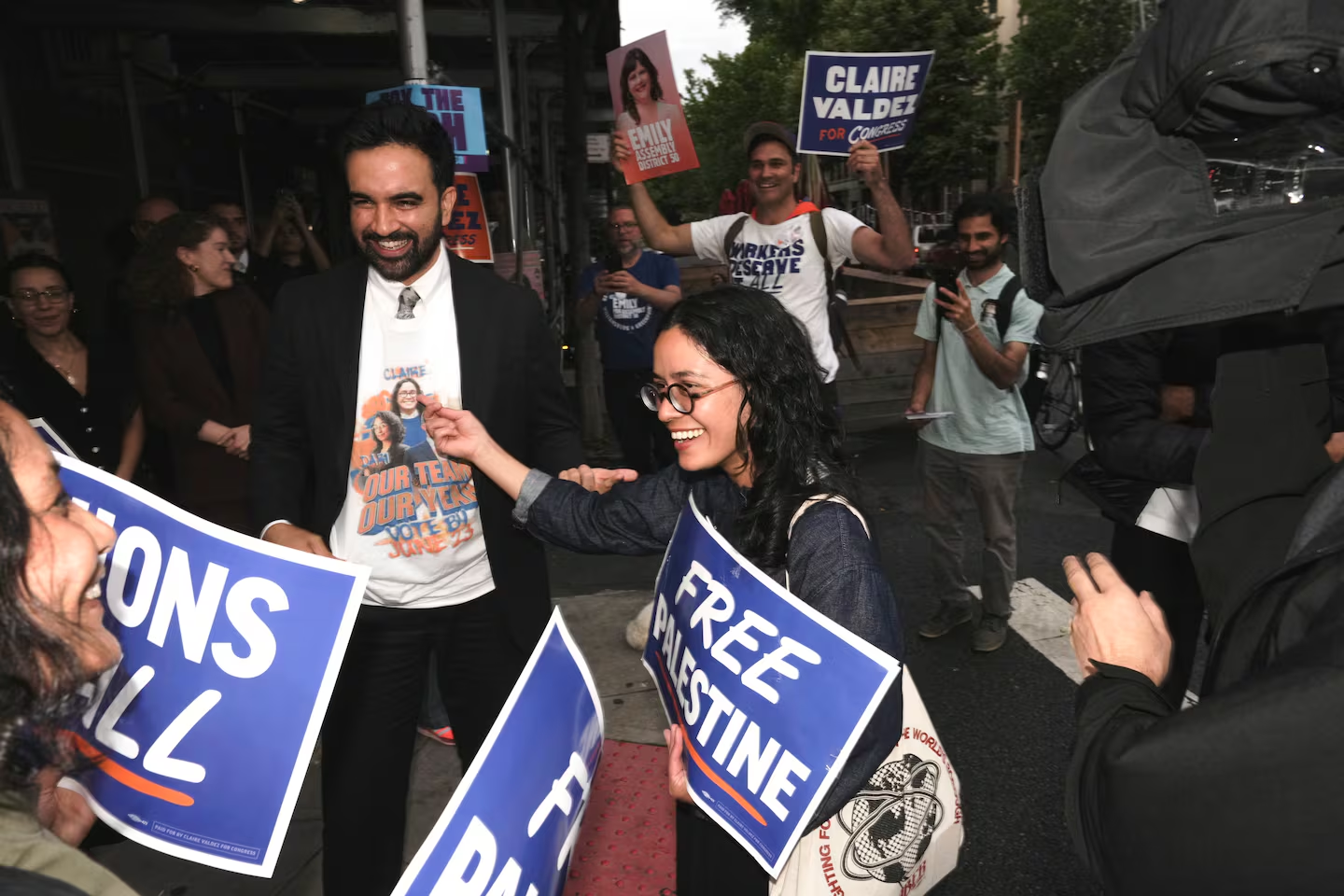
Two New Yorkers endorsed by Jeffries — Reps. Adriano Espaillat, the Hispanic caucus chair, and Dan Goldman — lost to a pair of left-wing primary challengers, Darializa Avila Chevalier and Brad Lander. A third primary, to replace Rep. Nydia Velázquez, who is retiring, was won by Claire Valdez, a democratic socialist who defeated Velázquez’s choice for the seat.
If Democrats do seize a House majority in the November midterm elections, the growing faction of leftists could cause headaches for Jeffries, both for his ascent as speaker and governance if a majority is narrow.
The House Democrats’ campaign arm has boosted candidates in several House primaries to elevate more moderate options only to be rebuffed by voters, including in California’s Central Valley and in a rural Maine district now represented by a Democrat despite voting several times for Trump. (Moderate Democrats prevailed in some primaries Tuesday night, including in Utah and Maryland. And in one race in New York’s 17th Congressional District on Tuesday, Democrats nominated Cait Conley, a combat veteran, despite Republican efforts to meddle in the race and defeat her.)
Progressives have triumphed in other races, particularly in cities. Janeese Lewis George, a democratic socialist, won the Democratic primary this month in the Washington, D.C., mayoral race.
“There is a desire for the old guard to stand down, and anything that smacks of the party establishment is in trouble,” said Tré Easton, a Democratic strategist at the Searchlight Institute, a Democratic think tank. “That’s not necessarily an ideological thing.”
Read more Rubio hails US-Gulf Arab unity despite the region’s persistent concerns about Iran agreement
This article originally appeared in The New York Times.


Post Comment