Plenty for teams to glean from MLB Draft Combine both on and off the field
Thirty teams and more than 300 high school and college prospects will descend on the desert this week for the MLB Draft Combine at Chase Field in Phoenix. Now in its sixth year, the event lacks the prestige of similar events in other sports, but has emerged as a critical part of the scouting cycle that now attracts most of the sport’s top prospects.
Last year, the Red Sox used the combine to meet with righthanders Kyson Witherspoon and Marcus Phillips, where the two pitchers solidified the impressions that led the team to take them with their top two picks. This year, the expected turnout by top prospects is greater than ever, including two players — UCLA’s Roch Cholowsky and Texas high schooler Grady Emerson — considered in play for the top pick in the draft, as well as local standouts such as Bishop Feehan lefthander Brody Bumila and Vermont Academy righty Kaiden McCarthy.
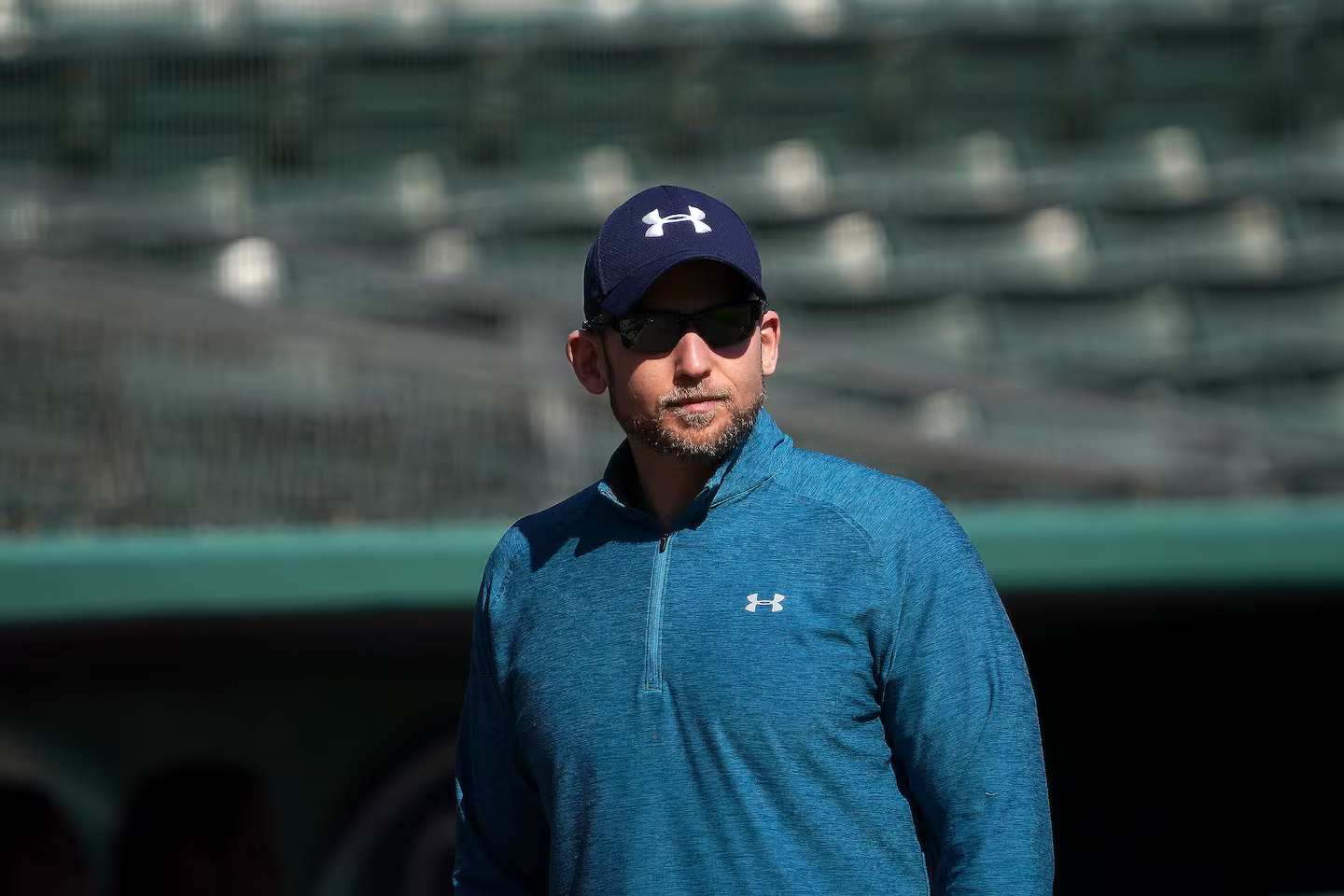
“It’s a thing,” Jake Bruml, overseeing his first Red Sox draft as the team’s director of amateur scouting this year, said of the combine.
Because it takes place in a big league park outfitted with Hawkeye tracking technology as well as KinaTrax biomechanical motion capture systems, teams can glean plenty of information about players’ tools through batting practice, bullpen sessions, simulated: Exit velocities, arm strength, and speed for position players; pitch velocities and shapes, release points, arm angles, and extension for pitchers.
For a pitcher such as McCarthy, who reclassified from the draft class of 2027 to 2026 this winter and who threw fewer than 20 innings in games this spring in part because of the nature of the short high school season in Vermont, the combine is a showcase. He’ll take part in a game between top high schoolers on Tuesday night, pitching in front of hundreds of evaluators who likely haven’t seen him in person, an opportunity to sway his draft standing considerably.
In addition to on-field evaluations, players take part in strength and conditioning tests such as force plate jumps, 30-yard dashes, and mobility testing as well as vision tests to allow teams to get a fuller picture of their physical abilities. They also undergo medical testing and evaluations.
Interestingly, when asked to identify the primary value of the combine to the Red Sox, Bruml didn’t begin with the on-field or physical information that can be gleaned from the event. Instead, he started with the opportunity presented at the combine to meet directly with and interview prospects to better understand their makeup, training backgrounds, and how they might take to instruction as pros.
“Especially if they’re at college programs, we don’t get a ton of access to them, and so getting them in a one-on-small group setting is very valuable,” said Bruml.
Teams take different approaches to the interview process. Some include behavioral analysts, posing outside-the-box problem-solving exercises. Some teams try to interview as many as 130 or more players.
The Sox, whose first-round pick this year will land at No. 20, meet with fewer players than most teams, preferring more in-depth conversations with a smaller pool of potential targets. They also prefer to keep the conversation focused on baseball rather than psychological profiling.
“It’s a job interview for these kids,” said Bruml. “We’re trying to break down that intimidation factor so that it’s a natural setting, and we can get into conversations, getting to meet with those prospects in a short window.”
In the meetings, the Sox typically include Bruml, assistant general manager Mike Groopman, amateur scouting assistants Chloe Gosselin and David Gerth, one of their three regional scouting coordinators, an acquisitions specialist, and assistant director of player development Jordan Elkary. (For some interviews, the Sox will also feature a special assistant or national crosschecker.)
Read more Erling Haaland scores twice as Norway holds off Senegal to clinch spot in knockout round
The inclusion of Elkary as a representative of the team’s player development efforts is particularly notable. The Sox see the meetings not merely as a chance to get to know the players, but also as a chance to sell potential draftees on how they might develop within the Sox organization, with individualized player development plans.
That opportunity has become particularly important in an era where MLB teams face a capped draft pool. An increasing number of players, particularly potential later-round draft picks, can get more short-term money by returning to (or enrolling in) college and receiving NIL money.
“It’s no longer like, ‘Oh, you’ve been drafted, you are going to sign.’ It’s now, ‘You’ve been drafted, but we’re competing with an offer from your big school that has an NIL budget,’ ” said Bruml. “I believe maybe a way we can separate ourselves is by trying to lean into development, because there’s going to reach a point in the draft where we cannot offer as much money as these other schools, which is crazy to say.”
Of course, while there’s value to the combine — and to the conversations that occur there — it offers pieces of information rather than being the defining part of how a team evaluates a player. While the Sox met last year with Witherspoon, Phillips, and second-rounder Henry Godbout at the combine, they didn’t meet with either third-rounder Anthony Eyanson or fourth-rounder Mason White, both of whom were in attendance.
Still, for many prospects, this week will represent one of the final chances leading up to the draft to influence where they’ll land — making the coming days potentially life-changing.
Three up
⋅ Over his last 10 appearances, Triple-A Worcester reliever Wyatt Olds hasn’t given up an earned run in 11 innings, with 19 strikeouts, 4 walks, and just 4 hits allowed in that span. He is pitching well enough to warrant consideration as a bullpen depth option.
⋅ Righthander Anthony Eyanson, who made his first start in 12 days on Sunday while trying to rebound from a difficult stretch in Double-A Portland, logged four shutout innings with five strikeouts and one walk, with his fastball velocity rebounding a bit to sit at 93-95 miles per hour. He’d been sitting at 92-93 m.p.h. earlier in the month.
⋅ Outfielder Harold Rivas, who turned 18 last month, is amidst an excellent stretch in rookie ball. Over his last 15 contests, the multi-dimensional center fielder is hitting .278/.420/.556 with three homers, seven extra-base hits, and 10 steals for the FCL Red Sox.
Three down
⋅ Though lefthander Eduardo Rivera remains a tough at-bat (.118 average against this month), he’s struggled in Worcester this month, allowing nine runs (five earned) in 10 innings while walking eight in six appearances. He’s throwing a lower percentage of pitches for strikes (56 percent) in June while also posting his lowest whiff rate of the season (33 percent, down from 37 percent in May).
⋅ While lefthander Hayden Mullins has an excellent 36 percent strikeout rate for Portland, he’s been a significantly different pitcher out of the stretch than in the windup. With the bases empty, he’s held hitters to a .151/.262/.290 line with a 40 percent strikeout rate. With runners on base, those marks go up to .245/.417/.321 with a 31 percent strikeout rate.
⋅ As a staff, the Single-A Salem RidgeYaks pitching staff has a 16.0 percent walk rate, the highest of any full-season minor league team this year.
Read more Bucks deal star center Giannis Antetokounmpo to the Heat, not the Celtics, in NBA blockbuster



Post Comment