Trump administration shuttered a criminal probe into fraudster’s clemency
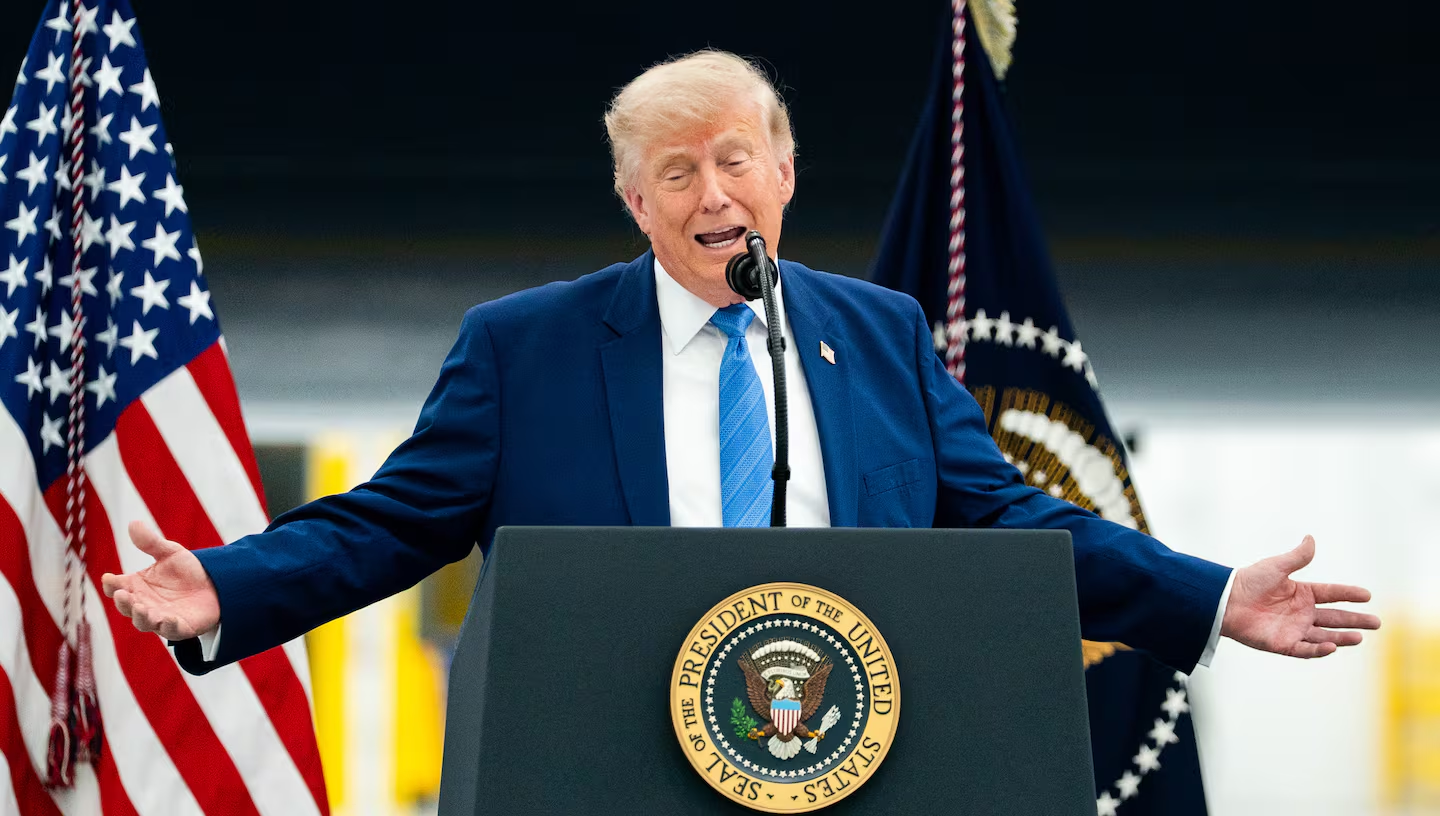
WASHINGTON — President Trump’s political appointees quashed an early-stage criminal investigation into the circumstances surrounding his clemency grant to a convicted fraudster, according to five people with knowledge of the events.
Read more Miyu Yamashita wins Meijer LPGA Classic playoff after Lottie Woad lips out 3-footer in regulation
The investigation, which has not been previously reported, had begun examining whether improper payments were made to help facilitate the commutation awarded to David Gentile, a private equity executive who was convicted in a $1.6 billion scheme that defrauded thousands of mostly mom-and-pop investors, some of whom lost their retirement savings.
The clemency grant freed Gentile last November less than two weeks into a seven-year prison sentence, and wiped away the possibility of forfeiting more than $15.5 million to the government.
Within a few months, federal prosecutors in New York City, where Gentile’s conviction had been secured, opened an investigation into how the commutation came about.
Among the evidence they gathered was information about jailhouse communications in which Gentile discussed making payments of $2.5 million or more to people or companies to help facilitate his clemency, according to two people with knowledge of the investigation who were not authorized to discuss it.
One of the people who came under scrutiny by investigators was the Rev. Frank Mann, a retired Catholic priest from New York City’s Queens borough who is friends with Trump. In an email sent to The New York Times, Mann denied having anything to do with the clemency. But people with knowledge of the prison communications say that the priest corresponded with Gentile about lobbying the president on his behalf.
By May, the investigation had come to an abrupt halt after the Times inquired about the matter with the White House and the US attorney’s office in the Eastern District of New York, where the career prosecutors pursuing the inquiry worked.
In a phone call with Joseph Nocella Jr., the US attorney for the Eastern District of New York, Aakash Singh, an associate deputy attorney general, expressed concern about the investigation, according to two people with an understanding of the sequence of events.
Shortly after, the career prosecutors were told to abandon their efforts.
A spokesperson for Nocella’s office referred questions about the Gentile investigation to the Justice Department in Washington.
Natalie Baldassarre, a Justice Department spokesperson, suggested that everything was done by the book.
“Our prosecutors always work within the bounds of our enforcement priorities to hold bad actors accountable and ensure the efficient use of taxpayer resources,” she said in a statement.
It is not clear how far along the investigation was or who was being targeted. While prosecutors had explored potential crimes like wire fraud, according to four people with knowledge of the situation, it is also not clear whether the investigation would have resulted in charges had it been allowed to continue, or if a crime was committed at all.
There is no indication that Trump himself was a target of the investigation.
Nonetheless, it had the potential to embarrass the president by highlighting how his pardons and commutations have often benefited wealthy or well-connected people, or his supporters.
Trump’s unorthodox approach to clemency has spawned a seamy cottage industry in which lawyers, lobbyists, and others with ties to the president have collected millions of dollars from pardon-seekers who would not necessarily qualify for second chances under the Justice Department’s criteria for identifying and vetting worthy recipients.
One lobbyist was charged in March by Nocella’s office for attempting to violently extort $500,000 from a client who received a pardon from Trump last year.
The suppression of the investigation into Gentile’s commutation is another example of the Trump administration’s politicization of the Justice Department. It has abandoned cases against some of his allies, including former New York Mayor Eric Adams, while targeting high-profile critics of the president, such as former FBI Director James B. Comey.
A key player in aligning prosecutors’ efforts with Trump’s political agenda is Singh, the Justice Department official who expressed concern to Nocella about the investigation into the Gentile commutation. Singh, a former federal prosecutor and Republican congressional aide, works as a liaison to US attorneys around the country and has become known as an aggressive enforcer, steering them to prosecute Trump’s critics and other targets of the president’s ire.
The Gentile commutation was particularly sensitive because of the personal relationship between Trump and Mann, who delivered the closing benediction at the inauguration last year and has attended at least two events at the White House since.
Trump has bristled at suggestions that people in his inner circle are making money by offering to lobby him for pardons and commutations.
Asked about Gentile’s commutation, White House press secretary Karoline Leavitt did not address the investigation. But she said in a statement that every application for a pardon or commutation is rigorously vetted before it reaches Trump’s desk, and that he “finds it detestable that anyone would even attempt to profit off pardons.”
Gentile, his family members and his lawyers did not respond to requests for comment.
In an email to the Times in March, Mann denied having anything to do with the clemency.
“There is no way in either Hell or God’s incredible universe that I had ANY involvement in Mr. Gentile’s commutation,” he wrote. “Such delusional nonsense!”
“All I have EVER offered were my heartfelt prayers for him and his family,” he wrote.
Mann has not responded to multiple requests for comment since. He declined to answer the door to his home in Queens when a reporter knocked in April and notified him via text message that the Times was preparing to report on the investigation and his efforts on behalf of Gentile.
But five people with knowledge of his efforts said that he pushed Trump to free Gentile.
And late last month, a parishioner at St. Francis of Paola, a Brooklyn church where the priest has occasionally said Mass, said Mann had described his efforts to him.
Mann said Gentile “was unjustly convicted,” according to the parishioner, Joe Falco, describing a conversation with the priest.
Mann said he had spoken to Trump and had “counseled him,” recalled Falco, “and then, from his suggestion, he got him to commute his sentence.”
Mann’s friendship with Trump started during the president’s first term.
The priest cleaned up and decorated the cemetery plot in Queens where Trump’s parents, grandparents, and older brother are buried, according to an article in The Tablet, the official newspaper of the Brooklyn diocese.
Mann told The Tablet that he had sent a photo of his handiwork to the White House. That prompted a phone call from the president and later an invitation to meet at Trump Tower in Manhattan after Trump’s election loss in 2020.
“He asked what he could do for me,” Mann told The Tablet. He said he replied that he did not want anything from the president, except for some signed memorabilia.
The priest, who is retired from full-time active service, stayed in touch with the ex-president as Trump plotted his path back to the White House.
Mann said he was invited to stay overnight at Trump’s golf club in Bedminster, N.J., according to The Tablet.
Trump endorsed a children’s book that Mann published in 2022. In a social media post featuring a photo of the two men together with a copy of the book, Trump called the author a “God-fearing Patriot, who loves our Great Nation, and understands that in order to preserve it, American’s next Generation must grow up with that same heart and spirit for God and Country.”
Gentile, 59, and Mann, 73, did not respond to questions about how or when they came to know one another.
Gentile was raised in Brooklyn and Queens in an Italian American family of practicing Catholics, but at some point, he converted to Scientology.
As his private equity firm, GPB Capital Holdings, grew, his ties to the Church of Scientology deepened. He donated to the church and promoted the faith to his employees and associates, while GPB purchased distressed businesses owned by members of the church, people familiar with the company told the Times last year.
In January 2021, Gentile and two associates were charged for their roles in what prosecutors described as a multiyear scheme to defraud more than 10,000 investors by misrepresenting the performance of GPB’s funds and the source of money used to make monthly distribution payments.
Prosecutors characterized the victims as “hardworking, everyday people,” including small business owners, farmers, veterans, teachers, and nurses.
After an eight-week jury trial, Gentile and a co-defendant were convicted in August 2024 of securities and wire fraud charges.
In a statement after Gentile and the co-defendant were sentenced last year, Nocella hailed their punishments as “a warning to would-be fraudsters that seeking to get rich by taking advantage of investors gets you only a one-way ticket to jail.”
Gentile reported to the minimum-security prison camp in Otisville, N.Y., last November.
Shortly after his arrival, he told inmates that he expected to be released imminently because Mann was pressing his case directly to the president, according to two people with knowledge of the jailhouse conversations.
Gentile indicated that he had already facilitated payment of some amount of money to the priest for his clemency effort, according to two people with knowledge of the former private equity executive’s representations while in prison.
Days later, Gentile walked free.
Prosecutors had begun looking into the commutation by late February, though what prompted it is still not clear, according to six people with knowledge of the situation.
Among Trump loyalists inside the Justice Department, there was a feeling that the prosecutors might have been pursuing the matter out of frustration that the commutation had undermined their office’s conviction. Some at the department also raised concern about the optics of an investigation that scrutinized a religious figure like Mann, according to a person with knowledge of the matter.
After the White House became aware of the possibility that Mann might have been compensated to lobby for Gentile’s release, the president called Mann, according to a White House official who requested anonymity to discuss a private call.
Trump confronted the priest, asking whether he had been paid, and Mann denied it, the White House official said.
The conversation did not appear to crimp Mann’s relationship with the president.
Soon afterward, the retired priest was at the White House for a meal, sitting near Vice President JD Vance, he told The Tablet.
And the following day, Mann appeared to boast about the visit to a food service worker in New York.
“I was in Washington all day yesterday,” Mann told the worker, in a conversation that was recorded in a voicemail message when he accidentally dialed a Times reporter’s phone.
Read more Sonny Gray ‘open for a conversation’ with Red Sox about no-trade clause
“I was with Trump. We had a luncheon — an Easter lunch.”


Post Comment