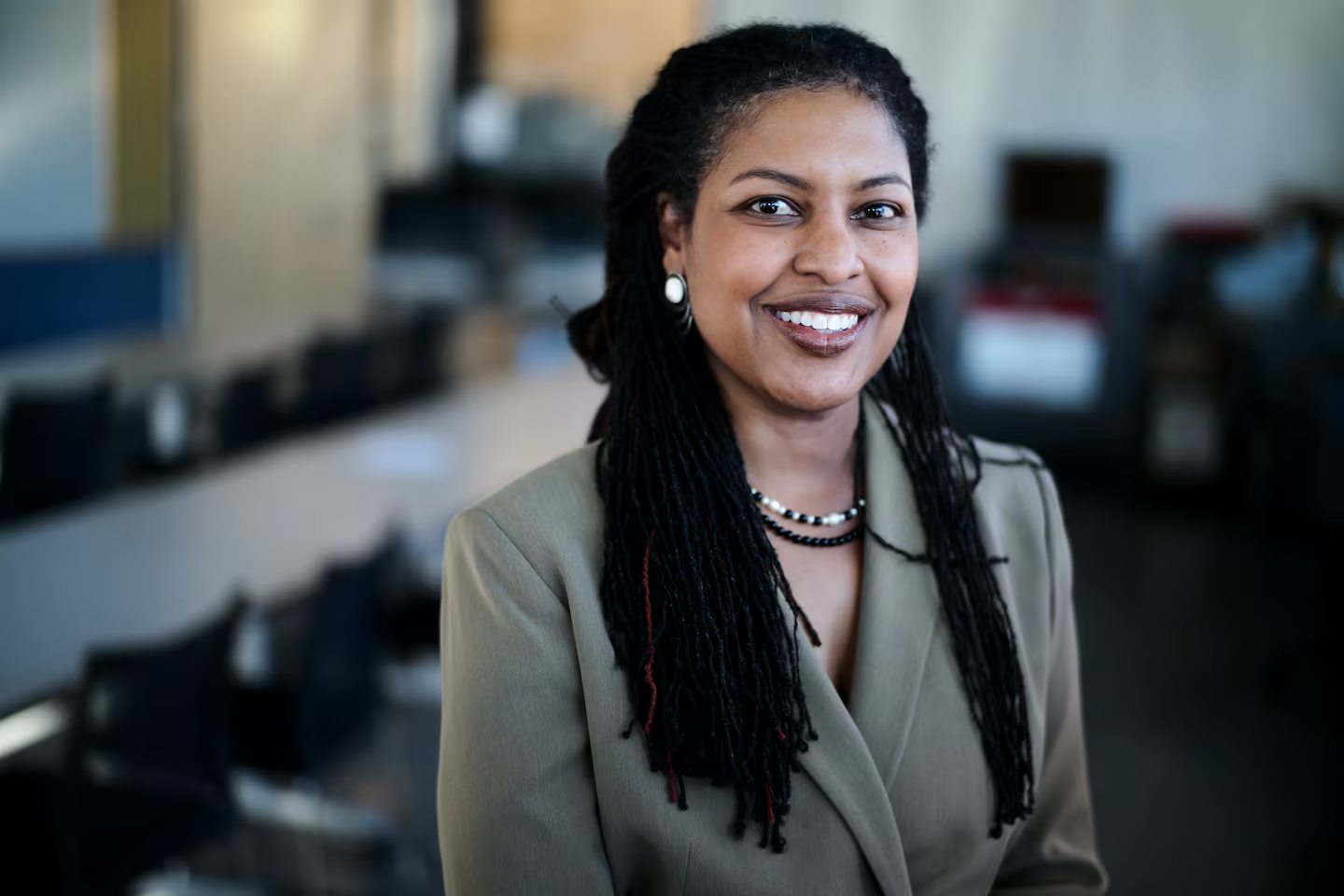
How Franklin Cummings Tech president Aisha Francis is transforming the vocational school
“I often call this building the home that hope, heart, and hustle built,” Aisha Francis said recently as she toured guests through Franklin Cummings Tech’s new campus in Roxbury’s Nubian Square.
Read more Meet the CEOs, founders, and other leaders on the Globe’s annual Tech Power Players list
Francis was named chief executive of the vocational school in 2020 and president in 2021, and since that time, her hustle has widened the vocational school’s reach in myriad ways. There’s the physical space, of course — the stunning new $75 million, 68,000-square-foot building which opened in January of this year, replacing a 118-year-old campus in the South End. Then there’s the school’s infrastructure and offerings, with top-of-the-line technical classrooms and several new majors. And finally, there’s Franklin Cummings Tech’s standing within the city’s philanthropic community, which, thanks to Francis’s vision, has funneled millions toward its expansion.
“It is a tough time in higher education, and we are not immune to the slings and arrows that are being aimed at so-called elite colleges,” Francis said. “It’s a call for us to be as creative as possible, as nimble as possible, and as collaborative as possible. Those are the hallmarks of our transformation over the past five years.”
In the latest episode of Bold Types, Francis sat down with Globe business reporter Janelle Nanos to talk about how her English PhD led her to lead a vocational school, why the job feels like part of her family history, and whether she’s managed to get any shut-eye lately. This interview was condensed and edited.
You became president of the then Benjamin Franklin Institute of Technology in 2021. Since that time, you’ve doubled enrollment, exceeded a $60 million campaign fund-raising goal, and established or expanded several majors. I’m curious if you’ve slept at all in the last few years.
I have slept [laughs]. I became president at a time when things were very different for the world and things were very different on campus. We have been very engaged here in this prospect of making trade and tech education accessible since 1791. When you do that work with folks who are first-generation and people who are not necessarily financially wealthy, it’s always work that can be precarious.
You have a PhD in literature. From an academic perspective, you may not expect someone with that sort of a background to lead a vocational school. I wanted to know more about what has driven you to this role.
Education, and education access, has always been a throughline. I come from a family of educators. And through some genealogy that I’ve been doing, I learned that I have a great-great aunt who actually was running a voc tech one-room school in the 1940s.
I do believe that there are things that you are called to do in this life. It’s really fate in some ways. I felt compelled by the mission of Franklin Cummings Tech at a point in my life when I wanted to work in higher ed administration and put the skills that I’ve amassed over my lifetime to bear for a community that I cared about.
Americans’ faith in higher ed is fading, with a recent Newsweek poll showing that nearly 60 percent of respondents said it wasn’t worth the cost. What’s your pitch for why vocational education can make a difference?
Read more Mass. has new limits on insurers’ much-hated prior authorizations. Here’s what to know.
We were established as a college for people who were working and wanted to get an apprenticeship. But what we realized is that the work the students were doing to pay their way through college was completely disconnected from the automotive associate degree or from the cybersecurity degree that they were pursuing. That then made it such that their work and their degree werein competition. And we need work and the pursuit of education that leads to a good job to be complementary.
We can create more incentives for companies to create career exposure opportunities for students who are learning at all different levels. Our piece of that puzzle is to provide education that embeds industry-recognized credentials and to do our level best to make sure folks get in and get out in a very timely fashion.
Can you tell me more about the opportunities you’ve been able to introduce in your new building?
We teach HVAC and refrigeration and are making sure that our education is as comprehensive as possible and is as embedded with sustainability as possible. So our students are also learning about installation of heat pumps as well as traditional furnaces.
We are mostly focused on delivering certificate and associate degree education that leads to wonderful careers in our region and beyond. We have 10 tech and trade majors. These are the makers. These are the folks that help to operate and maintain our infrastructure, our built environment, our homes, and the buildings where we conduct our daily life.
Everyone I’ve talked to has said that this school exists because of the sheer force of your will. Tell me about the behind-the-scenes — the networks you’ve created and the relationships you’ve developed — to get some of Boston’s biggest names to look here and say: “This is where my money should go. This is where my emphasis should go. This is where my heart should go.”
There are a few ways to answer that question. First of all, I do believe that it is important to bring all of yourself to a big project, to an assignment if you will. And I think of my professional roles as an assignment. And so if I’m going to commit to something, I’m all in.
And I do think that the mission of the college is one that absolutely deserves to be championed from the rooftops. That the city on a hill should be as much about the folks who are educated at a Franklin Cummings Tech as it is about an MIT. Because these two are synergistic. One should not exist without the other.
Read more Employers want more AI-fluent workers. It’s testing young graduates’ loyalties.



Post Comment